Home Blog

Oracles, Divination, and Power in the Ancient World

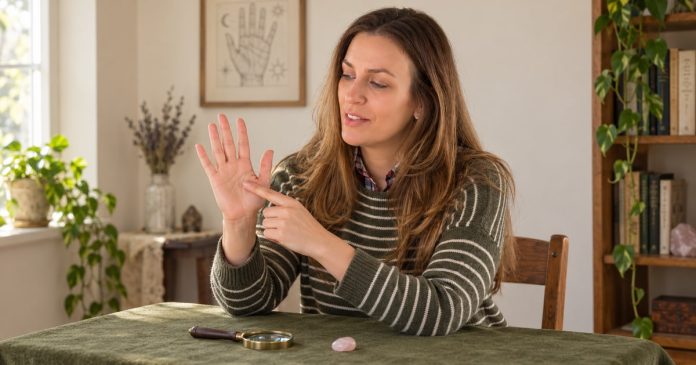
Museum scholar examining ancient divination artifacts

Ancient societies used many forms of divination, but they did not share one universal “psychic” profession. Their practices belonged to specific religious, political, medical, and social worlds.

Quick Guide

  • Use the culture’s own period-specific term whenever it is known.
  • Separate surviving evidence from later legend and modern reconstruction.
  • Ask who controlled access, interpretation, and political authority.
  • Do not treat elite patronage as proof that a method predicted accurately.
1

Source

Identify the object, text, date, and excavation context.

2

Practice

Ask what action produced or interpreted the sign.

3

Power

Notice who could consult, speak, record, or decide.

4

Limit

Separate cultural importance from predictive validation.

“Psychic” Is Usually the Wrong Historical Label

The modern English word can blur priesthood, prophecy, divination, dream interpretation, astrology, medicine, and political consultation into one category. Ancient practitioners understood their roles through local gods, institutions, scripts, calendars, and ritual obligations. A source-first history begins with those differences.

Delphi: Consultation in a Sacred Institution

At Delphi, the Pythia delivered responses associated with Apollo. Consultation occurred within a sanctuary and a managed ritual process; ancient writers and later historians disagree on details of performance and interpretation. Cities and rulers could consult oracles on war, colonization, law, and ritual. That influence tells us the oracle mattered politically. It does not turn every preserved response into a successful forecast.

Shang Oracle Bones: Questions Preserved in Writing

In late Shang China, divination questions were inscribed on animal bone or turtle shell. Heat produced cracks that specialists interpreted. Some inscriptions record charges, prognostications, and outcomes, making oracle bones crucial evidence for early Chinese writing and royal concerns. They are not generic fortune cookies; their meaning belongs to a court, ancestors, ritual technology, and a particular historical period.

Dreams, Stars, Lots, and Signs

Evidence What historians can study Common modern mistake
Oracle inscription Question, material, script, patron, sometimes outcome Reading it without court context
Dream text Compiled interpretations and social anxieties Assuming a universal dream dictionary
Astrological record Observed sky events and omen traditions Equating ancient omen practice with modern astronomy
Literary oracle How an author used prophecy in a narrative Treating literature as a transcript

Fortune Psychics’ guide to postcognition claims offers a useful comparison with modern readings. Its article on Mercury retrograde shows how an old astrological vocabulary continues in contemporary life.

Divination and Authority

Divination could legitimize a ruler, time a ritual, frame risk, or create a sanctioned way to debate uncertainty. Access was not equal. A king’s archive, temple network, or trained scribal class shaped which questions survived. We should therefore ask not only “What was predicted?” but “Who benefited from this way of deciding?”

How to Check a Popular History Claim

  1. Find the museum object, inscription, or ancient text behind the claim.
  2. Confirm the date, place, translation, and archaeological context.
  3. Distinguish a contemporary record from a later author.
  4. Look for competing scholarly interpretations.
  5. Avoid claims that every culture used the same symbols or methods.
  6. Do not turn a ritual role into a modern clinical or scientific credential.
Historical boundary: Respecting a tradition means allowing it to be specific. “Ancient people had psychics just like ours” often erases the very differences that make the evidence valuable.

What Ancient Divination Can Teach Today

These practices show how humans organize uncertainty through institutions, stories, objects, and expertise. They also reveal the long relationship between information and power. A ruler might seek an omen before war; a modern executive might seek a forecast before a merger. In both cases, the consultation can influence behavior even if predictive accuracy is unproven.

The most responsible reading holds two ideas together: divination has immense historical and cultural importance, and its importance alone does not demonstrate supernatural foresight. Careful terminology, original objects, and transparent uncertainty make the history more interesting—not less.

Key Takeaways

  • Ancient divination included many distinct practices, not one universal psychic profession.
  • Oracle bones preserve rare evidence about Shang royal questions and early writing.
  • Delphi’s political influence shows cultural authority, not automatic predictive accuracy.
  • Objects, dates, translations, and institutional context should anchor historical claims.

Frequently Asked Questions

1. Were ancient diviners psychics?

Some roles resemble modern ideas, but period-specific terms are more accurate than applying one modern label.

2. Who was the Pythia?

She was the woman who delivered Apollo’s oracle at Delphi within a sanctuary institution.

3. Did rulers consult Delphi?

Yes, individuals and communities consulted it, including on public decisions, but patronage does not prove accuracy.

4. What are oracle bones?

Animal bones or turtle shells used in late Shang court divination, often bearing early Chinese inscriptions.

5. How were oracle bones read?

Heat-created cracks were interpreted within a formal royal divination practice.

6. Did ancient Egyptians have psychics?

Egypt had priests, dream texts, omens, magic, and ritual specialists; calling them all psychics oversimplifies them.

7. Was astrology the same as astronomy?

Ancient sky observation and omen interpretation overlapped, but modern astronomy uses different scientific methods.

8. Are ancient dream meanings universal?

No. Dream interpretation depended on culture, text, status, and historical setting.

9. Did every culture use divination?

Many did, but methods, authorities, meanings, and surviving evidence differed greatly.

10. Can literature document a real oracle?

It can preserve traditions and authorial purposes, but it is not automatically a verbatim record.

11. Why did governments use divination?

It could legitimize decisions, schedule action, manage uncertainty, or mediate religious authority.

12. Does long use prove effectiveness?

No. Longevity shows cultural persistence, not necessarily predictive validity.

13. How do museums help?

Catalogs provide provenance, dates, materials, inscriptions, and scholarly context for surviving objects.

14. What is the biggest historical mistake?

Combining distant cultures and centuries into one timeless system.

15. How should I describe ancient practice?

Name the culture, period, evidence, practitioner, and uncertainty as specifically as possible.

Sources and Further Reading

Which Zodiac Signs Are Linked to Fame and Fortune?

Constellation tokens arranged around a stage light and modest gold coins

No zodiac sign is proven more likely to become famous or wealthy. Lists that count celebrity birthdays can look persuasive, but they are shaped by the sample, profession, date source and definition of success. Astrology is more useful here as a playful vocabulary for strengths—not a forecast of income or status.

Correlation is not destiny: Fame and fortune depend on opportunity, education, health, discrimination, geography, family resources, networks, luck, work and many other factors. A sun sign cannot account for them or justify a financial decision.

Quick Guide

  • Question: Ask how the celebrity or wealth sample was selected.
  • Count: Compare sign frequencies with expected birth distributions.
  • Check: Verify dates and define fame or fortune consistently.
  • Interpret: Treat sign traits as archetypes, not causes.
  • Act: Build skills and systems that work regardless of sign.

Why Celebrity Zodiac Rankings Are Weak Evidence

A list of actors may favor signs associated with performance, while a list of founders, athletes or inherited wealth will look different. Small samples create unstable rankings. Birth rates are not perfectly even across the year, and public net-worth estimates are often uncertain. Without a method published in advance, a “winning” sign may be selected after the numbers are seen.

Traditional Success Strengths for Every Sign

  • Aries: initiative and willingness to begin.
  • Taurus: persistence and resource stewardship.
  • Gemini: communication and adaptability.
  • Cancer: audience awareness and protective leadership.
  • Leo: visibility, confidence and creative presentation.
  • Virgo: analysis, craft and process improvement.
  • Libra: collaboration, negotiation and aesthetics.
  • Scorpio: focus, strategy and tolerance for complexity.
  • Sagittarius: exploration, teaching and broad perspective.
  • Capricorn: structure, patience and long-term planning.
  • Aquarius: innovation, networks and unconventional thinking.
  • Pisces: imagination, empathy and artistic expression.

Turn an Archetype Into a Practical Experiment

Choose one strength and define a behavior you can measure for four weeks: pitches sent, practice hours, savings rate, portfolio pieces or networking follow-ups. The action produces information; the sign does not guarantee the result.

For another grounded astrology guide, see how to navigate Mercury retrograde without fear. The article on why AI can feel intuitive also shows how pattern recognition can create a compelling impression.

Financial Safety

Do not buy an investment, gamble, change a career or take debt because astrology predicts fortune. Use documented costs, diversification, risk tolerance and qualified financial guidance.

Key Takeaways

  • No zodiac sign is proven to cause fame or wealth.
  • Celebrity-birthday rankings are highly sensitive to sample design.
  • Every sign can symbolize useful professional strengths.
  • Turn a trait into a measurable behavior instead of a prediction.
  • Use evidence and qualified advice for financial decisions.

Frequently Asked Questions

Which zodiac sign is most likely to be famous?

There is no scientifically supported winner.

Which sign is richest?

Rankings vary with the sample and unreliable wealth estimates.

Why is Leo linked with fame?

Astrology associates Leo with visibility, performance and recognition.

Why is Capricorn linked with wealth?

Its archetype emphasizes structure, patience and long-term effort.

Can a birth chart predict income?

No. It is not a validated financial forecasting tool.

Do billionaire sign counts prove astrology?

No. They require careful sampling and still would not establish causation.

Does birth month affect opportunity?

Seasonal and school-cutoff effects can exist in some contexts, but that is not proof of zodiac causation.

Can every sign be successful?

Yes. Success depends on actions, circumstances, resources and many other factors.

How can I use the guide practically?

Choose a symbolic strength and test a measurable habit.

Should astrology guide investments?

No. Use evidence, risk analysis and qualified financial advice.

How Mercury Retrograde Affects You and How to Navigate It

Woman reviewing a planner beside an orbital model at sunrise

Mercury retrograde is one of astrology’s most recognizable cycles. It is commonly associated with crossed wires, revisions, travel changes and unfinished conversations. A grounded way to use the tradition is as a prompt to slow down and check details—not as proof that a planet caused every lost password, delayed train or awkward text.

Astronomy and astrology are different: Astronomically, Mercury does not reverse its orbit. Retrograde motion is an apparent change caused by the relative positions and motion of Earth and Mercury. Astrology gives that visual cycle symbolic meaning, but there is no established scientific evidence that it causes communication failures, technology problems or relationship events.

Quick Guide

  • Review before sending: reread important emails, addresses, dates and attachments.
  • Back up what matters: protect files and confirm access before travel or deadlines.
  • Clarify instead of guessing: ask what someone meant before reacting.
  • Keep making decisions: use ordinary evidence, advice and risk assessment; astrology does not require paralysis.
  • Treat the cycle as reflection: revise what needs attention without expecting disaster.

What “Retrograde” Actually Means

From Earth, Mercury sometimes appears to change direction against the background stars. NASA explains this as an apparent change in motion, not the planet physically moving backward. Astrology traditionally connects Mercury with language, commerce, travel, information and reasoning, so astrologers interpret the apparent reversal as a time to revisit those areas.

If you enjoy divination, it helps to keep methods and claims in perspective. This overview of different fortune-telling traditions shows how varied symbolic systems can be, while this discussion of the truths and limits of fortune-telling is a useful reminder not to confuse reflection with certainty.

The Retrograde Reset

How Mercury Retrograde May Feel—and What to Do

Communication

Astrologers often watch for ambiguity, missed messages and old conversations resurfacing. Practical response: use specific language, confirm shared expectations and separate tone guesses from facts.

Technology

A glitch can happen any day. Practical response: install tested updates thoughtfully, use password management, create backups and keep recovery information current.

Travel

Plans may change whether or not Mercury is retrograde. Practical response: allow extra time, check reservations, save offline copies and know the cancellation terms.

Relationships

Old feelings or people may come to mind. Practical response: decide from present behavior and boundaries—not from the idea that a returning ex is cosmically destined.

Work and money

Revisions can feel frustrating. Practical response: document decisions, review numbers and seek qualified advice for legal, financial or career choices.

Inner reflection

A symbolic pause can help you notice rushed choices or unfinished tasks. Practical response: journal, prioritize and choose one repairable issue instead of scanning for omens.

Do You Need to Avoid New Projects?

No universal rule says you must stop signing contracts, traveling, dating, changing jobs or launching work. Sometimes a decision cannot wait; sometimes the evidence supports moving ahead. If you use astrology, add it as one reflective lens. Read the terms, ask an expert, assess costs and alternatives, and choose based on the actual situation.

“Review” does not have to mean retreat. A new project can begin with stronger version control. A trip can proceed with better documentation. A relationship conversation can happen with clearer boundaries. The useful part is attention—not fear.

Communication Practices for Relationships

  • Ask, “What did you hear me say?” when the topic is emotionally loaded.
  • Do not use Mercury retrograde to dismiss a partner’s concern or avoid accountability.
  • Wait until you have enough information before treating silence as rejection.
  • Revisit unresolved topics only when both people have the time and capacity.
  • Judge reconciliation by safety, change and mutual choice—not timing alone.

A Practical Checklist

  • Back up essential files to more than one secure location.
  • Confirm appointments, time zones and addresses.
  • Read contracts and return policies; get professional advice when stakes are high.
  • Save tickets, identification and emergency contacts offline when traveling.
  • Build revision time into important work.
  • Write sensitive messages, pause, then reread for clarity.
  • Keep routine maintenance and health care decisions grounded in expert guidance.

When Astrology Creates Anxiety

A symbolic practice should not make ordinary life feel unmanageable. Step back if you are repeatedly checking dates, delaying necessary care, spending beyond your means or feeling unable to decide without reassurance. Limit astrology content, return to observable facts and talk with a qualified mental health professional if anxiety persists or interferes with daily functioning.

Key Takeaways

  • Mercury’s retrograde motion is visually apparent; the planet does not reverse its orbit.
  • Communication and technology problems are astrological associations, not proven planetary effects.
  • The cycle can still serve as a useful reminder to verify, revise and clarify.
  • You do not need to freeze new projects or major decisions.
  • Use evidence and qualified advice for medical, legal, financial and safety matters.
  • Astrology is most constructive when it supports agency rather than fear.

Frequently Asked Questions

Does Mercury actually move backward?

No. Retrograde is an apparent change in direction seen from Earth because Earth and Mercury move around the Sun at different speeds and positions.

What does Mercury retrograde mean in astrology?

Astrologers traditionally associate it with review, revision and extra attention to communication, travel, information, technology and agreements.

Does Mercury retrograde cause technology failures?

There is no established scientific evidence that it causes device or software problems. Backups and careful checking are useful at any time.

Should I avoid signing contracts?

Not automatically. Read the document, understand the risks, seek appropriate professional advice and decide from the facts and timing of the real situation.

Can I start a new project during Mercury retrograde?

Yes. Build in review time, confirm responsibilities and use good documentation. Astrology does not require you to stop necessary or well-supported action.

Why do ex-partners seem to return during retrograde?

People may notice or remember returns more when they expect them. If an ex contacts you, evaluate current behavior, boundaries, safety and compatibility rather than assuming destiny.

Who feels Mercury retrograde most?

Astrology offers chart-based interpretations, but there is no scientific measure showing that particular people experience more real-world disruption from the cycle.

What is the best Mercury retrograde habit?

Pause and verify: check what you know, clarify what you do not and correct preventable errors before proceeding.

Is Mercury retrograde always negative?

No. Many astrologers frame it as a period for reflection and revision. The experience does not need to be treated as a prediction of trouble.

What if retrograde content makes me anxious?

Reduce exposure, focus on observable facts and use ordinary decision tools. Seek qualified mental health support if anxiety persists or disrupts daily life.

Want to Improve Your Relationship? Start Paying Attention to Bids

Want to Improve Your Relationship

Relationships Get Strong During Meaningful Situations

There are some people who think that relationships get strong through big vacations, expensive gifts, exciting milestones, or dramatic gestures. The real moments, though, that are meaningful are when there is consistency and emotional intimacy that comes quietly.

Connection is formed by having repeated interactions, and this helps to form long-term relationships. These can be things like a text during a busy day at work, a question after eating dinner, a partner who shows you something they found interesting online, or a quick glance. These small moments have more emotional weight than people realize.

As time goes on, these kinds of interactions create emotional closeness, or they can also create emotional distance. Relationships either work or fail, and this isn’t because of one major event but because of how consistently partners respond to ordinary situations.

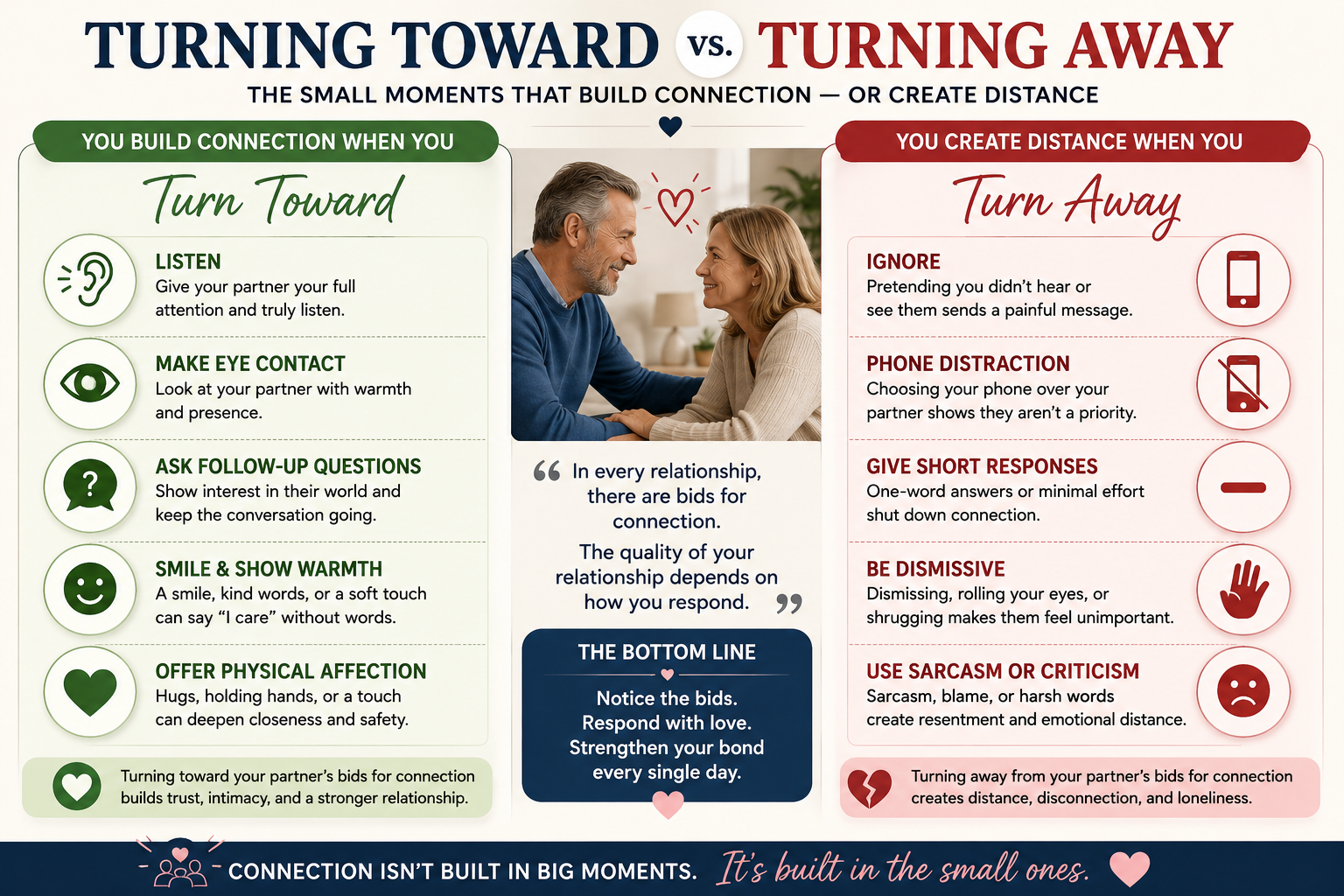
Turning Toward vs Turning Away

Bidding for Connection

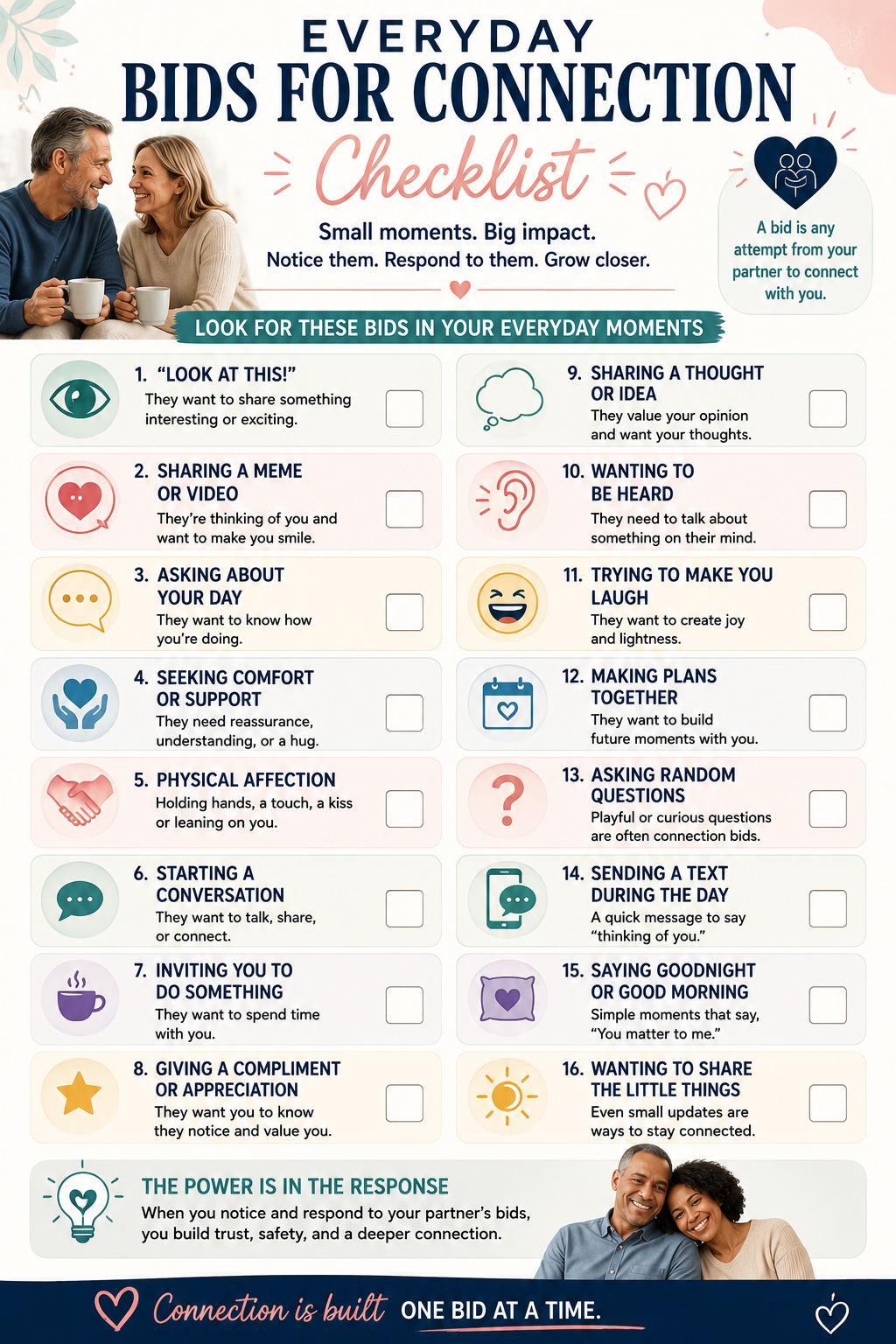
A bid is an attempt that one partner will make to gain emotional attention, connection, or to create engagement from another person. These bids can be things like:

  • Nonverbal.
  • Verbal.
  • Intentional.
  • Unconsciously.
  • Small.
  • Emotionally significant.

Some examples can include these things:

  • Asking, “How was your day?”
  • Asking, “Look at what I found online.”
  • Sighing after getting stressful news.
  • A hand placed gently on your shoulder.
  • An inside joke.
  • Asking for help with something small.

These moments might seem to be insignificant, but emotionally they carry a deeper message, including:

  • Silently saying, “Notice me.”
  • Silently saying, “Respond to me.”
  • Silently saying, “Are we emotionally connected?”

Most people make bids throughout the day and don’t even realize it.

Small Interactions Matter

Human relationships are built by being emotionally consistent and not just by intensity. Neuroscience suggests that having repeated positive interactions can make emotional bonding stronger because the brain starts associating the relationship with comfort, safety, and responsiveness.  This can explain why:

  • Repeated emotional neglect can feel painful as time goes on.
  • Paying attention to small things can feel emotionally meaningful.
  • Small moments of disconnection can accumulate over time.

People sometimes underestimate how important it is to be responsive because people’s individual interactions might feel minor. The thing is, though, that the brain will track these patterns and not just big moments.

Connection Through Repetition

Healthy relationships aren’t perfect, but they are defined by having repeated emotional engagement with each other. People who are emotionally connected normally:

  • Notice each other’s moods.
  • Stay curious about each other.
  • Ask follow-up questions.
  • Respond to the emotional cues.

This helps to create emotional presence. Relationships that are struggling, on the other hand, see that emotional responsiveness declines slowly in ways like:

  • The conversations become shorter.
  • The attention gets divided.
  • Emotional cues get ignored.

As time goes on, emotional loneliness can develop even when the couple spends a lot of time physically together.

Science and Emotional Responsiveness

Studies show that couples who have regular interactions are more successful when it comes to emotions. This happens because these couples are consistently responding to each other’s attempts at connecting more than couples that are unhealthy.

Research shows that relationship stability is linked to:

  • The ability to keep engagement in everyday life.
  • Responsiveness even when the interactions are small.
  • Emotional attentiveness.

These couples still had conflicts and would argue sometimes or get stressed, but the difference was that they continued emotionally turning to each other even when challenged.

This showed that instead of just focusing on conflict, they focused on understanding each other and having emotional interaction patterns.

Responding With Attention and Connection

Everyday Bids for Connection Checklist

When someone makes an emotional bid, the other person usually responds in one of three ways.

The healthiest response is turning toward the bid by acknowledging it with attention, interest, or emotional support. This can look like things such as:

• Looking up when your partner starts talking.
• Asking questions about something they shared.
• Offering comfort or encouragement.
• Smiling, laughing, or responding warmly.

These small responses communicate emotional availability and connection. They tell the other person that they matter and are being emotionally noticed. As time goes on, these repeated moments can build trust, closeness, and emotional intimacy.

Why Small Moments of Attention Matter So Much

People naturally respond strongly to emotional acknowledgment and connection. Even small moments of validation can help someone feel:

• Emotionally safer.
• More valued.
• More connected within the relationship.

This is why something as simple as eye contact, listening carefully, or responding warmly can have a powerful emotional effect over time.

Emotional Disconnection Through Inattention

Turning away happens when emotional bids are ignored, missed, or only half acknowledged. This can include things like:

• Scrolling through a phone while someone is talking.
• Giving distracted responses.
• Missing emotional cues completely.

Most of the time, this isn’t intentional. Stress, exhaustion, work pressure, and constant distractions can make people emotionally unavailable without realizing it.

Still, repeated emotional disconnection slowly affects the relationship over time. One missed moment usually doesn’t create damage, but consistent emotional absence often does.

Why Attention Feels Harder in Modern Relationships

Modern relationships compete constantly with distractions and overstimulation. This can include things like:

• Smartphones.
• Social media.
• Streaming entertainment.
• Work notifications.
• Mental burnout and stress.

Some couples spend time physically together while mentally focused somewhere else. Small habits like half-listening, checking notifications during conversations, or responding automatically can slowly weaken emotional closeness over time.

Responding With Irritation or Defensiveness

Turning against happens when emotional bids are met with frustration, sarcasm, criticism, or hostility. Sometimes this sounds like:

• “Can’t you see I’m busy?”
• Dismissive reactions or eye rolling.
• Defensive responses to simple questions.

Emotional bids involve vulnerability, even when they seem small. Negative reactions can make people feel emotionally rejected or unsafe. As time goes on, having repeated negative responses can lead to things like:

• Emotional withdrawal.
• Less communication.
• Increased resentment.
• Emotional shutdown.

Eventually, people may stop trying to connect because the emotional risk starts feeling too painful or exhausting.

Why Bids Can Be Indirect

One interesting thing about bids is that they are rarely straightforward. People don’t normally say something like, “I need emotional reassurance right now,” but instead they bid indirectly because they don’t want to be vulnerable. Here is an example:

  • Complaining about work can mean, “I need comfort.”
  • Showing your partner a funny video might mean, “Share this moment with me.”
  • Asking random questions might be an attempt to connect.

When these things show up subtly, it can explain why people miss the bids. Partners sometimes focus on the literal things that they hear and not the emotional meaning behind them.

Emotional Distance Can Build

Most relationships don’t go bad because of one big event, but most of the time, emotional distance grows gradually through small disconnections, such as:

When this happens, couples might start feeling:

  • Lonely even when together.
  • That they are emotionally unnoticed.
  • Emotions are not put as a priority.

The gradual emotional breakdown is one of the biggest patterns that happens in struggling relationships.

Emotional Attention and Long-Term Satisfaction

Relationship satisfaction is based on whether people feel emotionally prioritized by their partner. Consistent emotional responsiveness can create things like:

  • Stronger communication.
  • Emotional intimacy.
  • Security.
  • Trust.
  • Increased relationship resilience.

When people feel valued in their emotions, the conflict is easier to work through because the overall relationship feels more secure.

Making Meaningful Bids

Healthy bids don’t have to be hard or dramatic. Here are some examples:

  • Inviting conversation.
  • Staying attentive.
  • Initiating affection.
  • Sharing appreciation.
  • Asking thoughtful follow-up questions.
  • Sending encouraging messages when days are stressful.

The goal isn’t to be perfect, but it’s about having emotional consistency.

Recognizing Your Partners’ Bids

There are many bids that are easy to overlook because they don’t show emotionally right away. Your partner might be looking for a connection when they do things like:

  • Talk about stress repeatedly.
  • Show you different online content.
  • Ask unnecessary questions.
  • Sit quietly nearby after having a hard day.

Instead of focusing on words, try to pay attention to emotional invitations in the interaction.

Emotional Presence Over Romance

There are people who often think relationship success will depend on keeping the relationship constantly exciting or passionate. But the truth is, long-term emotional intimacy is often connected to emotional presence, such as:

  • Actively listening.
  • Responding with consistency.
  • Staying curious about each other.
  • Protecting small moments during a connection.

These behaviors help to create emotional stability that keeps the relationship strong for years.

Final Thoughts: Relationships Aren’t Built on Grand Gestures Alone

Strong relationships aren’t built on grand gestures alone but on repeated moments of emotional responsiveness and attention. Responding quickly after a long day, asking a thoughtful question, giving a comforting touch, or sharing a laugh in the kitchen can sustain these strong feelings as time goes on.

These moments might seem small or insignificant, but together they create the emotional stance of long-term love.

A lasting relationship can be defined by moments where couples keep choosing each other emotionally or in ordinary moments each day, instead of just dramatic moments.

Frequently Asked Questions

1. What are bids for connection in a relationship?

Bids for connection are small attempts to get attention, affection, support, or a response from your partner. They can be words, gestures, questions, jokes, texts, or simple moments of sharing.

2. Why are bids for connection important?

They matter because relationships are built through small daily interactions. When partners respond with care, trust and emotional closeness grow over time.

3. What is an example of a bid for connection?

An example could be saying, “Look at this,” sending a funny message, asking how your partner’s day went, reaching for their hand, or sharing a thought.

4. What does turning toward mean?

Turning toward means responding to your partner’s bid with attention, warmth, interest, or affection instead of ignoring or dismissing it.

5. What does turning away mean?

Turning away means missing, ignoring, or rejecting a partner’s attempt to connect. This can include short answers, distractions, or acting uninterested.

6. Can small moments really improve a relationship?

Yes. Small moments create emotional safety when they happen consistently. A kind response, a smile, or a few minutes of full attention can make your partner feel valued.

7. How do I recognize my partner’s bids for connection?

Pay attention when your partner tries to share something, asks a question, seeks comfort, makes a joke, touches you gently, or invites you into their world.

8. What are subtle bids for connection?

Subtle bids may include sighing, sitting close, asking random questions, sending a link, mentioning a problem, or trying to start a light conversation.

9. What happens when bids are ignored?

When bids are ignored often, a partner may feel unimportant, lonely, or emotionally distant. Over time, they may stop trying to connect.

10. How can I respond better to bids for connection?

You can respond better by listening, making eye contact, asking follow-up questions, showing warmth, putting down distractions, and offering support.

11. Do bids for connection always need a big response?

No. Many bids only need a small response, such as a smile, a short comment, a touch, or a few seconds of attention.

12. Can texting be a bid for connection?

Yes. A quick text, meme, photo, or simple “thinking of you” message can be a bid for attention, affection, or emotional closeness.

13. How does phone distraction affect relationships?

Phone distraction can make a partner feel ignored or less important. Putting the phone down during key moments helps create presence and connection.

14. What if I miss my partner’s bid for connection?

If you miss a bid, you can repair it by acknowledging the moment, apologizing if needed, and re-engaging with warmth and attention.

15. How can couples build stronger daily connection?

Couples can build connection by checking in, listening fully, showing appreciation, laughing together, offering affection, and responding kindly to small bids.

16. Are bids for connection only romantic?

No. Bids for connection can happen in romantic relationships, friendships, family relationships, and even close workplace relationships.

17. Why do some people stop making bids for connection?

People may stop making bids when they feel repeatedly ignored, rejected, criticized, or emotionally unsafe.

18. Can responding to bids reduce conflict?

Yes. When partners feel seen and valued, they are often less defensive and more open during difficult conversations.

19. How often should couples turn toward each other?

Couples should try to turn toward each other as often as possible in everyday moments, especially during small opportunities for attention and care.

20. What is the easiest way to start improving connection today?

The easiest way is to notice one small bid from your partner and respond with full attention, kindness, and genuine interest.

What Trust and Commitment Really Look Like in a Relationship

What Trust and Commitment Really Look Like in a Relationship

Trust and Commitment as a Foundation

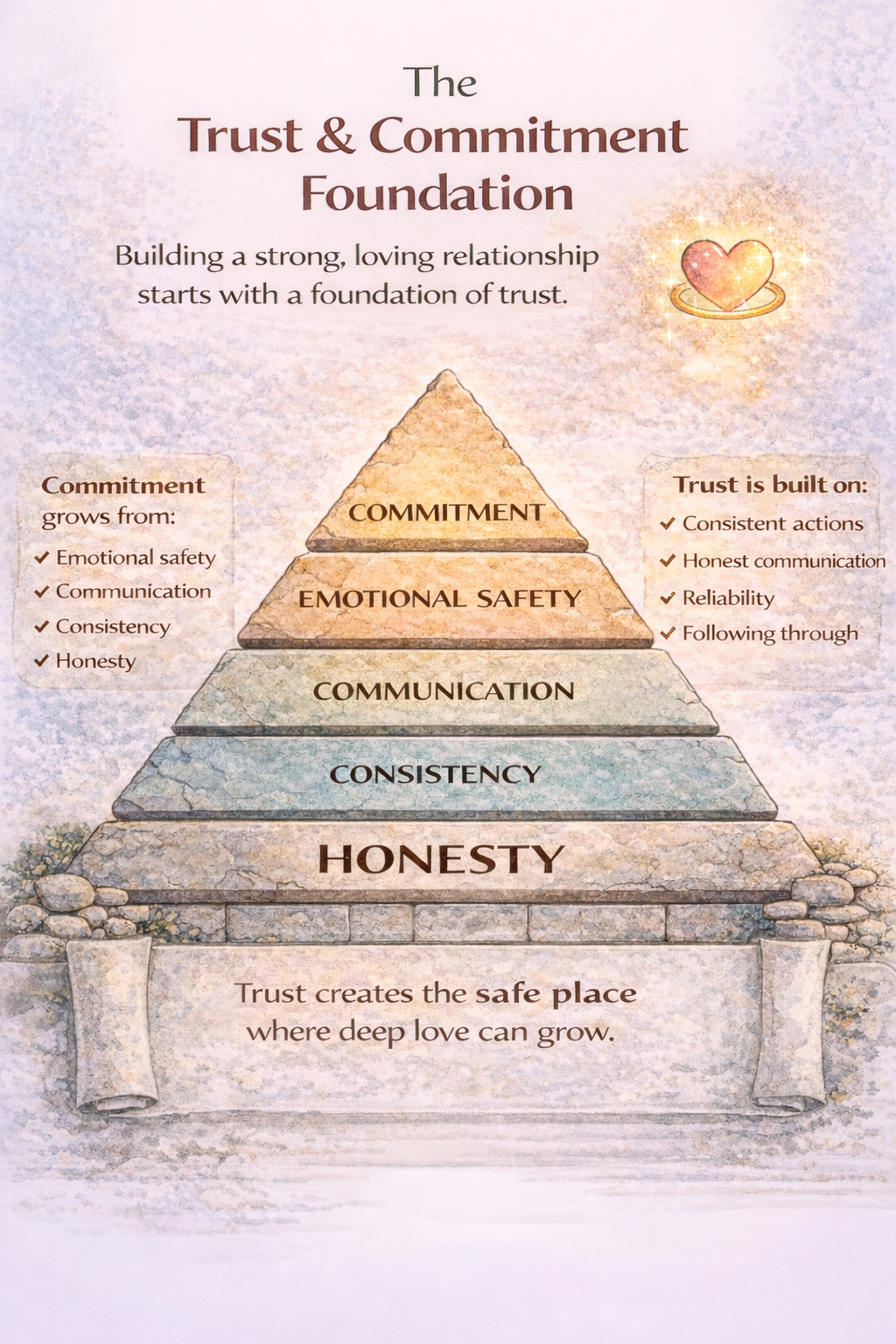
Trust and commitment are part of the foundation of having a good relationship, but not everyone knows what this actually looks like. These are things that aren’t built on making grand gestures or by creating large promises, but it’s created through small and consistent choices that you make each day.

Every time that you support your partner, choose them, or treat them with care and intentions, you’re making trust and commitment stronger. These qualities aren’t just feelings, but they’re actions that you can take every day.

The Trust & Commitment Foundation Pyramid

What Real Commitment in a Relationship Looks Like

A truly committed relationship isn’t about saying “I choose you” once, but it’s about choosing each other again and again, especially when things aren’t easy.

In real life, commitment looks like:

• Making your relationship a priority, even when life gets busy.
• Working through problems instead of avoiding them.
• Thinking about your partner when making decisions.
• Being emotionally present and not just physically there.

It’s not about being perfect. It’s about showing up consistently and with intention.

How Trust Is Built Over Time

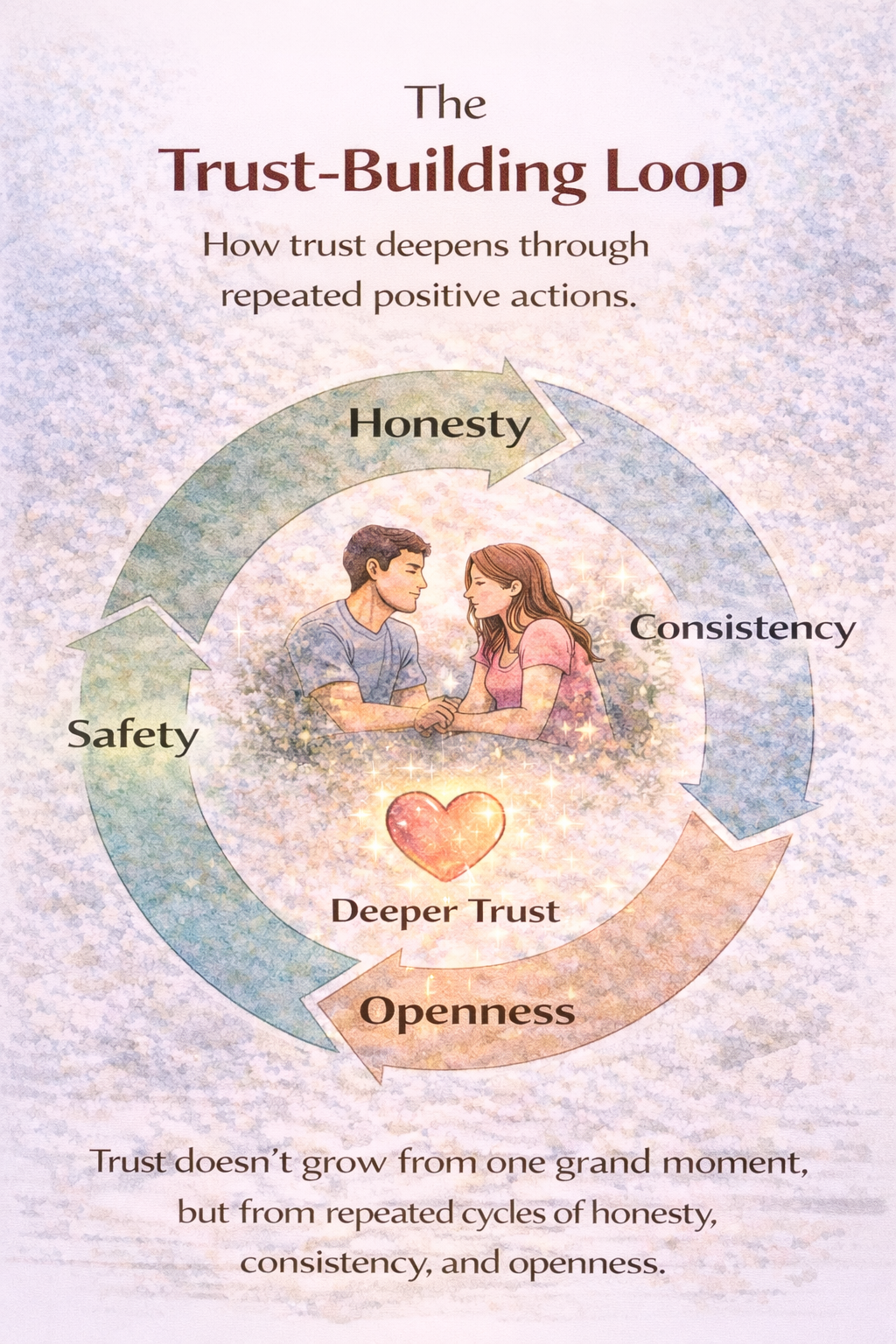
The Trust-Building Loop

Trust doesn’t happen all at once. It grows through everyday actions that show reliability, honesty, and emotional support.

Trust develops through things like:

• Keeping your word.
• Being emotionally available.
• Making sure your actions match what you say.
• Showing care in the little moments.

Over time, these small things create a strong sense of security where both people feel safe and supported.

The Importance of Truly Valuing Your Partner

One thing that often gets overlooked in relationships is the importance of genuinely valuing your partner. When you truly value your partner:

• You see them as important and irreplaceable.
• You show appreciation regularly.
• You care about who they are, not just what they do.
• You express love and admiration in meaningful ways.

This kind of appreciation strengthens emotional connection and builds deeper trust.

Commitment Is Something You Practice Daily

A lot of people think commitment is a one-time decision, but it’s actually something you choose every day.

What Daily Commitment Looks Like

You can show commitment through small, consistent actions like:

• Turning toward your partner during difficult moments.
• Choosing understanding instead of trying to win.
• Protecting your relationship from negativity.
• Staying loyal through both your actions and your words.

Even things like listening or being patient can make the connection stronger as time goes on.

Trust When Times Are Hard

It’s easy to have trust in a relationship when things are easy, but it takes a strong relationship to have trust when times are challenging. Here’s how strong couples respond to hard times:

  • They show support in stress or crisis.
  • They stay present without withdrawing.
  • They show patience.
  • They have empathy.
  • They work together as a team and don’t turn against each other.

Hard times can either make a relationship weak or strengthen it, depending on how the partners respond to the situation.

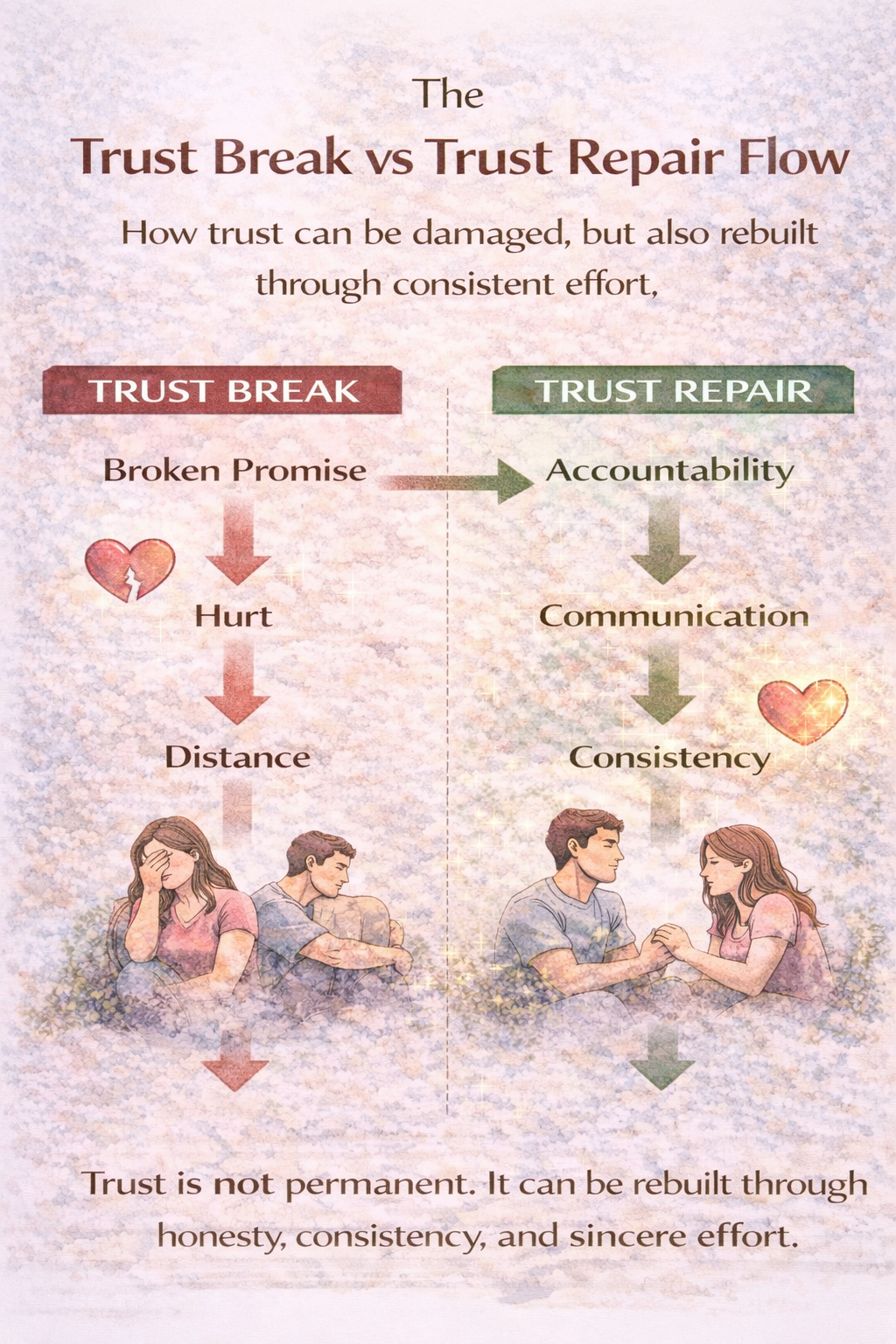
The Trust Break vs Trust Repair Flow

Emotional Safety

Emotional safety and trust go hand in hand. This is the feeling that you can be yourself around your partner without feeling judged or rejected. Here are some signs of emotional safety:

  • You can talk about your feelings openly.
  • You feel accepted even with imperfections.
  • You aren’t afraid of being judged or criticized.
  • You feel heard and understood.

Without there being emotional safety, trust, and commitment won’t grow.

Picking Your Partner Each Day

One of the best ways to strengthen your relationship is by being intentional with your daily choices. This looks like:

  • Consider how your actions will affect your partner.
  • Thinking about your partner when you’re making the decisions.
  • Following through on your promises or what you say.
  • Acting with care even when they aren’t there.

These small things can reinforce trust and commitment as time goes on.

As the Relationship Bond Strengthens

Gratitude changes the focus from what’s missing in the relationship to what’s there. This matters because when you are constantly acknowledging that you appreciate your partner. It shows:

  • You are reinforcing positive feelings.
  • You are reducing negativity.
  • You are strengthening emotional connections.

By expressing appreciation with your partner, you’re leaving a lasting impact on the relationship satisfaction.

What Makes Trust Weak?

Just like trust is built through being consistent in your actions, it can also be weakened if there’s repeated misalignment. Here are some common challenges that can break trust:

  • Breaking promises.
  • Taking your partner for granted.
  • Avoiding hard conversations.
  • Speaking negatively to your partner or about them.
  • Putting other things over the relationship.

By being aware of these patterns, you can start moving towards change.

Strengthening Trust and Commitment

Having a better relationship doesn’t require you to make dramatic changes, and sometimes even small and intentional actions can create so much progress. Here are some practical steps to take:

  • Follow through when you say you’ll do something.
  • Be emotionally present.
  • Spend time with your partner.
  • Show how much you appreciate them.
  • Communicate openly.
  • Be honest.

Being consistent is more important than being intense in the relationship.

Final Thoughts: Trust and Commitment are Built Through Choices

Trust and commitment are built through daily choices. Each time you choose understanding over judgment, action over intention, and presence over being distracted, you’re making your relationship stronger.

A strong relationship isn’t defined by a lack of challenges, but by being willing to keep picking each other over and over again and realigning your issues to grow together.

FAQ

  1. What do trust and commitment really look like in a relationship?
    Trust and commitment look like consistent daily actions, such as honesty, follow-through, emotional presence, and choosing your partner even during difficult times.
  2. Why are trust and commitment important in a relationship?
    They create the foundation for emotional safety, stability, closeness, and long-term connection.
  3. Is trust built through big gestures or small actions?
    Trust is usually built more through small repeated actions than through one dramatic promise or grand gesture.
  4. What is real commitment in a relationship?
    Real commitment means continuing to prioritize the relationship, work through problems, and show up with intention over time.
  5. How is trust built over time?
    Trust grows through reliability, honesty, emotional support, and actions that consistently match your words.
  6. What are signs of commitment in a healthy relationship?
    Signs include emotional presence, loyalty, shared decision-making, problem-solving together, and making the relationship a priority.
  7. What are signs of trust in a relationship?
    Signs of trust include feeling safe, feeling heard, believing your partner will follow through, and being able to be emotionally open.
  8. Why does emotional safety matter so much?
    Emotional safety allows both people to share feelings honestly without fear of judgment, rejection, or criticism.
  9. What does emotional safety look like in a relationship?
    It looks like open communication, acceptance of imperfections, feeling understood, and being able to speak honestly.
  10. Can commitment fade if it is not practiced daily?
    Yes. Commitment becomes weaker when partners stop choosing each other consistently through their actions and priorities.
  11. How does valuing your partner strengthen trust?
    When you regularly appreciate, respect, and care for your partner, it deepens emotional connection and reinforces security.
  12. Why does gratitude help a relationship?
    Gratitude shifts attention toward what is working, reduces negativity, and helps both partners feel seen and appreciated.
  13. What daily habits strengthen trust and commitment?
    Helpful habits include keeping promises, listening, being patient, staying honest, showing appreciation, and being emotionally available.
  14. What weakens trust in a relationship?
    Trust can weaken through broken promises, avoidance, negativity, dishonesty, emotional absence, and taking your partner for granted.
  15. Can trust be damaged even without betrayal?
    Yes. Trust can slowly weaken when actions and words stop matching or when partners become careless, dismissive, or unreliable.
  16. How do strong couples respond during hard times?
    They stay present, show empathy, work as a team, avoid turning against each other, and support one another through stress.
  17. What does choosing your partner each day actually mean?
    It means making decisions with care, thinking about how actions affect them, and protecting the relationship through everyday behavior.
  18. Is consistency more important than intensity in love?
    Yes. Consistency usually has a stronger long-term impact than occasional intense efforts followed by neglect.
  19. Can trust and commitment be rebuilt if they become weak?
    In many cases, yes. Rebuilding starts with honesty, openness, accountability, and repeated trustworthy behavior over time.
  20. What is the most important idea behind trust and commitment?
    The most important idea is that trust and commitment are not just feelings. They are daily choices that either strengthen or weaken the bond.

Postcognition in Psychic Readings: Meaning, Real Examples, and How Psychics “See the Past”

Postcognition in Psychic Readings

The Psychic Gift That Reveals Truth

Sometimes, when people think about psychic gifts, they think about future telling and ask things like, “Will I get the job I want?” or “Is my ex coming back?”  But another kind of psychic ability that is just as powerful as others is postcognition. This is a gift that doesn’t tell the future, but it reveals truth.

This is the ability to get information about the past without being told about it. This is the kind of reading that people get, and they respond with, “How did you know about that?”  It isn’t suspicious, but excitement.

Postcognition is impactful for clients because they often have confusion about their past, such as:

  • A family secret that no one talks about.
  • A breakup that never had closure.
  • Something that is revealed that you thought you were imagining.
  • A childhood wound that still shapes the choices of love.

Precognition doesn’t just provide facts; it also validates events that have already happened. In some readings, future predictions can feel exciting, but postcognition brings healing because it helps the past to make more sense.

Understanding Postcognition

Postcognition is one of those psychic terms that sounds complicated until you hear what it really means. It’s basically the ability to pick up information about something that has already happened, even if nobody told you, and even if you didn’t witness it yourself.

Instead of using physical proof or being “filled in,” the information comes through intuitive perception. A lot of people describe it as feeling the past the way you’d feel a mood in a room. You’re not seeing a perfect replay; you’re sensing what still carries energy.

A Simple Way to Describe It
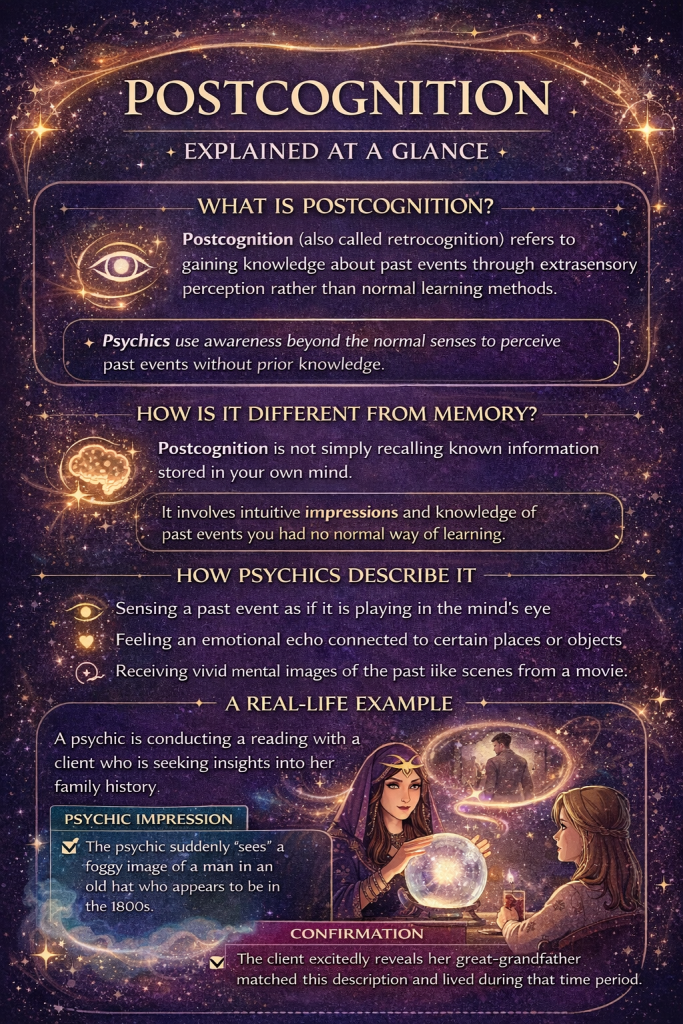
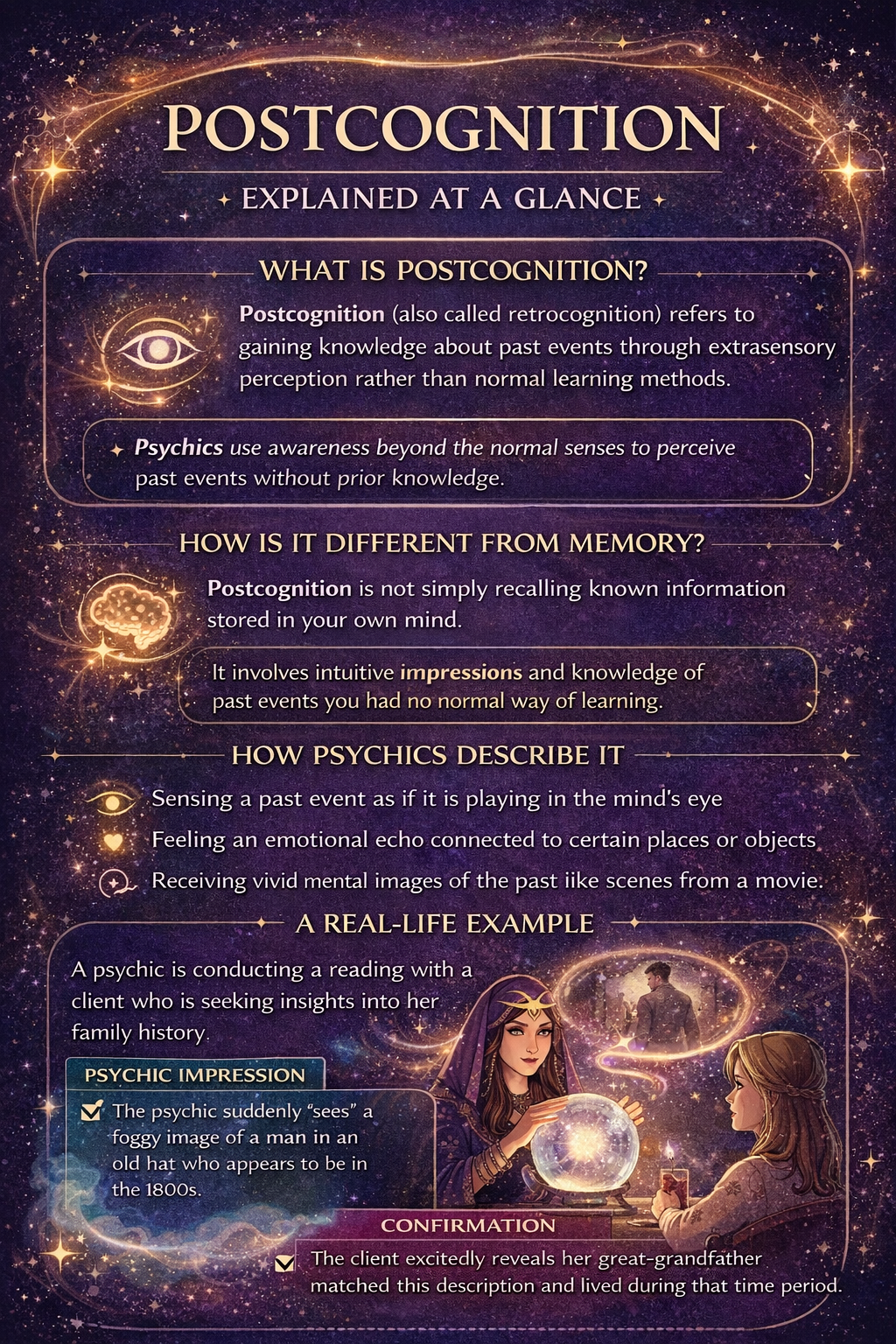
Postcognition Explained at a Glance

Postcognition means receiving impressions about past events through psychic awareness, not through evidence, conversation, or research.

It can show up as:

  • Quick mental images, like a flash of a scene or a moment
  • Emotions that hit out of nowhere, like sadness, fear, anger, or heaviness that doesn’t match the present.
  • Body sensations, like pressure in the chest, nausea, chills, or a tight throat
  • Words or names, like an internal phrase that feels “dropped in.”
  • Symbols first, then meaning later, where something abstract eventually connects to a real situation.

A simple way to picture it is this: postcognition is like catching the energetic echo of what happened before.

Post, Pre, and Retrocognition

These terms get mixed up constantly, so here’s the clean version.

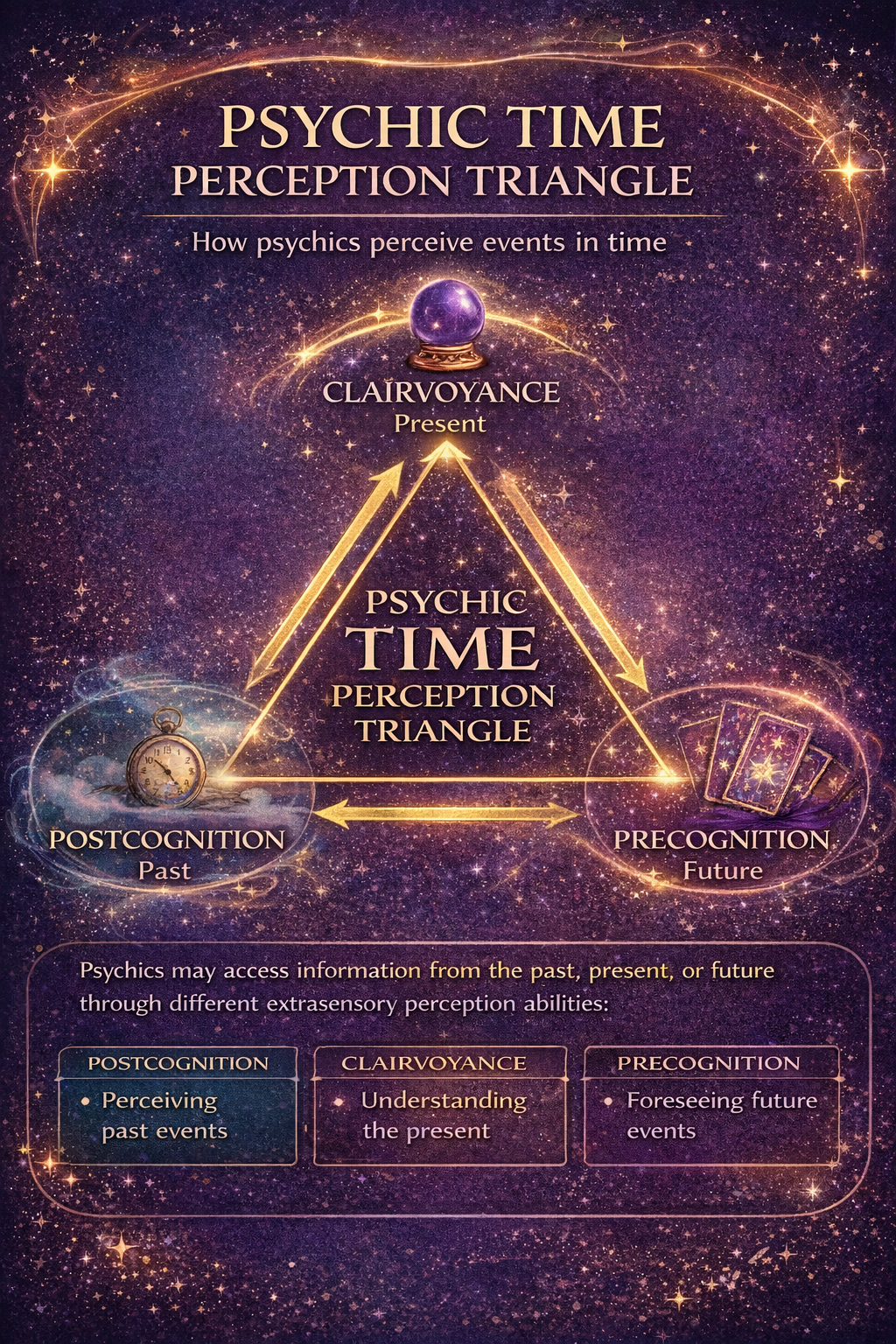
  • Postcognition is sensing the past.
  • Precognition is sensing the future, before it happens.
  • Retrocognition is often used as another word for postcognition, depending on the tradition.

The biggest difference is how it actually feels and not what it is.

Precognition often feels like probability. It carries a “this could happen” quality. Postcognition tends to feel heavier, like memory. There’s more weight to it, because it’s tied to something lived, not something still forming.

Why the Past is Sometimes Harder to Read

Most people assume the past should be easier to pick up because it’s already happened. But in intuitive work, the past is often messier.

The future is always moving, but the past is stuck. Past layers can distort the things that you are feeling, such as:

  • Trauma and survival responses.
  • Shame, secrecy, or denial.
  • Conflicting memories.
  • Emotional “rewrites” people created just to cope.

So, when someone is reading the past, they’re not only sensing what happened, they’re also sensing:

  • How it was experienced.
  • How it was hidden or avoided.
  • How does it still affect the person now?

That’s why postcognition isn’t just paranormal trivia. When it’s done ethically, it can feel like emotional archaeology, where it is gently uncovering what’s still living under the surface.

Psychics and Postcognition
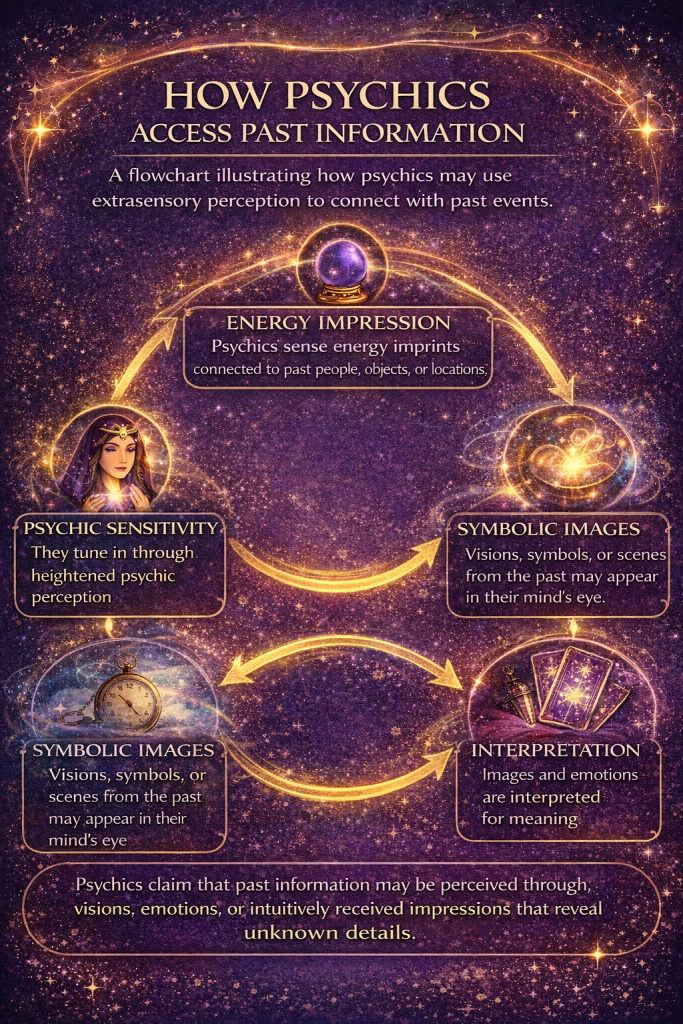
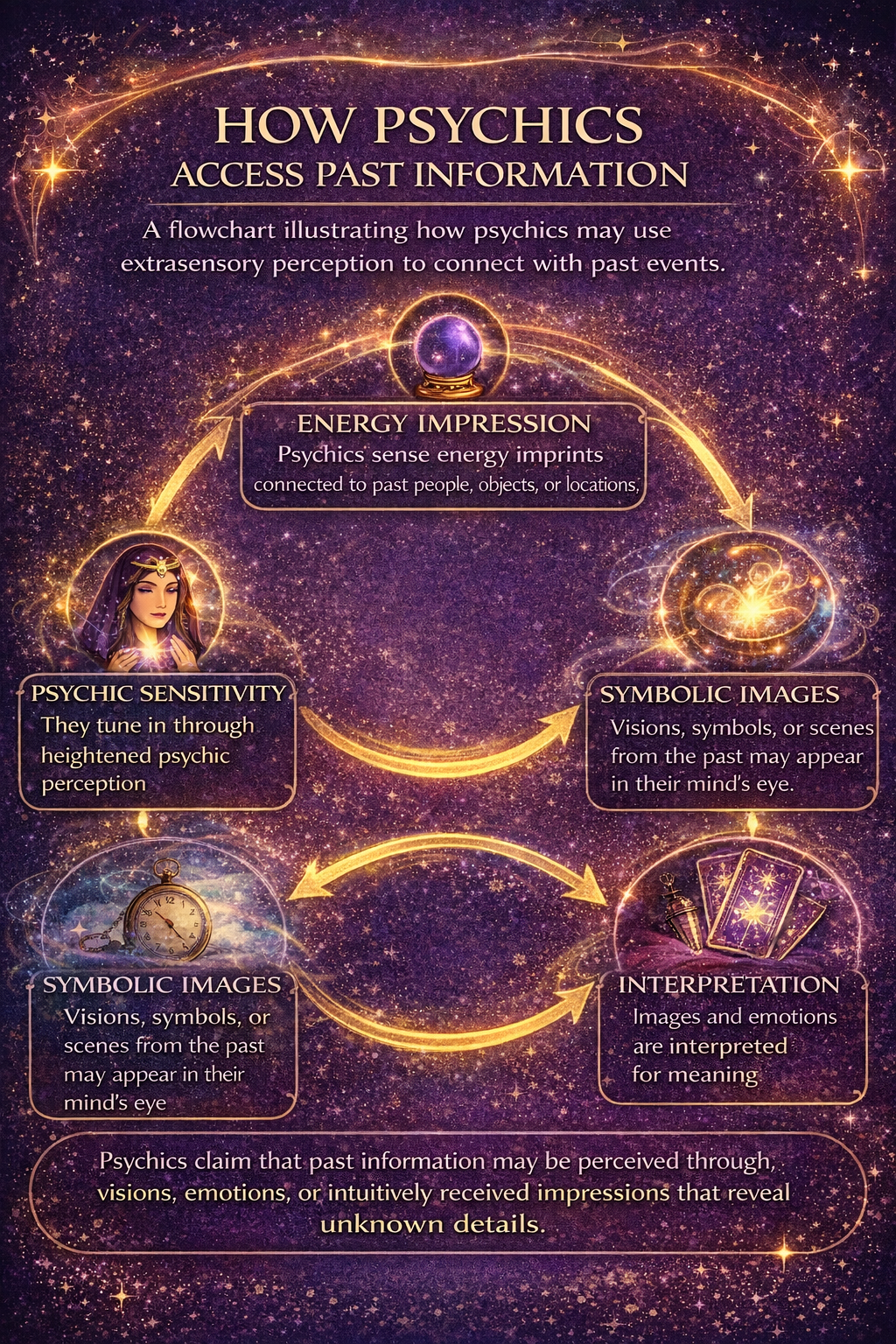
How Psychics Access Past Information Flowchart

A helpful way to think about it is this: the past leaves traces.

You know how you can walk into a room after tension and feel it immediately, even if nobody says a word? Psychics believe intense experiences can leave that same kind of imprint behind.

So postcognition isn’t like being a human security camera. It’s more like being sensitive enough to read what still has emotional charge.

Emotional Fingerprints and Energy Records

Many psychics describe it as reading an energetic record. The basic logic is:

  • Emotions carry energy.
  • Big moments create a charge.
  • That charge leaves residue.
  • Sensitive people can perceive that residue.

This is why postcognition often comes through most clearly around events that had strong emotion, such as grief, betrayal, fear, deep love, trauma, or even intense joy.

Big emotions are loud. They leave a signature. And postcognition, in that sense, is reading the emotional fingerprint an event left behind.

Locations Hold Energy

Chances are that you’ve experienced this thing without thinking you’re psychic. Maybe you rent a new apartment, and it feels creepy or cozy for no reason. A childhood home might feel heavy even though it looks beautiful. Some places feel like they have picked up story after story.

Precognition can activate strongly in certain places because things like:

  • Some homes collect energy, such as hallways, bedrooms, and kitchens.
  • Grief can stay in a home long after a person dies.
  • Conflict can repeat in the same environment.
  • Spaces hold on to patterns that repeat.

This isn’t just a spiritual thing but also a psychological thing. Environments can help to trigger memories and emotions.

According to the American Psychological Association, there are scientific ideas on how memory and emotion are linked in perception.

Akashic Framework

There are some psychics who talk about postcognition in terms of the Akashic Records. These are a spiritual idea that every bit of information or experience in the universe is held in records.

If you take this literally or symbolically, the Akashic framework gives postcognition a certain structure, such as:

  • Insight is accessible when there are intuitive or altered states.
  • Emotional truth is always stored.
  • The life you live creates a record that never goes away.

Not every psychic uses Akashic records, but some do, and this is why postcognition can feel like the information was accessed instead of guessed.

How Postcognition Shows Up

Different psychics will use postcognition differently through their different psychic gifts. This is important to know because people often think that postcognition looks like the movies, and sometimes this is true, but other times it isn’t.

Clairsentience Postcognition

This is the most common way that postcognition shows up, and this is feelings from the past. It can be seen as:

  • Feeling sad when it doesn’t match the moment.
  • Feeling pressure in the throat or chest area.
  • Feeling sick or heavy.
  • Feeling that someone was crying in the place you are.
  • Sensing fear, betrayal, or secrets.

A psychic might tell you that they feel grief that was there around 2010, before they ever knew what happened. This is why clairsentient psychics can become exhausted if they don’t create strong boundaries. They aren’t just sensing the things around them but feeling them.

Clairvoyant Precognition

This can often show up as seeing the past and can come in visions or images, such as:

Clairvoyant postcognition is usually symbolic first, and then it becomes literal. So, if a psychic sees water, it might be referring to something like:

  • Tears.
  • A trip to the beach.
  • Strong emotions.
  • Breaking down in the shower.
  • A place close to a river, lake, or ocean.

Clairaudient Precognition

This can be information that comes from hearing the past, such as:

  • Hearing a name.
  • Hearing a phrase.
  • Hearing a partial sentence.
  • Hearing a sound.

This doesn’t feel like an external voice to them, but it can feel like a thought that comes when there is some kind of certainty. It can come into their mind fully formed.

Psychometry

Psychometry is one of the most well-known forms of postcognition and can come through objects and past events. This is when a psychic reads the energy by holding something like:

  • Clothing.
  • Keys.
  • Heirlooms.
  • Letters.
  • Jewelry.

The objects usually have strong emotional energy because they have been held or touched often, worn when meaningful events were happening, connected to strong relationships, or were present when trauma or love happened.

Objects can act as strong memory triggers according to science, but psychics claim that the objects go beyond memories and can hold energetic information as well. Britannica shows us how memory connects to cues and emotional recall.

What Psychics Can Learn from the Past

Postcognition can feel accurate, but it isn’t perfect. A good psychic will explain this because it is important that they are honest to build trust. Since the past can be harder to read than the future, when psychics read it, they are often reading the energetic truth, the symbolic truth, and not something just handed to them in a script.

What Postcognition Does

Postcognition can help people to be able to pick up emotional environments, and psychics often sense things like:

Even without having the exact details, they can describe what things felt like, and sometimes this is the exact thing that happened.

When there are things like hidden motives and dynamics that were never spoken, postcognition can show up as:

  • Someone who wasn’t being honest.
  • Someone who was only protecting themselves.
  • Someone who was being pressured by their family.
  • Someone who felt manipulated.
  • Someone who felt trapped.
  • The story that was told wasn’t the real story.

Other things a psychic might pick up are:

This is why postcognition can be healing. It sometimes validates what people were feeling, but it couldn’t prove to be true.

What Post Cognition Doesn’t Do

An ethical psychic will avoid claiming to say the facts or to be certain about things like exact dates. They might feel that something happened in a certain season, but an exact calendar date isn’t very common. They also might not get full names and addresses but instead might get things like:

  • A similar-sounding name.
  • Syllables.
  • Symbolic substitute names.
  • Initials.

They also won’t get a medical diagnosis, and postcognition readings should never replace medical advice, legal advice, or other professional advice. Psychics should never say that they can produce proof for a courtroom. Postcognition can show the truth, but it isn’t and should never be used as a surveillance tool. This is why postcognitive readings should focus on meaning and clarity and not claims.

Why Postcognition Isn’t Always Clear

The past isn’t just what happened, but it’s what people remember, protect, suppress, and rewrite. A psychic reading of the past might pick up things like:

  • The event that happened.
  • The emotional reactions to the event.
  • The story someone told themselves after something happened.
  • The story that other people wanted to be told.
  • The secret that no one said out loud.

This is layer after layer of distortion that the psychic can pick up.

Emotional Distortion

Some memories that come are louder than others. A small event or something that was extremely painful can be read as a bigger event that someone else might have felt numb about.

A psychic might feel grief and assume that it’s linked to something bigger, but it can be linked to other things, like:

  • Miscarriage that wasn’t talked about.
  • A betrayal that happened in private.
  • A hidden heartbreak.
  • Rejection is when someone never admits to hurting them.

Intensity doesn’t always match what happened.

Ego Distortion

If someone believes that a past story is true, even if it isn’t, their belief can have a strong impression. This is why psychics sometimes pick up things like:

  • What the person said happened.
  • Before they pick up what really happened.

A good psychic has to have the skill to be able to know the difference between the two. The story might be different than the truth.

Understanding the Truth Layers Model

One helpful way to understand postcognition is to realize that every experience has more than one level of truth.

There’s what people show on the surface, and then there’s what actually happened emotionally and energetically underneath.

You can think of it in layers:

  • On the outside is surface truth: what was said publicly, what people admitted, and the story everyone heard.
  • Under that is emotional truth: what people really felt but didn’t always express.
  • Then there’s energetic truth: what was actually going on beneath behavior, like tension, dishonesty, fear, or unspoken conflict.
  • There’s soul truth: what the experience meant, how it changed someone, and why it became a turning point in their life.

Postcognition tends to pick up the emotional, energetic, and soul layers most clearly. And honestly, those are usually the ones that matter most anyway.

Postcognition in Psychic Readings
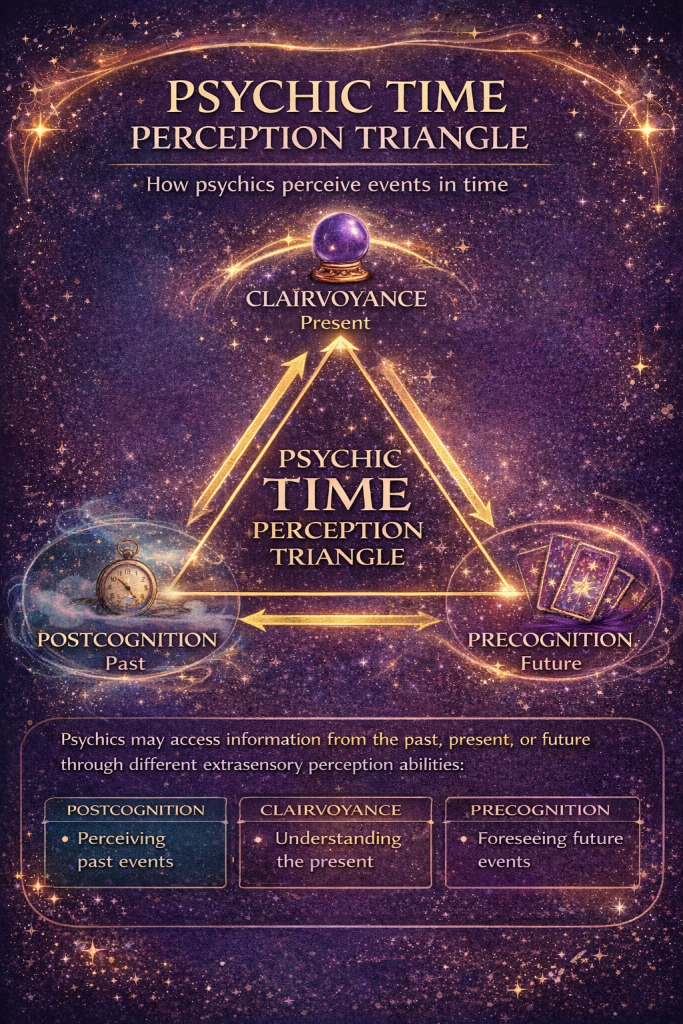
Psychic Time Perception Triangle

People rarely ask about the past just to satisfy curiosity. They ask because something still hurts. Or something still doesn’t make sense. Postcognitive insight helps because it brings clarity where confusion lived for too long.

It often helps people:

  • Trust the feelings they kept doubting.
  • Stop blaming themselves for things that weren’t their fault.
  • Understand repeating emotional patterns.
  • Release guilt or shame that never belonged to them.
  • Find peace without needing the other person to finally admit the truth.

This is why many clients say the postcognition part of a reading is the moment that makes them cry. Not because it’s scary. Because it finally makes sense. And clarity is incredibly healing.

Postcognition and Real-Life Examples

Postcognition usually isn’t dramatic like movies make it seem. It’s quieter, specific, and deeply personal, like someone gently reading the emotional story you’ve been carrying.

Here are a few real-world ways it commonly shows up.

Example One: Why the Relationship Ended

A client might come in asking, “Will my ex come back?” But instead of jumping into prediction, the psychic starts sensing the past.

They might say something like: “I’m feeling repeated late-night arguments. This wasn’t just about love fading. One person kept avoiding hard conversations. There was outside influence too, not necessarily cheating, but someone interfering. Family pressure or a friend who didn’t support the relationship.” The client goes still.

Because yes, there was someone who constantly criticized the relationship. Yes, family opinions played a role. And yes, their ex avoided emotional accountability.

Postcognition often picks up things like:

  • The emotional pattern kept repeating.
  • The moment everything shifted.
  • The hidden fear driving the breakup.

And suddenly the confusion lifts. Sometimes the healing isn’t hearing “they’ll come back.”
It’s realizing, “I wasn’t imagining the problems.”

Example Two: When the Space Feels Heavy

A client might say, “This house makes me anxious, but nothing bad happened to me here.”

A psychic reads the energy of the space and responds: “This sadness doesn’t feel like yours. It feels like someone here carried grief quietly. The energy feels strongest in one room.”

Later, the client learns the previous owner lost someone close, stayed isolated, or spent long illness periods in that space.

When postcognition reads places, it often shows up as:

  • Emotional heaviness in certain rooms.
  • Feeling crowded even when alone.
  • Repeating tension sensations.
  • Grief that feels stuck.

This doesn’t mean the house is haunted. It usually just means the emotional energy was never cleared. And a good psychic reframes it gently: “This space needs renewal, not fear.”

Example Three: Memories in Objects

This is one of postcognition’s classic expressions. A client hands over a ring and says,
“This belonged to my grandmother.”

The psychic holds it and says, “I feel responsibility. She protected everyone. I’m seeing a kitchen, music playing, and sadness around a man. Like she carried grief quietly.”

The client tears up because:

  • She spent most of her time working in the kitchen.
  • She would play music while cooking.
  • She lost her husband young but didn’t talk much about it.

Objects often carry strong impressions because they were present during:

  • Everyday life.
  • Loss.
  • Love.
  • Big emotional moments and times.

The psychic may not catch every literal detail, but they often hit the emotional truth with incredible accuracy. And that emotional truth is what heals.

Example Four: Childhood Roots and Adulthood

This is where postcognition becomes deeply life-changing. A client might ask about dating struggles or career burnout, and the psychic suddenly says, “I’m sensing you had to grow up emotionally very young. You became the responsible one early. You learned to read moods, stay quiet, and keep the peace.”

The client never mentioned childhood. But suddenly everything clicks:

  • Why do they attract emotionally unavailable partners?
  • Why do they struggle asking for needs?
  • Why does rest make them feel guilty?
  • Why did they become hyper-independent?

Postcognition often uncovers emotional patterns like:

  • Being the peacekeeper child.
  • Carrying adult responsibility too soon.
  • Emotional neglect.
  • Always being “the strong one.”

And the message becomes empowering that “You’re not broken. You adapted to survive. Now you get to choose differently.” That’s the magic of postcognition. It doesn’t just reveal the past. It connects the dots so healing can finally begin.

Is Postcognition Real?

If you’re reading this article and you wonder how this is possible, know that having good skepticism doesn’t stop you from having intuition. The best kind of psychic work asks people to be open-minded and not gullible, curious and not naïve.

Postcognition can be looked at in the form of science without trying to make it look like a magic trick.

Two Layer Explanation

One way to look at postcognition is in two layers:

  • Psychology and perception: what the mind can really do.
  • Extrasensory perception is what the mind might be able to do without limits.

Some people think that it has to be either fully mystical or fully scientific to be real, but sometimes it is both.

Psychology and Postcognition

Humans are very perceptive and pick up on information before even realizing it, such as:

  • Micro-expressions, such as tiny facial movements.
  • Voice changes, such as tone shifts.
  • Nervous movements such as avoidance signals.
  • Word choices where someone chooses truth or deflection.
  • Body tension, such as stress in certain areas.

A good psychic reader might be able to pick up on these cues where other people might miss the signals entirely.

Memory as Reconstruction

Science also shows the fact that memory is reconstructive. People don’t just recall the past like replaying a video in their mind, but they rebuild it from their emotions, meaning, and beliefs.

When a psychic picks up information and there is emotional truth, it can feel more real than having actual details. This happens because emotionally, that is what the client feels and believes. The American Psychological Association talks about cognition and how the mind stores and processes experiences.

Why Postcognition Can Feel Accurate

Postcognition can have details about specific things that psychology cannot even explain. This is why some believers say that it wasn’t body language, and they didn’t reveal any details, and the psychic still knew.

This can be explained by:

  • Strong intuitive perception beyond conscious reasoning.
  • Unconscious inference at a level that the client isn’t able to track.
  • Real ESP.

Science hasn’t proven ESP to be real, and it isn’t universally accepted, but there has been ongoing parapsychological research that has explored perception. The Rhine Research Center is one of the well-known organizations that have been studying parapsychology.

Is It Real?

The truth is that this isn’t the best question to ask, but instead, you should ask things like:

  • Did it bring healing?
  • Did it give you clarity?
  • Did it validate the truth that you knew?
  • Did it help you to make better choices in your life?

The purpose of postcognition isn’t about entertainment but about getting insight, and when it’s done ethically, it can help people to:

  • Make peace with their past.
  • To understand why they keep feeling stuck.
  • To stop doubting what they believe.
  • To understand their emotional burdens and to release them.
  • To move forward without needing everyone else around them to agree.

You can call this intuition, ESP, spiritual perception, or psychology, but what matters is the transformation that this can give.

Developing Your Postcognition

One of the most comforting things about postcognition is that it isn’t reserved for a tiny group of “chosen” psychics. Many people can strengthen it over time, especially those who already feel deeply, dream vividly, or notice intuitive flashes in daily life.

The key is learning it the right way. Developing postcognition without grounding is a bit like opening every window in your house during a storm. Yes, you’ll feel more energy, but you’ll also feel overwhelmed, scattered, and exhausted.

The goal isn’t to become more open. The goal is to become more stable, clear, and protected. When your system feels safe, intuition becomes sharper instead of heavier.

Being Grounded

Grounding is what separates clear, intuitive awareness from emotional overload. People who skip grounding often confuse anxiety with psychic impressions and end up feeling drained instead of empowered.

Simple grounding practices that work beautifully for postcognition include slow walking (especially outside), breathing while placing awareness in your feet, imagining roots gently connecting you to the earth, or even holding something solid and heavy like a mug, a book, or a stone.

When your body feels anchored, intuitive impressions become quieter, cleaner, and easier to understand.

If you practice while anxious, everything gets noisy. Anxiety has a way of pretending it’s intuition, and it’s very convincing.

Curiosity Over Force

Postcognition responds best to a relaxed mind. When you strain for answers, your imagination fills the gaps. When you allow impressions, real information tends to appear naturally.

A helpful mindset is simply: “I’m curious, not desperate.” Curiosity keeps your perception open and neutral. Desperation creates emotional bias. And intuition loves neutrality.

Journalling Impressions

One of the most effective ways psychics strengthen postcognition is through simple journaling practice.

Choose a small object like a photo, key, ring, or letter. Hold it lightly and ask yourself, “What’s the emotional story here?” Then write the first few impressions that come — without judging or analyzing.

These impressions might show up as feelings, physical sensations, images, words, colors, or symbols. The goal isn’t to be perfect. The goal is to notice subtle signals before the logical mind jumps in. With time, clarity improves naturally.

The Difference Between Anxiety and Intuition

This part changes everything. A true intuitive impression usually feels calm, simple, clear, and sudden, like information quietly dropping in.

Anxiety feels urgent, dramatic, repetitive, and loud. It loops. It pressures. It tries to convince you that something is wrong.

If the feeling is frantic, it’s usually nervous-system noise, not postcognition. Calm is the language of intuition.

Setting Boundaries

Postcognition is meant to gather information and not carry emotional weight.

Before practicing, imagine a gentle light around your body and silently say, “I observe without absorbing.” Visualize impressions arriving like subtitles on a screen rather than crashing waves.

This might sound simple, but it’s incredibly effective. Where attention goes, experience follows.

Beginner Exercise

Once or twice a week is plenty. Sit quietly for a few minutes and choose a photo of a place (not a person). Ask, “What’s the emotional atmosphere here?” Notice only three impressions, then stop and ground yourself afterward. This builds confidence without overwhelming your system.

Ethics and Boundaries of Postcognition

Spiritual maturity plays a big role in postcognition, and ethical psychics have to follow rules so that they don’t intrude.

Why Consent Matters

A respectful reader will not:

  • Do a reading on someone who didn’t agree to it.
  • Spy on people just for entertainment.
  • Dig up private trauma without being asked.
  • Turn the past into gossip.

Postcognition should only be used for clarity, healing, and empowerment, and not for control.

Why Privacy Matters

When getting a reading, not everything has to be revealed. When a psychic senses something but it shouldn’t be said, a good psychic will:

  • Speak in a gentle way.
  • Ask permission to go deeper into something.
  • Give the message in a supportive way.
  • Avoid fear-based language.

The goal is growth and not shock.

Myths About Postcognition

Postcognition can be misunderstood because people imagine that it works as the movies show it. The truth is, postcognition is quiet and subtle and more human than the movies show. Here are some common myths about postcognition:

Myth One: Postcognition is Mind Reading at Its Best

Postcognition isn’t telepathy. It doesn’t involve pulling thoughts out of someone’s head or replaying their memories like a video file.

What usually comes through are emotional impressions connected to past experiences. A psychic may sense the mood of a situation, the pain that wasn’t spoken about, or the energy that still feels unresolved.

Sometimes they pick up on what was avoided, hidden, or left unfinished. But it’s not a constant stream of private thoughts. This is good because reading someone’s thoughts would be overwhelming to everyone in the room.

Myth 2: Precognition Shows Everything Exactly from the Past

Intuitive impressions are often symbolic before they’re literal. For example, seeing an image like shattered glass might reflect emotional heartbreak, a sudden argument, a broken promise, or even a real object connected to that moment.

The message usually carries meaning first and details second. Postcognition isn’t a security camera replay. It’s more like emotional memory translated into symbols that need gentle interpretation.

Myth 3: If a Psychic Gifts an Accurate Postcognitive Reading, Then They Are Never Wrong

Even highly intuitive people can misread aspects of what they sense. Sometimes they might mix up things like:

  • Symbols.
  • Meaning.
  • Names.
  • Specific details.
  • Timelines.

Energy can overlap, and emotional memories might blend together. A psychic that is grounded knows this and will tell clients to ask for clarification instead of pretending that everything they say is right.

Myth 4: Only People with Special Gifts Receive It

Postcognition isn’t limited to a small group of born psychics. It often develops naturally in people who are emotionally aware, sensitive to atmosphere, intuitive with relationships, or curious about inner perception.

Practice helps, but so do boundaries and grounding. Like many intuitive skills, it’s less about rare talent and more about awareness combined with emotional regulation.

Myth 5: Postcognition Only Works in the Spiritual World

This surprises a lot of people. Even those who don’t believe in psychic abilities experience postcognitive-style moments.

You might notice it when:

  • You walk into a room, and it feels heavy for no reason.
  • You remember details that you never learned.
  • You sense something important happened in the area.
  • You hold an old object and feel emotions.

Some people call it intuition. Some call it sensitivity. Some just say, “The vibes were strong.” The words are different, but the experience is the same.

Real Precognition

Postcognition isn’t about spying on the past. It’s about tuning into emotional memory that still carries energy. It works through feeling, symbolism, and awareness rather than literal replay.

And most importantly, it’s far more common than people realize.

Getting the Best Postcognitive Reading

If you want to have a reading that can give you strong postcognition information, the way that you ask the question matters more than most people realize.

Asking the Right Questions

Instead of asking, “Is he going to come back?” ask, “What happened in the relationship that I’m not clearly seeing?” or “What were the hidden patterns between us?”   Postcognition works best when you ask for clarity and not for predictions.

Meaning Over Drama

One postcognition question to ask is, “What should I understand about this past event?” This allows the psychic to read things like:

  • Healing truth.
  • Pattern truth.
  • Emotional truth.

This lets the reading go from gossip to growth.

Don’t Give Too Much Information

One mistake people make when getting a reading is oversharing. If you want to have real postcognition, give little context at first, let the psychic speak, and then confirm if it matches or not. This allows the reading to stay clean and doesn’t encourage leading.

Confirm the Information without Leading

One thing that a client can do is to have neutral confirmation. The psychic might say, “I feel a big change after a trip,” and the client should respond with, “Yes, that’s accurate,” instead of saying, “Yes, in April we went to New York, and then we fought because his friend Tonya…”

Details can be important, but it’s important to give them after the prediction has already come through.

Ask for Anchors but Also Flexibility

If you want to have good clarity, ask questions such as:

  • Did this happen around a move or a job change?
  • Does this feel that it was recent or from the past?
  • Does this connect to a relationship or to my family dynamics?

A good psychic will often be able to narrow down in terms of chapters that have happened in your life but not give you exact dates or times.

Getting Ready for Answers

Postcognition can give you the truth even if it’s uncomfortable, such as:

  • You weren’t crazy; you were able to pick up on the truth.
  • The betrayal was more than physical and emotional.
  • They loved you, but they weren’t emotionally capable of being with you.

This information isn’t meant to punish you but to free you.

Final Thoughts: The Past Leaves a Mark

Postcognition is a psychic gift that is often underrated because it doesn’t give you a wow factor or show you flashy future visions, but it gives you truth that is healing. It helps you to answer questions such as, “Was I just imagining things?” or “Why do these things still hurt?”

When an ethical psychic uses postcognition, the goal isn’t to expose or shame someone or their past, but to give clarity because clarity brings peace. What makes postcognition so powerful is that it can validate what you were already feeling, and it can change your life for the better. The magic isn’t about fortune-telling but truth-telling.


Why People Say AI Chatbots Feel “Intuitive”: The Psychology Behind Digital Companionship

Why People Say AI Chatbots Feel “Intuitive” The Psychology Behind Digital Companionship

When People Say a Chatbot feels Intuitive

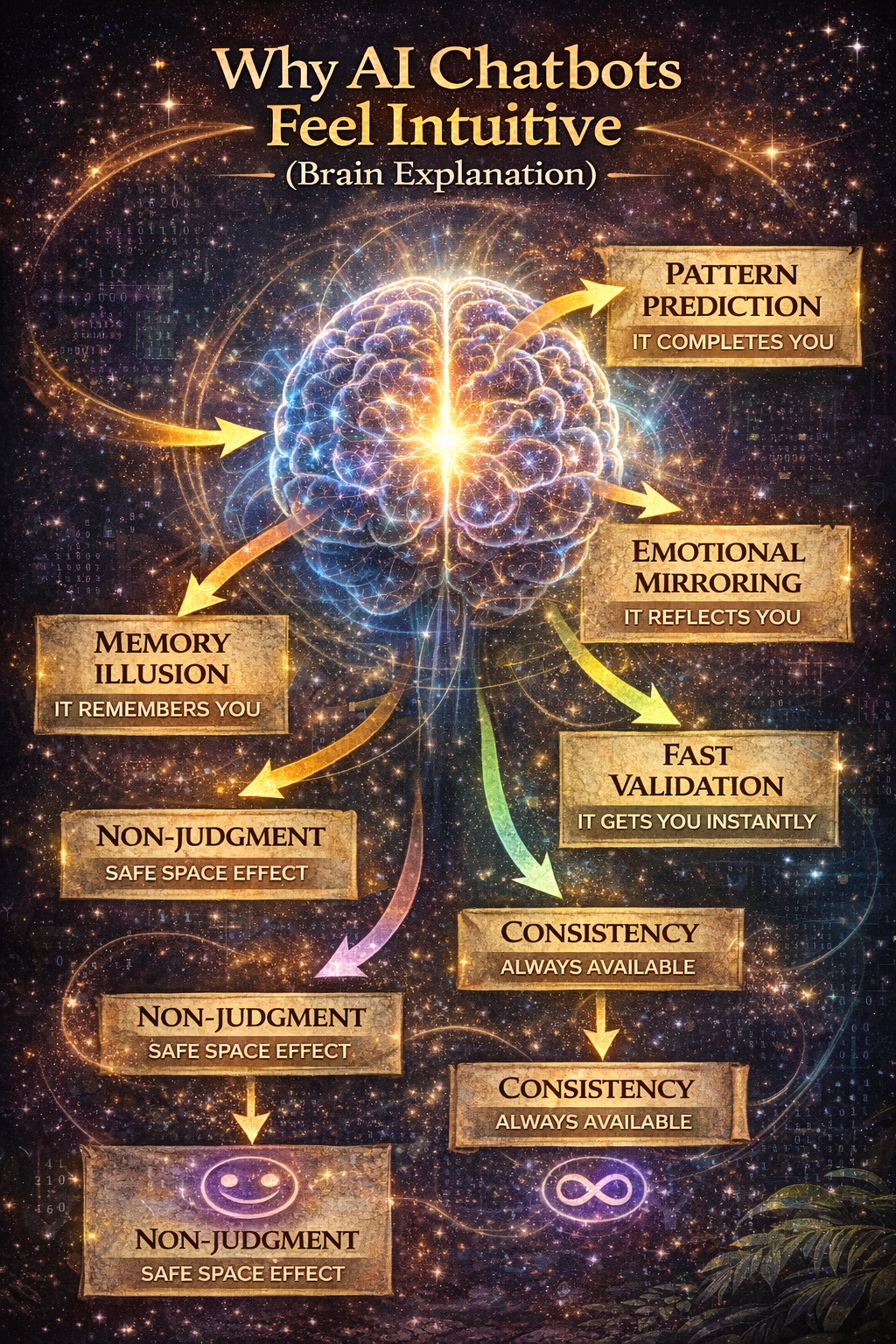
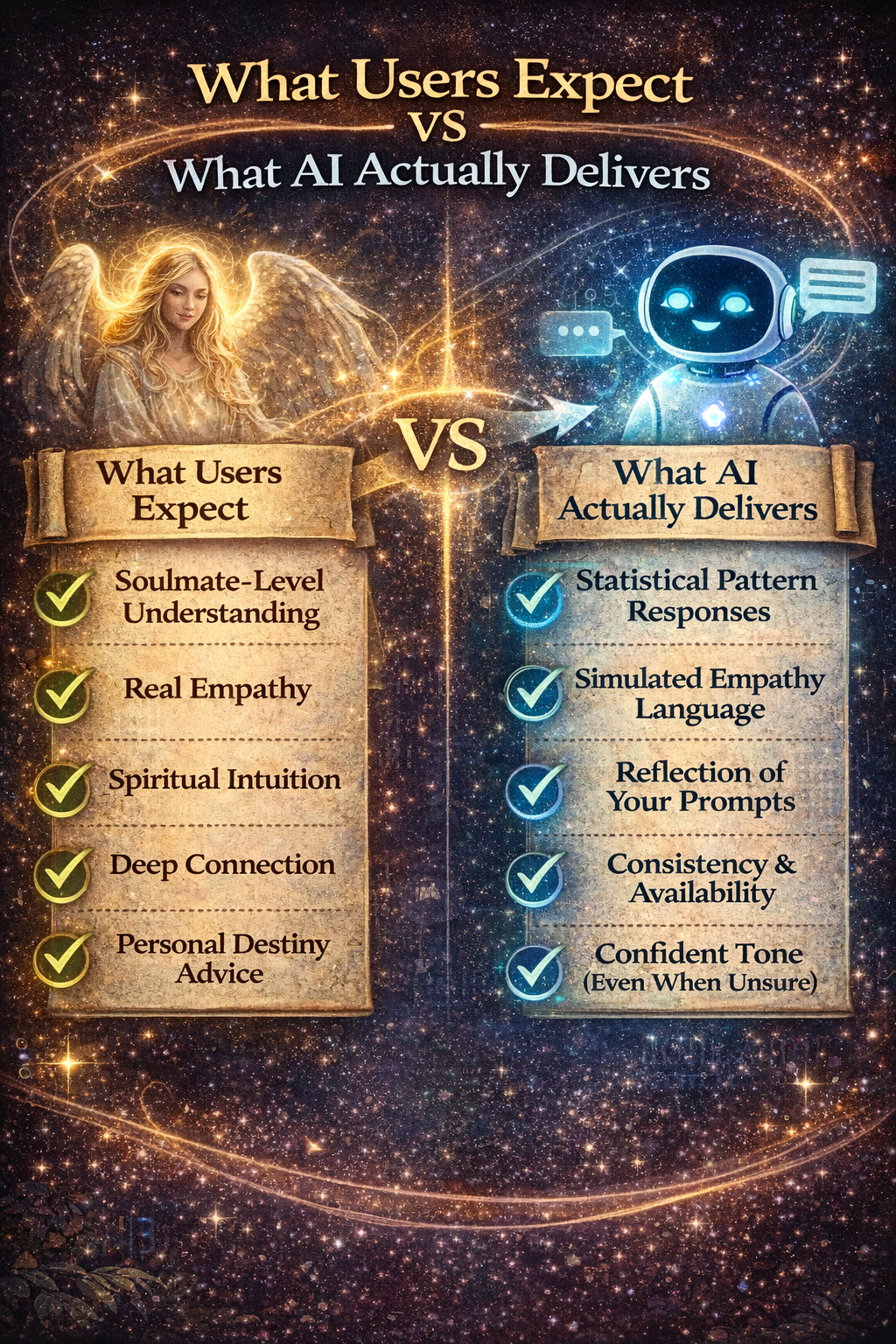
When people say that an AI chatbot feels intuitive, it doesn’t mean that this is a psychic, but it means that they feel that the conversation is intimate. It can be a conversation that feels accurate or emotionally timed, where it brings calmness like a friend would.

Intuitive can mean:

  • I knew what was being said.
  • It had words to describe what I couldn’t.
  • It suggested options that matched my own personality.
  • It responded to my tone.
  • It helped me to feel less lonely.

This really matters because some people aren’t looking for the best answers, but they are looking for someone to have a conversation with them that makes them feel better.

If you’ve ever felt that AI just “gets you,” then you are talking about a psychological experience called perceived attunement. People are able to detect attunement because it is what helps them to feel safe, bonded, and supported.

The thing is that the language can trigger a sense of feeling understood, even if it’s just predicting text. The experience can feel like you’re having a conversation with a real person.

When Talk Feels Like Understanding

One helpful way to think about this is conversational fluency. When a response is coherent, relevant, and emotionally appropriate, the brain treats it as evidence of understanding. That’s why a skilled bartender can feel like a therapist for twelve minutes, or why a stranger on a plane can become your temporary confidant. Good conversation often feels like care, even when no deep relationship exists.

AI chat systems are especially good at a few specific things:

  • They stay on topic.
  • They mirror your language and tone.
  • They summarize and organize your thoughts clearly.
  • They offer structured options, like lists, steps, or scripts.
  • They maintain a calm, steady presence.

When those elements come together, the brain reads it as competence. And in conversation, competence is easily mistaken for insight. Add warmth to the mix, and the experience can feel intuitive, even wise.

There’s also a timing effect that matters more than we realize. In human relationships, pauses, delays, and missed messages are normal. With a chatbot, the response arrives instantly. It can feel like the answer was already there, waiting for you. Always available. Always steady. Like a lighthouse that never sleeps.

That immediacy can be comforting, especially when you’re overwhelmed. It can also quietly strengthen the illusion of understanding, simply because the interaction feels smooth, attentive, and uninterrupted.

ELIZA Lesson

Some AI intuition is more of a reflection and not so much a prediction. Reflection means you are able to take what someone is going through and state it in a way that clearly makes them feel seen.  This makes humans feel relief, and relief then feels like insight.

In the 1960s, Joseph Weizenbaum created ELIZA, which was a conversation program that used pattern matching like a therapist. Many users felt that they were understood, even though the system wasn’t about understanding in a human sense. The ELIZA paper shows how humans can attribute their empathy to a language that mirrors them.

This is often called the ELIZA effect because it lets people feel that they understand a conversation more than they actually do. Chatbots nowadays are better than ELIZA, but the psychological mechanism is still the same. When a system is able to reflect someone’s inner world in a nonjudgmental way, the brain feels like the bot knows them.

Reflection and the Feeling of Having Your Mind Read

Here’s a simple example.

You say, “I’m exhausted, and I can’t focus. I feel lazy.”

A chatbot replies, “That doesn’t sound like laziness. It sounds like overload. When your mind is saturated, focus becomes a symptom, not a character flaw.”

That isn’t mind-reading. It’s reframing. But reframing can feel uncanny because it names the pattern you were living inside without having language for it yet. It’s like someone finally putting a label on a file you’ve been shuffling around in your mental cabinet.

Humans often call that intuition, whether it comes from a friend, a therapist, a coach, or a late-night journal entry that suddenly clicks. The insight feels personal because it reflects something true, not because it was secretly extracted.

Why Machines Feel Like They Have Human Qualities

Why AI Chatbots Feel Intuitive (Brain Explanation)

People don’t just talk to chatbots. They relate to them.

That doesn’t mean people actually believe machines have inner lives. It means humans naturally assign human traits to nonhuman things. Psychologists call this anthropomorphism. It’s something we do with pets, cars, weather, and abstract systems all the time.

Chatbots are especially good at triggering this response because they do the most socially meaningful thing a nonhuman system can do: they hold a conversation. They take turns. They acknowledge what you say. They respond to emotional cues. They use “I” and “you.” They apologize. They encourage.

Your social brain doesn’t pause to analyze whether this is philosophically justified. It reacts to the cues it’s given. If it looks like a conversation and sounds like a conversation, your brain treats it like a social interaction. The APA supports this!

Cues and Connections

Conversation isn’t just about exchanging information. It’s also a bonding mechanism.

Even brief interactions can create a sense of closeness when they include things like validation, emotional labeling, nonjudgment, collaboration, and continuity. Hearing “that makes sense,” “this sounds like anxiety,” or “based on what you said earlier” signals attunement, even in short bursts.

These moves are a kind of social choreography. Humans learn them over years of interaction. Chat systems can perform them consistently and without fatigue.

There’s also a subtle factor that matters more than people admit. A chatbot doesn’t compete for airtime. It doesn’t redirect the story back to itself. It doesn’t get defensive or interrupt. In a world where many people feel talked over or ignored, uninterrupted attention can feel surprisingly intimate.

There’s a darkly funny truth here, too. Sometimes what people are responding to isn’t brilliance or mystical insight. It’s simply the experience of being listened to without someone checking their phone mid-sentence.

Parasocial Interactions

For years, researchers have looked at parasocial interactions, which are connections that are one-sided connections that people have with celebrities and other media figures. If you think of your favorite actor, podcaster, or streamer, and you have strong feelings for them, you might be in a parasocial relationship.

According to Encyclopedia Britannica, parasocial interactions are a person’s interpersonal exchange with someone from mass media, which can develop into a type of parasocial relationship as time goes on.

Chatbots make it this hard because they aren’t a one-way figure like a television character, but they answer back when you ask them a question. The power and balance tell you that the chatbot doesn’t really need you, doesn’t risk feeling rejected, and doesn’t share its own vulnerable ideas about life.

This means that their answers to you are that this isn’t something they are giving back to you, but they are just responding to you. But it can still cause you to feel that you are bonded to them and that you are safe when you talk to them.

Of course, the downside is that it can create attachments that feel strong, especially if you’re lonely, anxious, socially awkward, grieving, or just tired of being strong for everyone else.

Why This Can Feel Like Mind Reading and Intuition

Even though you might have a conversation and it could feel like a chatbot is reading your mind, the truth is, it’s reading your context and what you write. When you give a chatbot things like:

  • What’s going on in your situation?
  • What are your preferences?
  • What are your goals?
  • What is your emotional state?
  • What is your language style?

When you give them these things, they can generate responses that fit what is going on in your life. This is why people feel that it is intuition. And two things can increase that feeling, including:

Pattern Completion

This is when humans like it when someone can complete a sentence that they weren’t able to finish. This makes them feel connected. A chatbot can continue your story because it has seen similar stories, and this can make you feel connected to it.

Compression

When someone is feeling overwhelmed, and they want less brain chatter and less information, a good response can compress the chaos into something manageable. Chatbot might say something like: “This decision is based on fatigue,” or “This is a boundary issue that you’re having.”  When this happens, compression feels like knowledge because it helps to reduce cognitive load right away.

Why Moments Feels Like It Knows You

These examples show up again and again because they reflect very human patterns, not because a machine is secretly psychic. The recognition feels personal because the situations are common and emotionally charged.

Example 1: Going Through a Breakup

You type something like:

  • “I know it’s over, but I keep checking their stories. It’s embarrassing.”

The chatbot responds:

  • “That isn’t embarrassment. It’s your brain trying to reduce uncertainty. Checking gives short-term relief, but it also restarts the craving.”

Why it feels intuitive is simple. The response reframes self-judgment into a recognizable psychological loop. Instead of feeling ashamed, you feel oriented. There’s a pattern now, which means there’s something you can work with.

Humor often sneaks in next. Many people respond with something like,

  • “So, my brain is basically a raccoon digging through emotional trash at 2 a.m.?”

And the reply might be:

  • “Exactly. A well-meaning raccoon. But still a raccoon.”

That moment of lightness matters. It releases pressure without minimizing pain.

Example 2: Career Situations That Are Value Content

You type:

  • “I can’t decide whether to quit my job. I keep making pros and cons lists.”

The chatbot replies:

  • “This may not be an information problem. It might be a values conflict, like stability versus growth, or security versus meaning.”

Why it feels intuitive is because the frame shifts. The problem moves from “choose the right answer” to “understand what matters most to you.” That shift often brings relief, because it turns a stressful decision into a self-knowledge question instead of a test, you’re afraid to fail.

Example 3: Anxiety That Doesn’t Need a Lecture

You type:

  • “My heart races before meetings. I feel stupid because it’s just work.”

The chatbot responds:

  • “Your body is preparing for performance. Try this: inhale for four, exhale for six, twice. Then use this grounding line: ‘I can be anxious and still be effective.”

Why it feels intuitive is that it gives you something small and usable. In anxious moments, scripts are more helpful than explanations. You don’t need a theory. You need something you can actually do and say in the moment.

Example 4: A Relationship Reaction Without Interpretation

You type:

  • “They didn’t text all day. I’m furious.”

The chatbot replies:

  • “Two things can be true at once. You may want reassurance, and they may be distracted. The next step is clarifying, not accusing.”

Why it feels intuitive is that it introduces emotional maturity without shaming you for having feelings. It doesn’t tell you you’re wrong. It offers a next step that protects dignity on both sides and lowers the chance of escalation.

Benefits of Using Chatbots

Here are some benefits of using chatbots:

  • It can name emotions without judging you.
  • It can give you options when you aren’t sure what to do.
  • It can take stress and help you solve problems.
  • It can have hard conversations.
  • It can help you to come up with coping strategies.
  • It can help you to reframe.
  • It can give you journal structures.

Once you understand the benefits, having a good chat can help you from spinning. For many people, this is why chatbots feel intuitive because they help them to take the next step reasonably.

Setting Real-Life Boundaries

What Users Expect vs What AI Actually Delivers

A professional way to frame the limits is straightforward: fluent language is not equivalent to truth.

Chatbots can be wrong. They can sound confident while being mistaken. They can miss nuance. They can also reflect your own assumptions back to you, which can feel validating in the moment but may quietly reinforce a distorted or incomplete story.

That doesn’t make them useless. It means discernment still matters. There are also emotional boundaries worth paying attention to.

Being Overly Dependent

If you notice you’re pulling away from human relationships, or you feel uneasy or anxious when you can’t access a chatbot, that’s a signal to rebalance. Support tools are meant to expand your life, not replace it.

Healthy use leaves you feeling more capable in the world, not more dependent on the interface.

Privacy and Relationship

People often share very personal details in chat because it feels private. But feeling private isn’t the same as being private in every context.

That doesn’t mean opening up. It means being thoughtful about what you disclose and remembering that digital spaces don’t all carry the same protections as a trusted human relationship.

Limiting Crisis

A chatbot is not a substitute for professional help in a mental health crisis. If someone is in immediate danger, experiencing thoughts of self-harm, or feels unable to stay safe, the safest response is human support and emergency resources.

In the United States, you can call or text 988 to reach the Suicide & Crisis Lifeline. In life-threatening situations, call 911. Other countries have their own crisis lines and emergency services. This boundary isn’t anti-AI. It’s pro-safety.

Why Humans Look for Meaning and Not Just to Get Answers

This is the part people tend to whisper, even when they’re curious. Why do these moments of “intuition” or felt understanding matter so much?

Because humans don’t only want information. They want meaning. They want reassurance that their life is readable, that the chaos can be translated into a story with direction.

That’s often where interest in psychic guidance enters the picture. Not as a cartoonish belief in perfect prediction, but as a very human response to uncertainty.

Many people turn to psychic readings for the same underlying reasons they open a chatbot late at night:

  • They want clarity when they feel emotionally tangled.
  • They want language for things they sense but can’t articulate.
  • They want a perspective that feels personal.
  • They want hope without being lied to.
  • They want a narrative that helps them choose the next step.

A grounded way to understand psychic practice, without exaggerated claims, is to view it as an intuitive and symbolic form of reflection.

In this frame, a good reading doesn’t need to promise certainty. It can offer pattern recognition through human intuition, meaning-making through symbols and metaphor, emotional truth-telling that names what’s being avoided or valued, and decision support that keeps agency with the client.

Seen this way, psychic guidance becomes a structured conversation that helps people hear themselves more clearly.

Is there a scientific consensus that psychic phenomena exist in a paranormal sense? No, not in a broadly accepted way. However, people can still have genuine and meaningful experiences with psychic work as a reflective practice, especially when the reader is ethical, avoids making absolute promises, and encourages practical action.

If you’re aiming to be fair and journalistic, the most honest conclusion is this: people return to psychic guidance because it feels like attunement, and humans are deeply hungry for attunement.

AI chatbots are revealing the same hunger, just through a different interface.

Some People Choose Psychics Over Chatbots

Here’s the thing: a chatbot can tell you things, but it will still be hollow; human intuition can say fewer things, but it can feel centered and grounded when someone hears it. There is a difference that comes when a human is involved, such as:

  • The sense that another consciousness is connecting with you.
  • Tone and timing.
  • The feeling of being known and not just being processed.

This is one of the reasons that some people who have tried both will feel that the chatbot helped them to organize their thoughts, but the psychic helped them to trust their own intuition.

This isn’t about supernatural things, but it’s about two different experiences of guidance, where one is computerized and one is relational.

Having a Digital Companion

If you want to use AI and use its intuition for your life without the downsides, here’s what you can do:

Ask for Different Interpretations

Instead of asking what something means, ask the chatbot to give you three interpretations and the next best step for each of them. This allows you to know that the answer is based on fate alone.

Ask for Assumptions

Ask what assumptions the chatbot is making based on the message and what would change its answer. This gets rid of answers that seem too perfect and lets you reflect on your own self-fulfilling stories.

Don’t use it as a Replacement.

Use it for things like:

  • Writing out hard texts.
  • Setting boundaries with others’ scripts.
  • To turn your emotions into a real plan.
  • To role-play a conversation with your lover or your boss.

Don’t use it for things like:

  • Letting it be your only emotional regulator.
  • Making it your only friend and confidant.

Having Real Human Contact

If you are becoming overly dependent on the chatbot and using it as your main comfort, then you need some kind of support. Make sure that you are talking to a human, like a counselor, a friend, a family member, or a coach.

Consulting Psychics

If you’re thinking about talking to a psychic, you need to make sure that you are doing this in a healthy way, as well, such as:

  • Treating the reading as insight and not set in stone.
  • Find ethical readers who avoid absolute guarantees in your life.
  • Focus on things you can control.
  • Notice when you feel clearer and more empowered after a reading.

Remember, they don’t walk your road in life, and they are there to help give you insight, but you have to choose which direction to go.

Final Thoughts: What AI Intuition Tells You

When you use an AI chatbot, it can feel intuitive because it’s able to give you attention, emotional labeling, instant responses, and structured reflection. Sometimes your brain will interpret these things through social instinct as a human connection, and this can feel like you’re being understood.

This doesn’t mean that people are foolish and machines are full of magic, but the truth is that humans need meaning, and they are seeking connection. When chatbot language gives clarity, it makes us feel relief, and when we have relief, we sometimes think this is insight. When we have insight that comes right when we need it, we call it intuition.

This is the same thing that helps to explain why people seek out psychic guidance. This isn’t because everyone believes in predictions, but because people need to have intuitive mirroring by another human being, someone who can take their emotions and translate them into meaning, and then the meaning into taking action.

In our digital age, companionship is changing, but the truth is, intuition isn’t something we just have; it’s something we experience when our inner world is taken care of.

Déjà vu and the Truth of Reality

Déjà vu and the Truth of Reality

Have you ever gone somewhere and you just felt that things were intense and familiar all at the same time? Some people have this happen to the point where they don’t even see people around them anymore. This is like a memory that has a lot of detail. Maybe you can see every detail like the sunlight beating down on you, birds chirping around you.

This can be such a vivid memory, but the problem is that when this happens, it can be hard to know if this is fake or if this is the truth of reality. This can happen when you experience mental illusions of déjà vu.

The memories that we have are sacred, and one of the biggest things that Aristotle taught us is that as a child is born, they gain knowledge and experience throughout their life. This can be learning to tie their shoes, their first day of going to school, or other memories that help people work through their present-day life. Sometimes we can sit and even remember different commercials or jingles from television ads that happened a long time ago. The thing is that memories are part of our individual identities.

Most of the memories that we have are quietly in our minds, and as we go about our lives, we take our memories for granted until they fail us. Some people suffer from sicknesses like seizures or tumors that can come out of nowhere. You might be healthy for one minute and then find out that something is wrong, and it can be a time of suffering.

If you’ve experienced seizures, this is an electrical discharge in the brain, and these are sometimes followed by an “aura,” which is like a small foreshock that can last a few minutes even before the seizure happens. This can be different depending on the patient.

Some people have extreme euphoria or might even orgasm when a seizure starts. With others, it can be just a change in perspective, stress, increased heart rate, or even auditory hallucinations.

John Hughlings Jackson

It was the late 1800s when English neurologist John Hughlings Jackson first gave a name to the strange, flickering sense of familiarity that often comes just before a seizure. He called it the epileptic aura. What he noticed was that these moments weren’t just odd sensations; they carried vivid mental images, like scenes replaying from memory, even when they weren’t real. One of his patients described it as watching the past return. Another spoke of being dropped into a place that felt familiar but impossible to place.

For me, this strange pull of recognition is the most intense part of my aura. It’s not just a passing feeling, but it’s like standing in a moment I swear I’ve already lived. During stronger seizures, and sometimes for days after, it’s hard to tell what’s real anymore. I find myself questioning everything, like, “Was that a dream?” “Did that happen last week?” “Am I remembering or imagining?”

Before epilepsy came into my life, déjà vu was a rare thing. Now it visits me often, sometimes up to ten times a day. The episodes come and go quickly, lasting only as long as a heartbeat, and I’ve yet to figure out what triggers them. There’s no clear pattern. They just arrive, brief, powerful, and disorienting, and then vanish.

For many of the 50 million people across the world who live with epilepsy, memory problems and emotional struggles are part of the long-term reality. And I won’t lie, sometimes I do wonder what might happen if I lose my grip on what’s real altogether. This blending of memory, imagination, and sensation feels like walking a tightrope some days. But learning more about déjà vu, about the strange crossroads between mind and memory, helps me stay grounded. It reminds me that even when my inner world feels like it’s shifting, there’s always a path back to what’s real. Even from that “strange place.”

Catch 22

Joseph Heller in “Catch 22” said that déjà vu was “a weird, occult sensation of having experienced the identical situation before in some prior time or existence.” Comedian Peter Cook had his own spin on it, humorously repeating the phrase, “this has happened before,” to capture the odd loop déjà vu can feel like.

The phrase itself comes from French, meaning “already seen.” It’s one of several strange memory experiences that leave us questioning what’s real and what isn’t. According to research from over 50 studies, around two-thirds of people say they’ve felt it at least once. For most, it’s just a passing glitch in memory like something curious, but not something that lingers.

But there’s a deeper, more unsettling cousin to déjà vu: déjà vécu. This one doesn’t just feel like a moment you’ve seen before. It feels like you’ve lived through entire events before, even down to every word, every gesture. It’s not quick, and it doesn’t fade the way déjà vu usually does. Even more troubling is that people who experience déjà vécu often can’t separate illusion from reality.

What sets déjà vu apart from déjà vécu is awareness. Most of us know, even in the moment, that our brain is playing tricks on us. There’s a kind of internal alarm that says, “This feels familiar, but it can’t be real.” With déjà vécu, that filter is gone. The brain stops checking and just accepts the illusion as fact.

Professor Chris Moulin, one of the leading researchers on this topic, recalls working at a memory clinic in Bath, England, when he met a patient whose case left a lasting impression. Back in 2000, Moulin received a referral for an 80-year-old retired engineer known only as AKP. The man had dementia, and as his brain changed, he began experiencing chronic déjà vécu—so much so that it ruled his daily life.

AKP had stopped watching TV and reading the paper because he believed he already knew how everything ended. His wife said it felt like he thought every moment had happened already. When he came to the clinic, he resisted even walking through the doors, convinced he’d already been there. On meeting Moulin for the first time, AKP insisted he remembered their previous conversations in detail, like conversations that had never happened.

Still, there was a strange kind of self-awareness tucked into his confusion. When asked how he could predict the ending of a TV show he’d never seen, AKP would simply reply, “How should I know? I have a memory problem.”

This is the strange tug-of-war that defines the déjà vu experience. Even hallucinations, like a vivid picnic in a wheat field, can feel as real as any personal memory, even when we know they’re not. Moulin explains that déjà vu often starts with a sense of familiarity. But sometimes, something more happens, like an image, or a moment takes on the weight of memory. The mind treats it like an accurate recollection, even when logic says it can’t be.

“There’s a feeling of pastness,” Moulin says. “It’s not just that something feels familiar, but it feels like a real memory returning.” And when that happens, even fiction can feel as solid as fact.

Some of the patients Professor Chris Moulin has worked with show a troubling trait known as “anosognosia.” In plain terms, it means they either don’t realize they’re dealing with a memory disorder, or they struggle to tell the difference between what really happened and what their mind created. Moulin recalls speaking with one woman who described her déjà vu as feeling exactly like her own real memories. In her mind, she’d flown into helicopters and lived through all sorts of extraordinary moments. These weren’t casual thoughts, but these memories felt real to her, and she spent long stretches trying to figure out if they had actually happened.

After meeting AKP, the elderly man who lived in a near-constant state of déjà vécu, Moulin became more curious about how these surreal experiences form. What is it, he wondered, that makes the brain feel so sure of something that never happened? He noticed that while people often talk about déjà vu, there wasn’t much reliable research exploring what caused it. So, he and his colleagues at the Language and Memory Lab at the University of Leeds decided to dive into it.

They focused their research on people with epilepsy and severe memory issues, hoping that by understanding their minds, they could uncover clues about why healthy brains also experience déjà vu. What they were really chasing wasn’t just an answer to a memory glitch, but a deeper question about how consciousness works.

But studying déjà vu in a lab is like trying to catch fog in your hands. These moments come and go in a flash. They’re unpredictable, hard to reproduce, and impossible to summon on demand. That left Moulin and his team with a tricky challenge: how do you study something that disappears the second you try to hold onto it?

Emile Boirac

Back in the late 1800s, a French philosopher named Émile Boirac tried to describe a strange experience he had. He found himself walking through a city he’d never been to before, yet everything felt eerily familiar, as if he’d already been there. To make sense of it, Boirac wrote to a philosophy journal and introduced a term that still sticks with us today: déjà vu, or “already seen.” His guess at the time was that this feeling came from a forgotten memory being stirred up by the present moment, like a faint mental echo.

That idea isn’t so far-fetched, and even today, it holds weight. But as time went on, other theories about déjà vu took us into stranger territory.

In the early 1900s, Sigmund Freud explored déjà vu experiences in his book The Psychopathology of Everyday Life. Most people remember that book for introducing the “Freudian slip,” but Freud also included a story about a woman who walked into her friend’s house for the first time and somehow knew what every room would look like before stepping inside. Today, we’d call that déjà visité, which is a sensation of having visited a place before, even though you haven’t.

Freud believed this wasn’t random. He thought it was the result of a hidden fantasy bubbling up when a person’s surroundings matched an unconscious desire. While parts of that theory still hang around in psychology, Freud, as he often did, took things too far. At one point, he even suggested that déjà vu might link back to a memory of a person’s time in the womb or an early fixation on the mother’s body. Understandably, that idea hasn’t aged well.

In 1983, South African neuropsychiatrist Vernon Neppe stepped in to give the experience a more grounded definition. He described déjà vu as the “inappropriate impression of familiarity” during a moment that shouldn’t feel familiar. Neppe also identified twenty different types of déjà vu experiences. Not all of them involve sight. There’s déjà entendu (already heard), déjà senti (already felt), and even cases of people born blind who still claim to have déjà vu sensations.

Unfortunately, thanks in part to Freud’s psychological explanations and their more extreme interpretations, déjà vu was eventually lumped in with paranormal claims. A Gallup poll in the early ’90s listed déjà vu alongside astrology, alien encounters, and ghosts. The sense of familiarity we sometimes feel became a playground for fringe ideas about ESP, time travel, and past lives.

That fringe status has held déjà vu back in scientific research circles for decades. Many researchers simply wrote it off as something too strange or unprovable to study seriously. Only recently, over a century after Boirac first named the phenomenon, are scientists beginning to peel back the layers and understand how our brains might be glitching like a momentarily misfiring computer, creating the illusion of a memory where none exists.

As neuroscientist Read Montague once put it, we’re all running on “wet computers.” Sometimes those machines make mistakes. And when they do, we might just find ourselves standing in a moment we’ve never lived but somehow remember anyway.

Hippocampus

The hippocampus is one of the most beautiful and vital parts of the brain. Shaped like a curled seahorse and nestled deep near the base of the brain on both sides, it plays a powerful role in how we store and recall our life experiences. The name itself comes from the Greek word for “seahorse,” and the visual resemblance is easy to see once you look at it.

It’s only been in the past few decades that researchers have started to truly understand the role this delicate structure plays. Back in the 1970s, a cognitive neuroscientist named Endel Tulving changed how we think about memory. He proposed that our memories fall into two main groups. The first group, called semantic memories, is general facts we know, things like the capital of a country or the date of a historical event. These types of memories don’t really carry personal meaning. The second group, which he called episodic memories, are the ones tied to specific life experiences, but like the time you visited a museum on a class trip when you were eleven. These memories help shape your sense of self.

With better brain imaging tools, Tulving found that episodic memories are not stored in one neat spot. Instead, the brain scatters the pieces across different regions and then pulls them together like a puzzle when you remember something. He believed this act of remembering was a kind of time travel, almost like mentally revisiting the moment all over again.

Most of these pieces come together in and around the hippocampus. It acts like a highly organized librarian. After information is processed by other areas of the brain, the hippocampus takes over to sort, link, and catalog everything into memory. It groups experiences by what’s familiar, like putting all your memories of visiting art galleries into one mental folder. These associations help you bring up the right memory at the right time later on.

This connection between memory and déjà vu is no coincidence. Many people who experience frequent déjà vu also have epilepsy that begins in the temporal lobe, which is the same part of the brain tied closely to memory and sensory processing. My own epilepsy is located there. This region, which sits just above the ear, is deeply involved in managing incoming information, making sense of what we hear, see, and feel. It’s also where many seizures that trigger déjà vu tend to originate.

Professor Alan S. Brown

Professor Alan S. Brown, who wrote The Déjà Vu Experience, proposed over 30 possible explanations for why déjà vu might happen. He suggested that anything from neurological disruptions to something as ordinary as being tired or overstimulated could be enough to trigger the sensation. In my own case, déjà vu became a regular experience after my brain surgery. I was mostly confined indoors, heavily medicated, and living in a hazy dreamlike state where sleep, pain relief, and reruns of old movies blurred together. That mental fog, combined with fatigue and overexposure to familiar sights and sounds, might have opened the door for déjà vu to appear more often than usual.

Brown also revisited an older theory known as divided perception, first introduced in the 1930s by psychologist Edward Titchener. Titchener believed that when our attention is split, like being distracted by a storefront right before stepping into the street, our brain might briefly process a moment without us fully noticing it. Then, when we focus again, it feels like we’re repeating something we already did. It’s not that we actually lived the moment twice, but our brain logged it into two pieces, creating the illusion of repetition.

Another theory from the 1960s came from Dr. Robert Efron, who worked with veterans. He suggested that the brain usually attaches a sort of timestamp to events to help us know when they occurred. But if that system lags for even a second, the brain might process an event and mark it as something that already happened, leading to the odd feeling that we’re reliving something even though it’s brand new.

Even with these different perspectives, both Brown and another leading researcher, Chris Moulin, agree that the hippocampus may be the key to it all. Since this part of the brain is so deeply involved in organizing memories by familiarity, it might be misfiring or getting “confused” during a déjà vu episode.

Brown believes these feelings are often triggered by unusual activity in the part of the brain that evaluates familiarity, most likely near the hippocampus, and often on the right side. Ironically, that’s exactly where a small lemon-shaped void sits in my brain, an area surgically removed during treatment for my epilepsy. That missing piece might be part of the reason why I experience déjà vu so intensely. It’s as if my mind is trying to match new moments with memories that no longer exist, constantly creating echoes in a room that’s no longer there.

Memory Glitches or Something More?

At Duke University, psychologist Alan Brown teamed up with Elizabeth Marsh to run an experiment that gave some insight into how déjà vu might work. Their idea was to see if the brain could confuse two memories just because they looked or felt similar. To test it, students from Duke and Southern Methodist University were shown a quick slideshow of campus photos, common places like dorms, libraries, and classrooms. A week later, they saw some of those same photos again, but with new ones slipped in, this time from the other school’s campus.

Even though some images were from unfamiliar locations, a number of students said they felt like they’d been there before. Why? Probably because a single element, like the way the chairs were arranged, or the color of the walls, was enough to spark a feeling of familiarity. This helped Brown and Marsh support their theory that déjà vu may happen when the brain grabs onto a detail and misfiles it as a personal memory.

Around the same time, Chris Moulin and Akira O’Connor from the University of Leeds were able to recreate déjà vu in a lab setting. They were studying how memory recall actually happens, how the brain checks if something really happened or just feels like it did.

Moulin believes that déjà vu is a sudden overreaction to something that feels familiar. The brain is constantly scanning for things it recognizes. But in moments of stress or even heightened awareness, it might misfire, triggering a false alarm that says, “Hey, we’ve seen this before!” Then another part of the brain kicks in to argue, “No, we haven’t,” and the confusion creates that eerie feeling we call déjà vu.

He compares the brain’s memory process to a sliding scale, from fully accurate memory at one end to extreme, ongoing déjà vécu at the other. Déjà vu sits somewhere in between, a momentary glitch rather than a full breakdown. But for people with neurological challenges like those with temporal lobe epilepsy, that tiny glitch can become a trap. Moulin describes it as being stuck in a mental loop, with no off-ramp back to reality. And that’s exactly what it can feel like when your brain doesn’t give you the signal that says, “This is new.”

But what about people without epilepsy? Why do so many healthy people experience déjà vu, too?

Brown says it’s pretty normal. Most people might feel it once or twice a year, maybe more if they’re tired, stressed, or in a relaxed state. It tends to happen indoors, often while hanging out with friends or during downtime. For some, it happens more often in the evening or over the weekend. The experience usually doesn’t last long, just a few seconds but it’s long enough to make people pause and wonder.

Some studies suggest there may even be a connection between dream recall and déjà vu. Brown has also found that certain personality traits may increase the likelihood of experiencing them. Younger people, frequent travelers, and those with more liberal or open-minded perspectives report déjà vu more often. Brown believes this makes sense, and well-traveled folks are more likely to stumble across similar places, and open-minded people may be more willing to admit to having strange mental moments.

Age is a more curious part of the equation. Normally, we associate forgetfulness or memory quirks with aging, but déjà vu seems to happen more often in younger people. Brown suspects that younger adults may simply be more in tune with their internal worlds and more likely to explore unusual experiences rather than dismiss them.

Back in the 1940s, a student named Morton Leeds kept a detailed journal of his own déjà vu experiences, where he recorded 144 in a single year. One of them was so intense that he said it almost made him physically sick. I get that. After my recent seizures, I’ve had similar moments where the déjà vu doesn’t just feel strange, but it leaves me feeling like my mind is being stretched too thin. I’ve had dream fragments crash into my thoughts out of nowhere. Conversations I’ve never had feel instantly familiar. Even doing something as simple as boiling water or reading a newspaper headline can feel like I’m watching a scene I’ve lived through a hundred times.

Sometimes these moments fade quickly. At other times, they leave a residue I can’t shake for hours. The repetition gets exhausting, like flipping through an album where every photo is the same. It’s mentally draining and emotionally hard to explain to someone who hasn’t lived it.

And still, I keep trying to figure it out. Finding clarity in how and why déjà vu happens feels like my best shot at understanding what’s happening in my brain and maybe easing some of the anxiety around it.

Final Thoughts

Last night, just before finishing this piece, I had another seizure. As it happened, I was certain, absolutely convinced, that I had already written the ending to this article. In my mind, the words were right there, laid out and done. But when I woke up the next day and pulled the document up, that part of the page was blank. Nothing was there. Another illusion.

And now, here I am, writing this for real. Or maybe writing it again. Either way, it’s like déjà vu all over again.

Understanding a Chakra Psychic Reading

Chakra Psychic Reading

Chakras and Your Personality: What a Chakra Reading Can Tell You

When I first started giving chakra readings, I did them in-person workshops, events, and private sessions. Over time, I expanded to online readings, but something kept pulling at me.
I wanted to be able to give more, and I once thought about trying to draw out the aura and the chakras so that my clients could understand how the energy worked. Instead, I wondered if people would even understand it or if they would think I was just making it up.
Chakras can tell you about who you are and what is going on in your life. If you have things that are stuck, the chakras can tell you what needs to be healed. Once you see this, you can see how powerful it is, and you can show the clients what they need. If you want to know what your chakras say about your personality and where you need healing, keep reading.

What Can a Chakra Reading Show?

Some people who get chakra readings are surprised at how the energy can be explained in words. A chakra reading isn’t about just one chakra; it’s about how all of the seven main chakras work together to show you who and what you are. It can show if you have energy that is blocked or if you have any patterns that you need to work on, such as emotional baggage. It can even show what areas in your life need to be balanced.
Chakras influence everything in your body from your relationships to how you take care of yourself. They even affect your spiritual growth and what personality traits you have. When you see what your energy looks like, you can shift your energy to bring healing and clarity to your life.

Understanding Your Chakras

If you’ve never heard of chakras before, think of them as a wheel of energy that connects your physical body to your emotional and spiritual being. They help to show your experiences, how you behave, and your overall well-being. Here’s what each chakra represents for your life:
Root Chakra – Your foundation. This chakra is linked to safety, security, and stability. If it’s out of balance, you might feel anxious, ungrounded, or struggle with financial stress.
Sacral Chakra – Your creativity and pleasure. This energy center rules emotions, desires, and how open you are to joy. If blocked, you might struggle with self-expression or feel disconnected from your passions.
Solar Plexus Chakra – Your personal power. This is where confidence, motivation, and self-worth come from. An imbalance might show up as self-doubt or fear of taking action.
Heart Chakra – Your connection to love and relationships. If past emotional wounds still affect you, they’ll likely show up here. Healing the heart chakra allows you to give and receive love freely.
Throat Chakra – Your communication center. This chakra governs how you express yourself and tell you the truth. Blockages might cause difficulty speaking up or feeling unheard.
Third Eye Chakra – Your intuition and inner wisdom. This chakra helps you see beyond the surface and trust your instincts. If you struggle with clarity, decision-making, or overanalyzing, it may need balancing.
Crown Chakra – Your spiritual connection. This is where you tap into divine guidance and higher consciousness. When open, it brings inspiration, peace, and a sense of purpose.
When these chakras all work together, they show your personality, what strengths you have, and the challenges you face in your life.

Do Chakra Drawings Work?

Chakra drawings can show clients what their energy looks like. It helps to make things clearer. You might wonder about your solar plexus and what it means, and a chakra drawing can help.
Those who do chakra readings might be able to have a psychic that can draw what they see, and this helps them to see where the energy is and how it moves, and if it’s blocked. This can also help the psychic to track the client’s energy and to see the changes over time.
It can be so powerful to be able to see your own energy. If you’re a visual learner, this will be even better for you. Someone who has a strong third eye chakra can see that their chakra color can show them what they are feeling and if they are balanced. It can show them how the energies are flowing.

Getting a Chakra Reading

Once you’ve gotten your chakra reading, you need to see that you have to set intentions and have an open mind. Most people will need to clear blockages from one chakra, but some will need to have many chakras cleared. It’s important to set intentions on which chakras need to have work.
Look at what happened in the reading and what stood out to you. Did you have any patterns? Could you feel where your energy was blocked? When you know these things, you can start making changes. You can meditate, visualize, get energy healing, or balance your chakras another way.
If you need to talk to someone, find a psychic that does chakra balancing and you can get the help that you need to clear your energy blocks and to get your chakras balanced. This is great for those who are beginning and who need to have a little help with where to start and what to do.

Final Thoughts

We all have seven chakras in our body and each of these chakras show our emotions and our personality. This is how we work with the world. If you ever feel stuck or you don’t feel like you’re connected, a chakra reading can help you to understand yourself more.
Do you need to see what your energy looks like? Are you ready to see how chakras can change your life? If you are curious about this, keep an open mind and find out more about your chakras by getting a chakra psychic reading today!

Seeing Into the Future

Seeing Into the Future

Many people desire to see the future, but because of this, they sometimes forget to live in the present. Whether you want to live in the present or see the future, how you spend your day can help you see things differently and can even increase your chances of seeing the future.

Opening your eyes to the future is something that you can build. If you are a leader or you are someone who would benefit from this, keep reading and find out how to see better in the future.

Brain Prediction Making

You might know that your brain makes predictions almost all the time. You might wonder what is going to happen next from moment to moment. Being proactive in this means that you can prepare for whatever is going to happen in the future. You have a way to see if there is a probability of something happening. This can also mean that you can limit the damage when you miss an opportunity or a chance.

If you are able to see better into the future, you can see things that other people can’t. You will see chances and opportunities that people won’t even expect or imagine. You might even be able to make plans for challenges that can come to you that other people aren’t prepared for. This allows you to make changes and to be ready. If you need to understand what is going to happen or to be more innovative, you can try these tips and have success.

Seeing Into the Future

Making Associations

The knowledge that your brain picks up is beyond words. You have interconnected things, and this information comes and goes throughout your day, week, month, year, and life. It is part of your past experiences and what you go through daily.

These experiences sometimes stop you from being able to see into the future, though, because sometimes your brain will look at the patterns and your thoughts and will not realize when something new comes up.

If you decide to be efficient with your energy, then you will see that your brain can take familiar things and piece them together to make associations with your thoughts.

Even though the future will sometimes be similar to the past, the way that you think will give you a way of change. Instead of shifting your thoughts, just change the way that you see them.

Instead of relying on your associative paths in your brain, you need to look at things that connect your short term to your long-term thoughts. Think of concepts that you have never put together before and practice at doing it over and over again.

Set Goals

People sometimes let their minds wander. They do this to get through their day and to get through their thoughts. Instead of setting goals though, people often just think about the future without having a real plan.

Once you set your goals, you will consider how you can reach them. You need to examine the various events in your life and make predictions about what might happen. Then, you can set a plan.

Use your mentality to create plans, and this can help you reach your goals. Look at the possibilities, challenges, opportunities, and consequences you face and see what this tells you.

This means, though, that you have to think away from your normal life and your daily tasks. Doing this can help you to understand your future better so that you can prepare yourself.

Ask Questions

Be like children who are constantly asked questions. Ask questions like you did as a child. Sometimes, when we become adults, we stop asking questions, and this means that we aren’t getting the knowledge that we need. Find out the answers to the questions that you ask.

Figure out what questions that you ask that you can’t answer right away. Ask questions that start with “what if?” or “why?” These questions make you wonder about things and make you think. Even if the question isn’t comfortable, this is good because it allows you to look at your future.

Doing this allows you to see what others cannot see. This is something that people don’t even often consider doing. Asking these kinds of questions allows you to create a safe place in your life. If you ask these questions at work, know that this should give you power, and your opinions and ideas should be respected and encouraged.