

Home Blog Page 13

Resolve Your Money-Ache Through Psychic Reading

       “I’ve got so much to pay with IRS! then I had to put new tires on my car, and my dog needs surgery,” Sasha desperately talking into the phone. “My finances are such a mess! Every time I think I’m ahead, everything goes to hell and I’m back at square one. Can you please help me?”

This kind of situation is very common; many of us have financial struggles we just can’t seem to move past. So frustrating! As a psychic and astrologer, I can help bring to light the blocks preventing financial success and assist my clients in making lasting changes. Clearing past life blocks can pave the way to more positive energy around money, and understanding the current life lessons found in your astrological chart can help you move forward.

Considering Past Life Karma

Sasha and I started by looking at her Akashic Records. I was shown a past life in which she had taken a vow of poverty when she entered a monastery as a young woman. Vows taken to God or to a person believed to represent God are very powerful because there is usually a lot of devotion or motivation behind the vow. Sasha had been especially devout and took her vows of poverty seriously, giving away all her belongings and a stake in the family inheritance. She even refused a bed in her cell, using a pallet on the floor instead. Whenever she could forsake a material comfort, she did so. Still, she died feeling that she hadn’t done enough for God.

Though that lifetime was over and done, the vow still existed in her energetic field, as she had never renounced it. So, she found ways to attract or create financial difficulty—unconsciously—so that she never had any kind of cushion. She also felt she hadn’t done enough to deserve God’s love, so a feeling of atonement and a willingness to suffer were also blocking her. Once we cleared the past life energy and released the vow, she noticed a decrease in her dramatic money problems.

Astrology and Finances

Healing some of Sasha’s past life attachments gave her a clearer slate from which to make changes to her financial life, but there were more places to look for clues that would help her make better decisions. The Second House in a natal chart is where we find indications of wealth and money issues. Sasha had Gemini ruling the Second House and Saturn placed within it. The ruler of Gemini, Mercury, was in the Twelfth House. This gave me a huge amount of info to share with Sasha.

Gemini in her Second House indicated that money was approached with a potentially scattered, “easy come, easy go” kind of attitude. Gemini energy isn’t one to look to the long-term, so this, by itself, was a good place to start. Add in Saturn’s placement, and I could see that some of Sasha’s primary life lessons were around the practical and prudent management of money (opposite of Gemini’s casual energy). The fact that the Second House ruler was in the twelfth added a dimension of illusion, delusion, or escapism around issues related to Mercury’s houses.

I saw it would be important for Sasha to take stock of her various financial assets and create a structure around them (Saturn) that would help her get out of the ongoing crisis. Sasha admitted that she hated to deal with finances and often just avoided opening bills or saving money for taxes (she’s self-employed). This is classic Twelfth House stuff. She owns several micro-businesses (Gemini variety), but keeps haphazard records at best and has never had a true long-term plan. Add to this mix a past vow of poverty, and you’ve got a potent recipe for the kind of disaster Sasha was always facing.

To keep her Gemini happy, we had to make financial planning interesting. This meant adding humor where we could and finding better coping strategies than avoidance for when she was feeling financially stressed. I had her create an agreement with a trusted friend who would help keep her organized when Sasha started feeling overwhelmed (Gemini likes social connection). In return, Sasha agreed to help this friend create a website, so there was a clear energy exchange. Eventually, Sasha could create a long-term strategy to deal with her businesses and plan for the future. But we had to just do a little at a time since Gemini gets overwhelmed if you go too deeply too quickly.

Sasha was amazed at how empowered she felt once she started working consciously with her astro energies.The energetic burden to stay poor also began to lift—she was on her way to greater prosperity and abundance.

A spiritual advisor can help you approach your money problems by looking at energies you may not be able to perceive yourself.  It’s incredibly helpful to get an objective, compassionate viewpoint, especially if you are in the midst of stress and worry. Working with both past and present karma through healing and astrology can help you make clear, lasting changes that will impact your finances for the better.

Are You Dragging Yourself To Be Poorer?

    You are most likely speaking silently to yourself every time you are not speaking out loud to another person or reading someone else’s words. Now, This type of “self-talk” goes on all day long, usually as unmonitored chatter. If you start paying attention to your inner commentary, you might find that it is talking you out of the things you want. The quality of your self-talk could even be affecting your bank balance.

Thoughts Are Connected to Behavior

If you discover an opportunity that aligns with your goals, but then your self-talk tells you, “You’ll never be able to do that,” it is unlikely that you will pursue that opportunity. That little voice in your head might not even be your own voice. It could be echoes of other people’s voices over the years—such as your parents, siblings, teachers, or bosses—that you’ve internalized as part of your identity.

Familiar Words Work Best

Psychologists have found that people tend to cling to and expand on words and thoughts that are familiar. For example, in the 1970s, the research experiments of David McClelland, an expert in motivation, revealed that when his subjects were flashed two sets of words, one positive—such as “success” and “profit”—and the other negative—such as “failure” and “loss”—the participants who ranked high in need for achievement recognized the positive words significantly faster than those with low need for achievement. And, as you might expect, those who ranked low in need for achievement recognized the negative words faster.

Improve Your Self-Talk

Simply changing your self-talk from “I can’t” to “I can” inspires hope. Changing “That’s impossible” to “Well, that could happen” instantly opens your mind to accepting new options. Changing self-criticism and blame to self-praise and acceptance breaks down barriers between you and your goals. Even changing the word “but” to “and” will expand your perceptions.

Emblazon your mind with words that are conducive to wealth—such as “success,” “confidence,” “achievement,” “winner,” and “action”—until they become familiar to you. If your self-talk tries to cancel your positive thoughts with negative ones, visualize pressing the “Delete” or “Skip” button on that counterproductive audio. In the same way that you create playlists for music, create playlists for your daily self-talk. You’re in control of what gets stored in your memory for playback later.

Psychic Advice In Achieving Your Dreams

Never let go of your dreams, Follow your dreams… All of these clichés about chasing our dreams tend to encourage going beyond our capabilities to attain the impossible but while these sentiments are very inspirational, they don’t address the fact that going after your dreams can be a real hard work. Going after your most desired goal is not as easy as it might seem.

And before you jump off the deep end and try to accomplish a dream, make sure you have both eyes open first. The following six tips can guide you. Remember, being realistic about your dreams will make you more likely to achieve them.

1. Make Sure You’re Not Being too Idealistic
It’s easy to fall in love with the idea of living in another country, being a pop star, or quitting your day job in order to run a bespoke bakery. However, these things aren’t all play and no work. There are always going to be less-than-savory aspects when it comes to your dreams, so make sure you’re aware of them. Then take an honest look at yourself and determine if you are really up to all the challenges that come with your dreams.

2. Realistically Assess Your Abilities
You may want to be an opera singer, but that doesn’t mean you can carry a tune. Or, you may desire to climb Mount Everest, but you won’t be able to if climbing a few flights of stairs is challenging. I’m not saying you can’t train your body or your talent over time. But it’s important to honestly assess your abilities first.

3. Understand What You Need to Get There
You may need special training, money saved up (more on that in a moment!) or time in order to achieve your dreams. Do your research so you can prepare to put in whatever combination of sweat, effort, and funds that may be necessary. This way, you won’t be caught off guard.

4. Know the Costs
Money can be a major barrier to dreams like traveling or starting your own company. Therefore, you should create a budget and start saving so that you can get going on your dream, whatever it may be, ASAP. If you don’t know the costs, not having enough cash could keep you from getting where you want to go.

5. Devise a Reasonable Timeline
Understand that dreams take time. You may need time to prepare your body or your mind to accomplish a dream by training at the gym or going back to school. You might need to log some years after launching a startup before you break even. Be honest with yourself about how much time accomplishing your dream will take so that you can keep your focus and commit to sticking with it for the long haul.

6. Enlist an Accountability Partner
To help you along the way, ask a friend or family member to assist you in analyzing the facets of your dream—time, training, finances, etc—so that you can be sure you’re on the right track. This person can also be a sounding board who will listen when you’re feeling unsure or when you just need to bounce ideas around. Having someone you trust who can cheer you on will ensure that you’ll be able to accomplish your goal without getting discouraged or being too unrealistic about it.

Want to build a better future? A life path reading with one of our talented life path psychics can tell you where you’re headed. And if you don’t like where you’re headed, your life path psychic can steer you down a better path.

Does Happiness Have A Price Tag?

Can money buy you happiness? A lot of people says “No” but what we do not know is that how we use our money can have a dramatic impact on our happiness. There is a captivating quote in William Somerset Maugham’s novel “Of Human Bondage” , a novel, widely admired as a masterpiece of 20th century literature : “Money is like a sixth sense without which you cannot make a complete use of the other five.”  An interesting way of looking at it, in my opinion.

So, can money buy happiness? Thinkers, philosophers and psychologists have debated this topic throughout the ages. Indeed, it is a topic of fascination for almost everyone.  And while it is an absorbing thought it is also a complex one. Everything is relative and the answer to our question is not so straight forward as it may seem. The tantalizing question remains- Can it, really?

Over the last decade or so, the field of psychology turned towards exploring the idea of what makes people feel fulfilled and happy.  The Positive Psychology Movement produced numerous researches looking at things such as happiness, health and general well-being.  Interestingly, almost all of this academic work explored the relationship between money and happiness and having a positive outlook on life. Trying to better understand this relationship, the effect of money on our lives is unquestionably important if we want to be healthier and happier!

We can look at happiness in two distinct ways. These can be described as whole life satisfaction or a type of emotional state that oscillates, what can be described as moment-to-moment moods.
There is a key concept in happiness economics called the Easterlin Paradox. The economist and professor Richard Easterlin argued that economic and happiness data suggested a “paradox” that increased income after a certain point did not increase well-being. He was convinced that when a society reaches a certain economic level, money contributes less in the pursuit of happiness that other societal factors.

Some researchers, including Professor Justin Wolfers, are convinced that the link between money and happiness is unbreakable and that wealthy people are simply happier than poor people. His exact words are: “It may be that the relationship is not between your income and the number of iPhones you can buy; it’s about the choices you can make.” This appears to be touching the earlier idea of Somerset Maugham .And, this point of view reminds me the philosophical position of the great American author and 19th century philosopher Henry David Thoreau: “Wealth is the ability to fully experience life”.

According to the First World Happiness Report 2012 “Happier countries tend to be richer countries. But more important for happiness, then income are social factors like the strength of social support, the absence of corruption and the degree of personal freedom.”

Of course it is easy to believe that material riches must make us happy. But do they? On some level and up to a point… it is probably so. It certainly causes genuine happiness to be able to provide medical help for your family, to own your own house without rent or mortgage, to be able to travel, not having to worry about where to find money for your or your children’s education, etc… But, in reality, when we truly start to believe that money directly determines happiness, life becomes a race of “constant wants”. I find myself in agreement with Martin Seligman, father of the Positive Psychology Movement: ”As you accumulate more material possessions and accomplishments, your expectations rise. The deeds and things you worked so hard for no longer make you happy; you need to get something even better to boost your level of happiness.”

To attempt to form a plausible hypothesis we must examine the countless theories, read the studies, reflect upon the abundant research, listen to the opinions. I have also tried to balance this with my own beliefs, trying always to be honest with myself in the search for, to me, a satisfactory answer to the question of whether money can buy or guarantee happiness… I conclude that happiness has no price tag and comes from within, not from the possessions.

What Is The Value Of Splurging?

              It is never too easy to save and value money especially if it kept on coming or you are quite sad. If you are anything like most people, you have to keep careful track of your personal budget, accounting for each dollar (or penny) that flows in and out of your bank account. While budgeting comes naturally to some people, it can be a real struggle for many others.

And no wonder many people balk at the very idea of a financial budget with its visions of “trimming the fat” and “scraping by” with little to no indulgences. What you need to know is that a carefully considered budget can be the foundation of your financial health, which in turn may lead you to greater levels of happiness and satisfaction.

That’s the thing about a budget; it’s entirely personal—you get to set your priorities, and you get to decide if an item or experience is worth the splurge, or not. When facing a budget-busting choice, it’s important to ask yourself the following questions:

Is This A Want or Need

Almost all budgetary questions start by asking yourself if the purchase in question is a want or need. This question helps set the baseline for your response. If something is an actual need, then it’s time for you to play around with the budget to find the funds from another area or sacrifice the little luxuries. If however, the purchase in question is a want, it’s time to do some more soul-searching on whether or not you want to give into your desire.

Is This “My Thing”?

We all have different budgets that reflect our personal interests and priorities. How does the splurge in question align with your interests and priorities? If it’s something that’s barely on your radar or is more consumer trend, rather than a personal priority, it’s probably a good idea to skip the indulgence. However, if it is something that you will use or value, it may be a good idea to splurge and get exactly what you want in one purchase.

What Are The Alternatives?

Some splurge


s have budget-friendly options that give you the style and functionality you want at an affordable price. Do your research to figure out if there is a more cost-effective way to get what you want. Don’t forget that sometimes it’s better to spend more money up front and end up with a better quality piece than to buy multiple of a cheaper version.

While it’s relatively straightforward to comparison shop for items, you can also comparison shop travel destinations and other experiences. It may take some creative thinking, but take the time to think about what you want out of a vacation and alternate locations that can provide the perfect mix of scenery, relaxation or adventure for you.

It doesn’t pay to ignore the financial red flags that your budget is sinking under the weight of unwise spending and unnecessary debt. Face your fears and your bank account to build a future of financial security.

Attract More Money Than Usual

         If you search “attracting wealth” online… you will get back in no less than a million hits. Unfortunately, most of those results claimed knowledge of the secret to attracting wealth and the willingness to reveal it to you…for a small fee. Of course, one can’t dismiss them all as snake oil salesmen, but being a magnet for money and surviving a recession often comes down to a combo of proven techniques and some good old-fashioned common sense.

Laws of Attraction.

This is a blend of visualization, faith and positive thinking. Negativity actually repels what you want to attract, so you shouldn’t say, “I want more money, because I’m broke.” Lingering on the negative (“I’m broke”) simply emphasizes it and ensures you’ll remain so. Instead, you must commit to positive thinking such as, “The world is filled with abundance and my share is coming to me now.” All that aside, you probably shouldn’t bank on this too much, as your mortgage company isn’t likely to grant you an extension because you’re waiting on the universe to align itself and send you a check.

Savings Safety Net.

Economists recommend having six months’ worth of salary tucked away. Right. If you’re like most Americans, you’re living hand-to-mouth and you probably won’t find that much cash accidentally waylaid under your couch cushions. But even if your paycheck doesn’t match Warren Buffett’s, you should try to set something aside each week, even if it’s only ten dollars. Just be sure to take that money and stick it away as soon as you get paid, before paying anyone else.

Cut Corners.

There is something (usually more than one thing) which you can live without — cable TV, dinner out three times a week or those bi-monthly pedicures. While no one is recommending you reject all your earthly possessions, you probably could live just fine with a bit less. Cut back on some of those luxuries and tuck away the money you save. It’ll add up fast.

Sell Stuff.

Between garage sales, pawn shops, EBay, Craigslist and other sites, you could actually make some dough. Though it’s hardly the fast track to financial freedom, it can give you a fast cash infusion. Don’t forget to sell your old gold too. Prices may have peaked, but you can still make some dough on those old disco chains you’re not wearing anymore.

Finally, you could just start your own online business and sell your secrets to obtaining wealth…for a small fee, of course.

Be Financially Stable

     A lot of us says money isn’t important but little did we realize that finances can make or break even the strongest of relationships. Crunched budgets created from rising prices and stagnant wages can extract a heavy toll on couples that are struggling to make ends meet. If you find that your income trickles in while the money flows out to bills and debt obligations, something has to change before you get drown in the dark and muddy waters of debt.

While there are countless resources out there to help you track your spending, find incredible savings with coupons or to consolidate debt, nothing will ever really change your financial future until you take steps to change your spending habits. Like changing any other habits, it can feel like a daunting task. But it can be done, and it can change your life.

When you find that you need to vanquish debt and change your spending habits, look to the practice of mindfulness. If it can help you deal with stress and make you more aware of the world around you, it can help you achieve financial freedom. The practice of mindfulness is aimed at making you more aware of the present moment, and in this case more aware of your spending habits in the present moment.

Between one-click online shopping, free two-day shipping and debit cards, it’s easier now than ever before to spend money without having cold hard cash in your hand. This leads us to spending money quickly, without always thinking about it or fully realizing that we are indeed spending money, just like cash. In fact, research has shown that we spend less and are more cautious with our purchases when using cash in hand, as it forces us to realize that we are parting with our hard-earned dollars and cents.

Decrease Spending by Increasing Mindfulness

Pay with Cash

When you pay with cash, you can only buy something if the money is actually right there in your hand at that exact moment. This may help you avoid racking up charges that surprise you on next month’s credit card bill.

Slow Down the Shopping

Remove yourself from anything that makes it easy and convenient to shop. Unsubscribe from one-click ordering, or log out of your account and order as a guest so that you have to fill out your shipping and billing information each and every time you want to place an order. This will help you slow down the shopping and give you time to reevaluate your purchase.

Visualize the Future


Before you buy, take a few deep breaths and visualize the future with the item you are about to purchase. Where will you keep it in your house? How will you use it? Will you use it often? Do you already have something serving its intended purpose in the home? Taking a minute to visualize the future with your purchase will help you determine if you are buying out of need or emotion.

At its heart, mindless spending is a simple trap to fall into and is very often used to create a rush of feel-good emotions that we might otherwise find lacking. With thought and consideration, you can change your spending habits in order to achieve financial freedom from stressful debt.

Control Your Money Before It Runs Away

      Where did my money goes? How can i keep up with all bills? How can i pay everything? When can i buy that? Too much questions about money. Money and finances are always tricky subjects and one that many people like to keep private. And no wonder, there is always someone out there with more than you and less than you. It often feels like you are judged for your financial decisions, no matter what you do.

It’s this tendency towards secrecy that can get you in a financial hole so deep that you don’t know how to get out. If you haven’t asked yourself the following questions, it’s time for you to take a hard look at your budget and make revisions before it’s too late!

Where’s the money?

What’s left in your wallet at the end of the pay period? If it’s always empty and you have trouble stretching it out until the next paycheck, it’s time to examine every aspect of your budget. While you may not be able to go get another job to cover your expenses, you can take a look at spending patterns. Identify key areas that take up too much of your budget and find ways to cut back. While you may miss some of the comforts, the increase in financial security will go a long way to improving your wellbeing.

What are you hiding?

Do you find yourself throwing away shopping bags and pretending new purchases have been there all along? Have you ever opened a statement and hidden it from your significant other? Hiding purchases and financial statements, especially when you are in a relationship, are one of the reddest of red flags that you need a budget intervention.

What’s at the heart of your fight?

Are you in perpetual conflict with your significant other? Have you stopped to examine what’s really at the core of the fighting? You may find that differing approaches to finances can cause conflicts in seemingly every aspect of your relationship. Maybe it’s time for you to sit down with your partner and have the awkward conversation that addresses your financial values and obstacles that you need to overcome to achieve the goals you share together.

Are you ashamed of your financial situation?

When you begin to feel ashamed of your financial situation, it’s time to examine why you feel the way that you feel. Pay attention to whether the feeling of shame stems from comparing yourself to others who appear to have more or is it because you don’t know how to stop spending more than you truly have? Once you pinpoint the source of the shame, you will be in a better position to make positive changes in your life.

Are you ready to make changes?

You can’t change your life until you’re willing to do the work. Are you ready to take the necessary steps to achieve financial security? Don’t be afraid to take the first steps and let your smaller successes build the foundation of your financial future.

While asking yourself these questions may be painful and embarrassing at times, it’s worth it if it helps you build a brighter, more secure future.

Can A Sun Sign Predicts Your Financial Success?

    A Sun sign can says a lot about your general personality and your love life but can it also have a wide view of  your financial outlook? By gaining a better understanding of what your sun sign says about your financial practices, you can stop working against yourself and find new ways to improve your situation.

Aries

You are driven more by your competitive nature than your desire for wealth. This fact helps balance out your careless use of financial resources. However, don’t let your impulsiveness and competitive nature drive you to make hasty decisions on a get-quick-rich scam.

Taurus

Your stubborn streak comes out as loyalty and steadfastness in your career. These same traits will allow you to build up substantial savings that can grow into great wealth. Be careful not to stay at a job that is no longer working for you out of feelings of loyalty.

Gemini

As a general rule, you are happy to spend money on what makes you happy without too much thought. However, your practical side and cleverness will help you weather any financial setbacks. Don’t be afraid to ask for help in managing your long-term finances.

Cancer

You are driven by a strong work ethic, which is good because stability and security rule your financial portfolio. You don’t feel comfortable to spend money on beautiful things until you have substantial savings. Risky investments are not wise for you and you should stick to safer financial opportunities.

Leo

Luxury and unexpected gifts are how you show love and affection. Luckily, your dedication and love of power will drive you to success in your career. With your ambition and drive for success, you will be able to fund the sparkly things that make you happy.

Virgo

Your cautious nature and hard work are evident in the way that you manage your finances. You take great pride in being a provider and will work whatever job you need to take care of yourself and your family. Don’t be so cautious that you miss out on a profitable opportunity, backed by your research of course!

Libra

As a Libra, you can balance your love of luxury with making wise financial decisions. However, this love of balance may make it hard for you to make a decision regarding your investments. A trusted financial advisor may help you make wise financial decisions that you can trust.

Scorpio

Scorpios are known for their love of material wealth and tend to have the instincts to make money. More importantly, you know how to make your money grow over the long term. Your instinct for squirrelling money away will serve you well if and when your circumstances take a dramatic turn.

Sagittarius

This sign tends to have a casual approach to earning money and saving money. While this makes it hard for you to find success in a career, you may have good luck when it comes to unexpected windfalls or gambling. Your quick thinking and optimism will serve you well when you experience a financial setback.

Capricorn

You never give up chasing after achievement and success in your career, which leads you to make a nice living for yourself. Your ambition and work ethic combine with your practical nature to ensure that you will have financial security throughout your life. Just be careful not to miss out on a good investment because you’re too scared to take the risk.

Aquarius

You find the best career success when you pursue a path that means something to you. It’s easier for you to remain dedicated if you believe in the cause, and you just have to hope that the cause has advancement opportunities. The amount of time and resources you dedicate to charities or innovative investments reveals your humanitarian nature.

Pisces

Your compassion and emotions are apt to cloud your thinking when it comes to financial decisions. Be careful that the people you support aren’t taking advantage of your generosity. Remember; your debt won’t disappear just because you ignore the bills!

Whenever you find yourself struggling to make a career or financial decisions, take a look at your sun sign. Consider the warnings for your sign and think about whether you are fighting against your nature or working with it to build a better future for yourself.

Tarot and Money: Reflection Without Financial Predictions

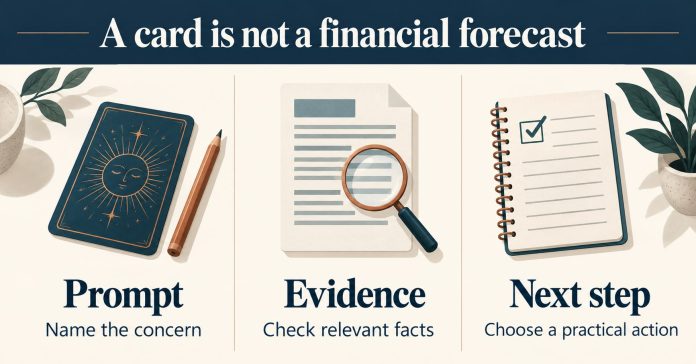
Three-column infographic: Prompt—Name the concern; Evidence—Check relevant facts; Next step—Choose a practical action.

Updated

A tarot reading is not a reliable basis for predicting income, investment returns, an inheritance or a gambling win. If you enjoy tarot, use its images to explore a question or feeling. Then evaluate any financial decision using relevant information that exists independently of the cards.

Correction: An earlier version said tarot could create wealth, identify high-earning investments and predict windfalls. It also speculated about the private fulfillment of deceased public figures. Those unsupported claims have been removed.

What a reflective reading can actually involve

You might look at a card and notice that an image of comfort appeals to you, or that a scene of change makes you uneasy. That can be a starting point for writing about what you want. It does not reveal the balance of a future bank account or verify that an offer is safe.

Keep the question personal and open: “What am I hoping this purchase will change?” or “Which part of this decision am I avoiding?” You can ask the same questions without a deck. A reader’s interpretation is a suggestion you may question or decline.

Use three separate notes: prompt, evidence and next step

The graphic’s three columns are an optional note-taking format, not a validated financial method. Their purpose is to stop an interesting interpretation from quietly turning into a factual claim.

Prompt: name the concern

Write the thought the card brought up. For example: “I want more control over my work schedule.” Keep it in your own words rather than treating the card as an instruction.

Evidence: check the relevant facts

For a job offer, this could mean reading the written hours, pay, benefits and conditions, then considering commuting or other costs. Mark unanswered questions clearly. A favorable reading does not fill those gaps.

Next step: choose a practical action

You might request the written terms, ask a question, compare another option or arrange qualified advice. Asking for information is a different action from committing money or accepting an offer.

Illustrative example: A card makes a new project feel exciting. Your note can say, “I am interested in trying this.” Before paying for it, check the actual price, what is included and whether the commitment suits your situation. Excitement is relevant to your preferences; it is not evidence of future profit.

Investment questions belong outside the reading

The U.S. Securities and Exchange Commission’s Investor.gov guide to questions before investing recommends checking the seller, understanding the investment and examining risk. It warns about pitches offering high returns with little or no risk. A card name, lucky date or reader’s confidence does not replace those checks.

Read the relevant disclosures and ask for explanations you understand. For investment advice, check the professional’s registration and background through the appropriate regulator. Investor.gov provides U.S. resources; elsewhere, use your country’s securities regulator. Registration does not guarantee an investment’s success.

Decide what the reading itself is worth to you

If you choose a paid session, treat its fee as spending on an optional service. Ask about the rate, minimum charge, taxes, recurring payments and any extra services before starting. Set a maximum you are comfortable spending without relying on a hoped-for windfall to cover it.

For example, an advertised rate of $3 per minute for 20 minutes totals $60 before any additional charges. That arithmetic tells you more about the session’s immediate financial effect than a promise that the reading will “pay for itself.” The numbers are illustrative, not a quote from a provider.

When to stop and reassess

A reading should not require you to buy spells, amulets or further sessions to unlock money. If the conversation becomes a promise of financial rescue, our guide to money-psychic promises, costs and practical help explains what to examine.

Keep decisions open until you have the information you need. Tarot can remain part of a personal reflective practice without being given authority over investments, essential spending or another person’s financial choices.