


The Psychic Gift That Reveals Truth
Sometimes, when people think about psychic gifts, they think about future telling and ask things like, “Will I get the job I want?” or “Is my ex coming back?” But another kind of psychic ability that is just as powerful as others is postcognition. This is a gift that doesn’t tell the future, but it reveals truth.
This is the ability to get information about the past without being told about it. This is the kind of reading that people get, and they respond with, “How did you know about that?” It isn’t suspicious, but excitement.
Postcognition is impactful for clients because they often have confusion about their past, such as:
- A family secret that no one talks about.
- A breakup that never had closure.
- Something that is revealed that you thought you were imagining.
- A childhood wound that still shapes the choices of love.
Precognition doesn’t just provide facts; it also validates events that have already happened. In some readings, future predictions can feel exciting, but postcognition brings healing because it helps the past to make more sense.
Understanding Postcognition
Postcognition is one of those psychic terms that sounds complicated until you hear what it really means. It’s basically the ability to pick up information about something that has already happened, even if nobody told you, and even if you didn’t witness it yourself.
Instead of using physical proof or being “filled in,” the information comes through intuitive perception. A lot of people describe it as feeling the past the way you’d feel a mood in a room. You’re not seeing a perfect replay; you’re sensing what still carries energy.
A Simple Way to Describe It
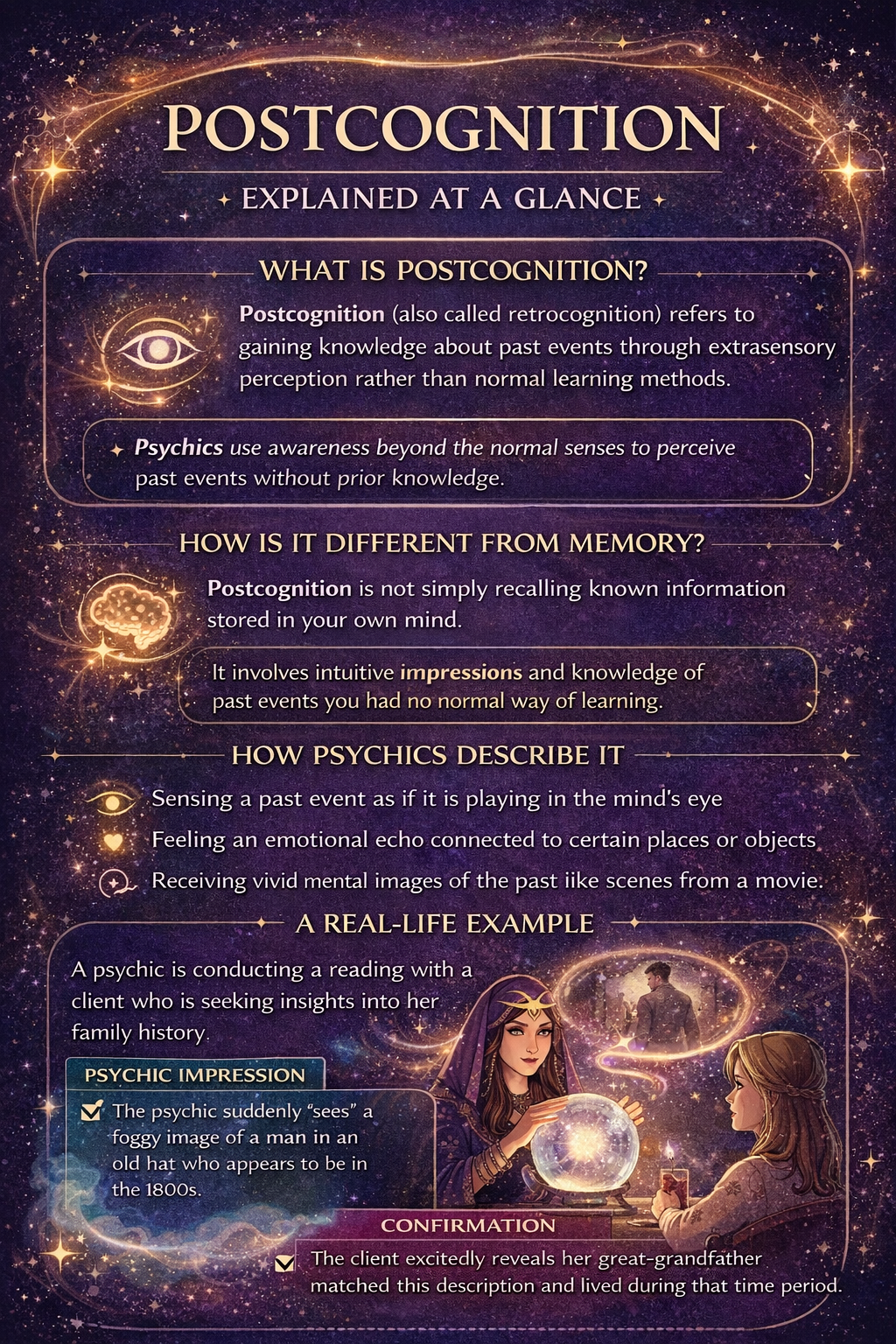
Postcognition means receiving impressions about past events through psychic awareness, not through evidence, conversation, or research.
It can show up as:
- Quick mental images, like a flash of a scene or a moment
- Emotions that hit out of nowhere, like sadness, fear, anger, or heaviness that doesn’t match the present.
- Body sensations, like pressure in the chest, nausea, chills, or a tight throat
- Words or names, like an internal phrase that feels “dropped in.”
- Symbols first, then meaning later, where something abstract eventually connects to a real situation.
A simple way to picture it is this: postcognition is like catching the energetic echo of what happened before.
Post, Pre, and Retrocognition
These terms get mixed up constantly, so here’s the clean version.
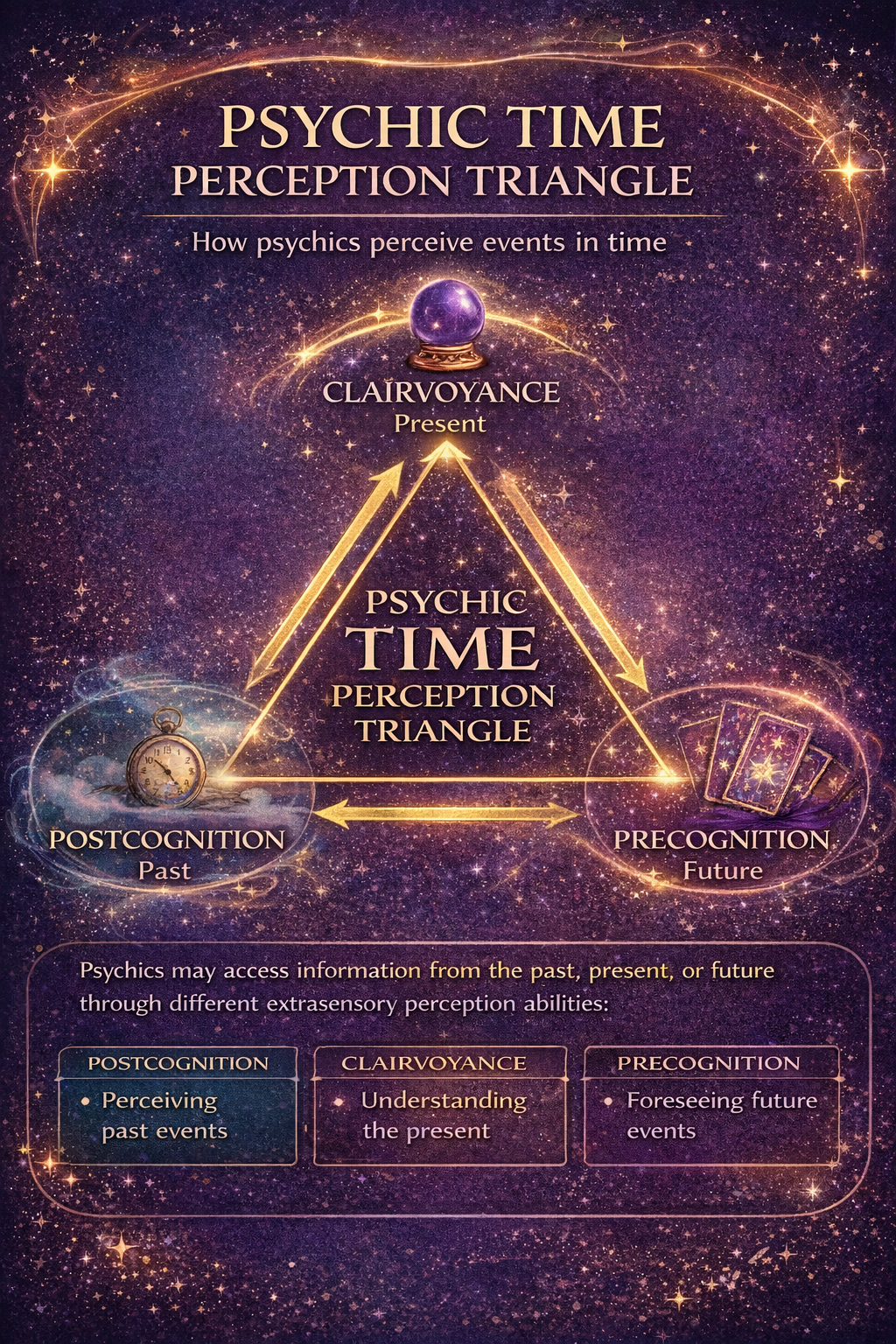
- Postcognition is sensing the past.
- Precognition is sensing the future, before it happens.
- Retrocognition is often used as another word for postcognition, depending on the tradition.
The biggest difference is how it actually feels and not what it is.
Precognition often feels like probability. It carries a “this could happen” quality. Postcognition tends to feel heavier, like memory. There’s more weight to it, because it’s tied to something lived, not something still forming.
Why the Past is Sometimes Harder to Read
Most people assume the past should be easier to pick up because it’s already happened. But in intuitive work, the past is often messier.
The future is always moving, but the past is stuck. Past layers can distort the things that you are feeling, such as:
- Trauma and survival responses.
- Shame, secrecy, or denial.
- Conflicting memories.
- Emotional “rewrites” people created just to cope.
So, when someone is reading the past, they’re not only sensing what happened, they’re also sensing:
- How it was experienced.
- How it was hidden or avoided.
- How does it still affect the person now?
That’s why postcognition isn’t just paranormal trivia. When it’s done ethically, it can feel like emotional archaeology, where it is gently uncovering what’s still living under the surface.
Psychics and Postcognition
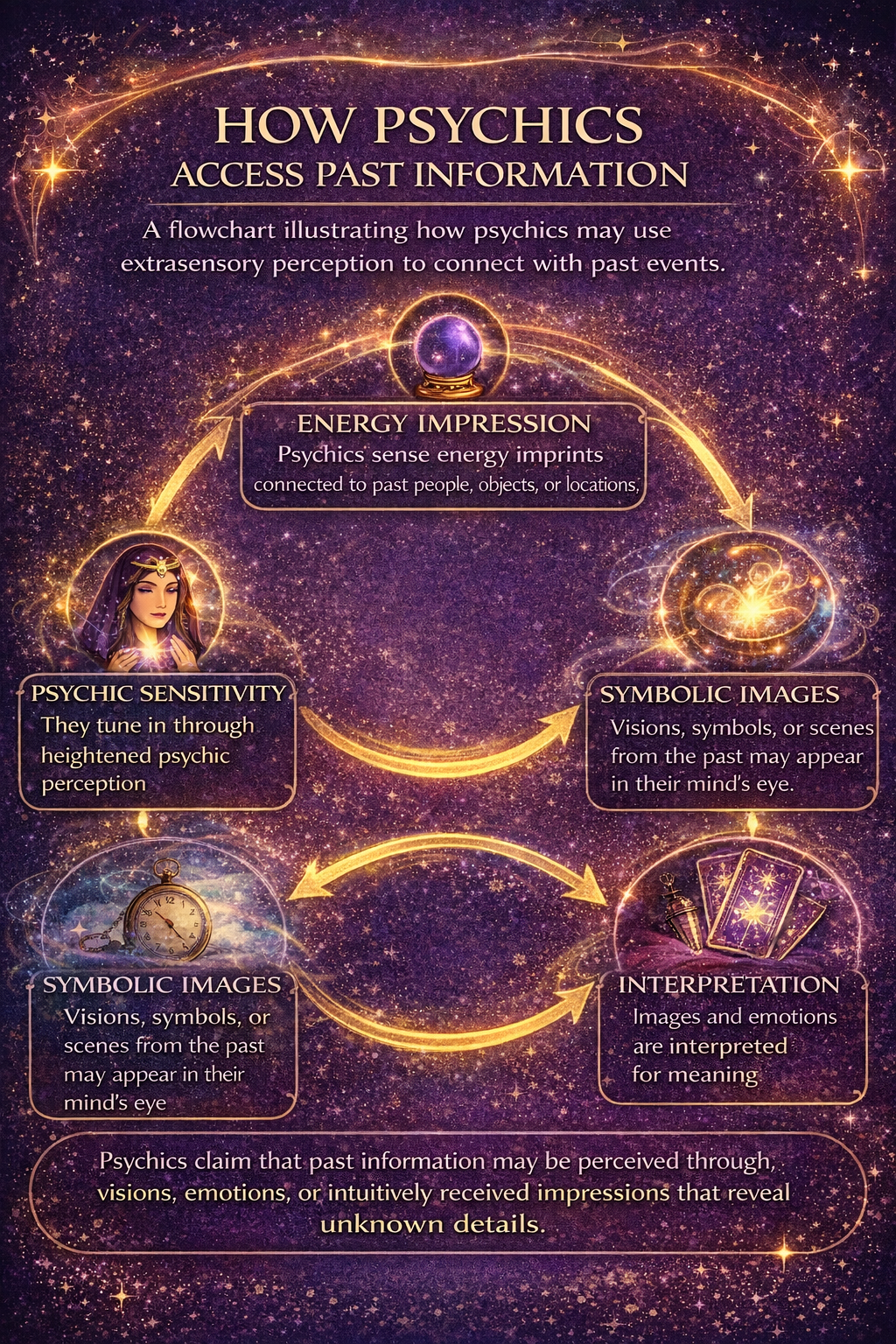
A helpful way to think about it is this: the past leaves traces.
You know how you can walk into a room after tension and feel it immediately, even if nobody says a word? Psychics believe intense experiences can leave that same kind of imprint behind.
So postcognition isn’t like being a human security camera. It’s more like being sensitive enough to read what still has emotional charge.
Emotional Fingerprints and Energy Records
Many psychics describe it as reading an energetic record. The basic logic is:
- Emotions carry energy.
- Big moments create a charge.
- That charge leaves residue.
- Sensitive people can perceive that residue.
This is why postcognition often comes through most clearly around events that had strong emotion, such as grief, betrayal, fear, deep love, trauma, or even intense joy.
Big emotions are loud. They leave a signature. And postcognition, in that sense, is reading the emotional fingerprint an event left behind.
Locations Hold Energy
Chances are that you’ve experienced this thing without thinking you’re psychic. Maybe you rent a new apartment, and it feels creepy or cozy for no reason. A childhood home might feel heavy even though it looks beautiful. Some places feel like they have picked up story after story.
Precognition can activate strongly in certain places because things like:
- Some homes collect energy, such as hallways, bedrooms, and kitchens.
- Grief can stay in a home long after a person dies.
- Conflict can repeat in the same environment.
- Spaces hold on to patterns that repeat.
This isn’t just a spiritual thing but also a psychological thing. Environments can help to trigger memories and emotions.
According to the American Psychological Association, there are scientific ideas on how memory and emotion are linked in perception.
Akashic Framework
There are some psychics who talk about postcognition in terms of the Akashic Records. These are a spiritual idea that every bit of information or experience in the universe is held in records.
If you take this literally or symbolically, the Akashic framework gives postcognition a certain structure, such as:
- Insight is accessible when there are intuitive or altered states.
- Emotional truth is always stored.
- The life you live creates a record that never goes away.
Not every psychic uses Akashic records, but some do, and this is why postcognition can feel like the information was accessed instead of guessed.
How Postcognition Shows Up
Different psychics will use postcognition differently through their different psychic gifts. This is important to know because people often think that postcognition looks like the movies, and sometimes this is true, but other times it isn’t.
Clairsentience Postcognition
This is the most common way that postcognition shows up, and this is feelings from the past. It can be seen as:
- Feeling sad when it doesn’t match the moment.
- Feeling pressure in the throat or chest area.
- Feeling sick or heavy.
- Feeling that someone was crying in the place you are.
- Sensing fear, betrayal, or secrets.
A psychic might tell you that they feel grief that was there around 2010, before they ever knew what happened. This is why clairsentient psychics can become exhausted if they don’t create strong boundaries. They aren’t just sensing the things around them but feeling them.
Clairvoyant Precognition
This can often show up as seeing the past and can come in visions or images, such as:
- Symbols.
- Flashes of scenes.
- Shapes or colors that are able to have meaning.
Clairvoyant postcognition is usually symbolic first, and then it becomes literal. So, if a psychic sees water, it might be referring to something like:
- Tears.
- A trip to the beach.
- Strong emotions.
- Breaking down in the shower.
- A place close to a river, lake, or ocean.
Clairaudient Precognition
This can be information that comes from hearing the past, such as:
- Hearing a name.
- Hearing a phrase.
- Hearing a partial sentence.
- Hearing a sound.
This doesn’t feel like an external voice to them, but it can feel like a thought that comes when there is some kind of certainty. It can come into their mind fully formed.
Psychometry
Psychometry is one of the most well-known forms of postcognition and can come through objects and past events. This is when a psychic reads the energy by holding something like:
- Clothing.
- Keys.
- Heirlooms.
- Letters.
- Jewelry.
The objects usually have strong emotional energy because they have been held or touched often, worn when meaningful events were happening, connected to strong relationships, or were present when trauma or love happened.
Objects can act as strong memory triggers according to science, but psychics claim that the objects go beyond memories and can hold energetic information as well. Britannica shows us how memory connects to cues and emotional recall.
What Psychics Can Learn from the Past
Postcognition can feel accurate, but it isn’t perfect. A good psychic will explain this because it is important that they are honest to build trust. Since the past can be harder to read than the future, when psychics read it, they are often reading the energetic truth, the symbolic truth, and not something just handed to them in a script.
What Postcognition Does
Postcognition can help people to be able to pick up emotional environments, and psychics often sense things like:
- Betrayal.
- Grief.
- Fear.
- Devotion.
- Emotional shifts.
- Shame.
Even without having the exact details, they can describe what things felt like, and sometimes this is the exact thing that happened.
When there are things like hidden motives and dynamics that were never spoken, postcognition can show up as:
- Someone who wasn’t being honest.
- Someone who was only protecting themselves.
- Someone who was being pressured by their family.
- Someone who felt manipulated.
- Someone who felt trapped.
- The story that was told wasn’t the real story.
Other things a psychic might pick up are:
- A before-and-after moment.
- A secret that is being learned about.
- A sudden decision.
- A sudden disappearance.
- A change or break in a relationship.
- A big argument.
This is why postcognition can be healing. It sometimes validates what people were feeling, but it couldn’t prove to be true.
What Post Cognition Doesn’t Do
An ethical psychic will avoid claiming to say the facts or to be certain about things like exact dates. They might feel that something happened in a certain season, but an exact calendar date isn’t very common. They also might not get full names and addresses but instead might get things like:
- A similar-sounding name.
- Syllables.
- Symbolic substitute names.
- Initials.
They also won’t get a medical diagnosis, and postcognition readings should never replace medical advice, legal advice, or other professional advice. Psychics should never say that they can produce proof for a courtroom. Postcognition can show the truth, but it isn’t and should never be used as a surveillance tool. This is why postcognitive readings should focus on meaning and clarity and not claims.
Why Postcognition Isn’t Always Clear
The past isn’t just what happened, but it’s what people remember, protect, suppress, and rewrite. A psychic reading of the past might pick up things like:
- The event that happened.
- The emotional reactions to the event.
- The story someone told themselves after something happened.
- The story that other people wanted to be told.
- The secret that no one said out loud.
This is layer after layer of distortion that the psychic can pick up.
Emotional Distortion
Some memories that come are louder than others. A small event or something that was extremely painful can be read as a bigger event that someone else might have felt numb about.
A psychic might feel grief and assume that it’s linked to something bigger, but it can be linked to other things, like:
- Miscarriage that wasn’t talked about.
- A betrayal that happened in private.
- A hidden heartbreak.
- Rejection is when someone never admits to hurting them.
Intensity doesn’t always match what happened.
Ego Distortion
If someone believes that a past story is true, even if it isn’t, their belief can have a strong impression. This is why psychics sometimes pick up things like:
- What the person said happened.
- Before they pick up what really happened.
A good psychic has to have the skill to be able to know the difference between the two. The story might be different than the truth.
Understanding the Truth Layers Model
One helpful way to understand postcognition is to realize that every experience has more than one level of truth.
There’s what people show on the surface, and then there’s what actually happened emotionally and energetically underneath.
You can think of it in layers:
- On the outside is surface truth: what was said publicly, what people admitted, and the story everyone heard.
- Under that is emotional truth: what people really felt but didn’t always express.
- Then there’s energetic truth: what was actually going on beneath behavior, like tension, dishonesty, fear, or unspoken conflict.
- There’s soul truth: what the experience meant, how it changed someone, and why it became a turning point in their life.
Postcognition tends to pick up the emotional, energetic, and soul layers most clearly. And honestly, those are usually the ones that matter most anyway.
Postcognition in Psychic Readings
People rarely ask about the past just to satisfy curiosity. They ask because something still hurts. Or something still doesn’t make sense. Postcognitive insight helps because it brings clarity where confusion lived for too long.
It often helps people:
- Trust the feelings they kept doubting.
- Stop blaming themselves for things that weren’t their fault.
- Understand repeating emotional patterns.
- Release guilt or shame that never belonged to them.
- Find peace without needing the other person to finally admit the truth.
This is why many clients say the postcognition part of a reading is the moment that makes them cry. Not because it’s scary. Because it finally makes sense. And clarity is incredibly healing.
Postcognition and Real-Life Examples
Postcognition usually isn’t dramatic like movies make it seem. It’s quieter, specific, and deeply personal, like someone gently reading the emotional story you’ve been carrying.
Here are a few real-world ways it commonly shows up.
Example One: Why the Relationship Ended
A client might come in asking, “Will my ex come back?” But instead of jumping into prediction, the psychic starts sensing the past.
They might say something like: “I’m feeling repeated late-night arguments. This wasn’t just about love fading. One person kept avoiding hard conversations. There was outside influence too, not necessarily cheating, but someone interfering. Family pressure or a friend who didn’t support the relationship.” The client goes still.
Because yes, there was someone who constantly criticized the relationship. Yes, family opinions played a role. And yes, their ex avoided emotional accountability.
Postcognition often picks up things like:
- The emotional pattern kept repeating.
- The moment everything shifted.
- The hidden fear driving the breakup.
And suddenly the confusion lifts. Sometimes the healing isn’t hearing “they’ll come back.”
It’s realizing, “I wasn’t imagining the problems.”
Example Two: When the Space Feels Heavy
A client might say, “This house makes me anxious, but nothing bad happened to me here.”
A psychic reads the energy of the space and responds: “This sadness doesn’t feel like yours. It feels like someone here carried grief quietly. The energy feels strongest in one room.”
Later, the client learns the previous owner lost someone close, stayed isolated, or spent long illness periods in that space.
When postcognition reads places, it often shows up as:
- Emotional heaviness in certain rooms.
- Feeling crowded even when alone.
- Repeating tension sensations.
- Grief that feels stuck.
This doesn’t mean the house is haunted. It usually just means the emotional energy was never cleared. And a good psychic reframes it gently: “This space needs renewal, not fear.”
Example Three: Memories in Objects
This is one of postcognition’s classic expressions. A client hands over a ring and says,
“This belonged to my grandmother.”
The psychic holds it and says, “I feel responsibility. She protected everyone. I’m seeing a kitchen, music playing, and sadness around a man. Like she carried grief quietly.”
The client tears up because:
- She spent most of her time working in the kitchen.
- She would play music while cooking.
- She lost her husband young but didn’t talk much about it.
Objects often carry strong impressions because they were present during:
- Everyday life.
- Loss.
- Love.
- Big emotional moments and times.
The psychic may not catch every literal detail, but they often hit the emotional truth with incredible accuracy. And that emotional truth is what heals.
Example Four: Childhood Roots and Adulthood
This is where postcognition becomes deeply life-changing. A client might ask about dating struggles or career burnout, and the psychic suddenly says, “I’m sensing you had to grow up emotionally very young. You became the responsible one early. You learned to read moods, stay quiet, and keep the peace.”
The client never mentioned childhood. But suddenly everything clicks:
- Why do they attract emotionally unavailable partners?
- Why do they struggle asking for needs?
- Why does rest make them feel guilty?
- Why did they become hyper-independent?
Postcognition often uncovers emotional patterns like:
- Being the peacekeeper child.
- Carrying adult responsibility too soon.
- Emotional neglect.
- Always being “the strong one.”
And the message becomes empowering that “You’re not broken. You adapted to survive. Now you get to choose differently.” That’s the magic of postcognition. It doesn’t just reveal the past. It connects the dots so healing can finally begin.
Is Postcognition Real?
If you’re reading this article and you wonder how this is possible, know that having good skepticism doesn’t stop you from having intuition. The best kind of psychic work asks people to be open-minded and not gullible, curious and not naïve.
Postcognition can be looked at in the form of science without trying to make it look like a magic trick.
Two Layer Explanation
One way to look at postcognition is in two layers:
- Psychology and perception: what the mind can really do.
- Extrasensory perception is what the mind might be able to do without limits.
Some people think that it has to be either fully mystical or fully scientific to be real, but sometimes it is both.
Psychology and Postcognition
Humans are very perceptive and pick up on information before even realizing it, such as:
- Micro-expressions, such as tiny facial movements.
- Voice changes, such as tone shifts.
- Nervous movements such as avoidance signals.
- Word choices where someone chooses truth or deflection.
- Body tension, such as stress in certain areas.
A good psychic reader might be able to pick up on these cues where other people might miss the signals entirely.
Memory as Reconstruction
Science also shows the fact that memory is reconstructive. People don’t just recall the past like replaying a video in their mind, but they rebuild it from their emotions, meaning, and beliefs.
When a psychic picks up information and there is emotional truth, it can feel more real than having actual details. This happens because emotionally, that is what the client feels and believes. The American Psychological Association talks about cognition and how the mind stores and processes experiences.
Why Postcognition Can Feel Accurate
Postcognition can have details about specific things that psychology cannot even explain. This is why some believers say that it wasn’t body language, and they didn’t reveal any details, and the psychic still knew.
This can be explained by:
- Strong intuitive perception beyond conscious reasoning.
- Unconscious inference at a level that the client isn’t able to track.
- Real ESP.
Science hasn’t proven ESP to be real, and it isn’t universally accepted, but there has been ongoing parapsychological research that has explored perception. The Rhine Research Center is one of the well-known organizations that have been studying parapsychology.
Is It Real?
The truth is that this isn’t the best question to ask, but instead, you should ask things like:
- Did it bring healing?
- Did it give you clarity?
- Did it validate the truth that you knew?
- Did it help you to make better choices in your life?
The purpose of postcognition isn’t about entertainment but about getting insight, and when it’s done ethically, it can help people to:
- Make peace with their past.
- To understand why they keep feeling stuck.
- To stop doubting what they believe.
- To understand their emotional burdens and to release them.
- To move forward without needing everyone else around them to agree.
You can call this intuition, ESP, spiritual perception, or psychology, but what matters is the transformation that this can give.
Developing Your Postcognition
One of the most comforting things about postcognition is that it isn’t reserved for a tiny group of “chosen” psychics. Many people can strengthen it over time, especially those who already feel deeply, dream vividly, or notice intuitive flashes in daily life.
The key is learning it the right way. Developing postcognition without grounding is a bit like opening every window in your house during a storm. Yes, you’ll feel more energy, but you’ll also feel overwhelmed, scattered, and exhausted.
The goal isn’t to become more open. The goal is to become more stable, clear, and protected. When your system feels safe, intuition becomes sharper instead of heavier.
Being Grounded
Grounding is what separates clear, intuitive awareness from emotional overload. People who skip grounding often confuse anxiety with psychic impressions and end up feeling drained instead of empowered.
Simple grounding practices that work beautifully for postcognition include slow walking (especially outside), breathing while placing awareness in your feet, imagining roots gently connecting you to the earth, or even holding something solid and heavy like a mug, a book, or a stone.
When your body feels anchored, intuitive impressions become quieter, cleaner, and easier to understand.
If you practice while anxious, everything gets noisy. Anxiety has a way of pretending it’s intuition, and it’s very convincing.
Curiosity Over Force
Postcognition responds best to a relaxed mind. When you strain for answers, your imagination fills the gaps. When you allow impressions, real information tends to appear naturally.
A helpful mindset is simply: “I’m curious, not desperate.” Curiosity keeps your perception open and neutral. Desperation creates emotional bias. And intuition loves neutrality.
Journalling Impressions
One of the most effective ways psychics strengthen postcognition is through simple journaling practice.
Choose a small object like a photo, key, ring, or letter. Hold it lightly and ask yourself, “What’s the emotional story here?” Then write the first few impressions that come — without judging or analyzing.
These impressions might show up as feelings, physical sensations, images, words, colors, or symbols. The goal isn’t to be perfect. The goal is to notice subtle signals before the logical mind jumps in. With time, clarity improves naturally.
The Difference Between Anxiety and Intuition
This part changes everything. A true intuitive impression usually feels calm, simple, clear, and sudden, like information quietly dropping in.
Anxiety feels urgent, dramatic, repetitive, and loud. It loops. It pressures. It tries to convince you that something is wrong.
If the feeling is frantic, it’s usually nervous-system noise, not postcognition. Calm is the language of intuition.
Setting Boundaries
Postcognition is meant to gather information and not carry emotional weight.
Before practicing, imagine a gentle light around your body and silently say, “I observe without absorbing.” Visualize impressions arriving like subtitles on a screen rather than crashing waves.
This might sound simple, but it’s incredibly effective. Where attention goes, experience follows.
Beginner Exercise
Once or twice a week is plenty. Sit quietly for a few minutes and choose a photo of a place (not a person). Ask, “What’s the emotional atmosphere here?” Notice only three impressions, then stop and ground yourself afterward. This builds confidence without overwhelming your system.
Ethics and Boundaries of Postcognition
Spiritual maturity plays a big role in postcognition, and ethical psychics have to follow rules so that they don’t intrude.
Why Consent Matters
A respectful reader will not:
- Do a reading on someone who didn’t agree to it.
- Spy on people just for entertainment.
- Dig up private trauma without being asked.
- Turn the past into gossip.
Postcognition should only be used for clarity, healing, and empowerment, and not for control.
Why Privacy Matters
When getting a reading, not everything has to be revealed. When a psychic senses something but it shouldn’t be said, a good psychic will:
- Speak in a gentle way.
- Ask permission to go deeper into something.
- Give the message in a supportive way.
- Avoid fear-based language.
The goal is growth and not shock.
Myths About Postcognition
Postcognition can be misunderstood because people imagine that it works as the movies show it. The truth is, postcognition is quiet and subtle and more human than the movies show. Here are some common myths about postcognition:
Myth One: Postcognition is Mind Reading at Its Best
Postcognition isn’t telepathy. It doesn’t involve pulling thoughts out of someone’s head or replaying their memories like a video file.
What usually comes through are emotional impressions connected to past experiences. A psychic may sense the mood of a situation, the pain that wasn’t spoken about, or the energy that still feels unresolved.
Sometimes they pick up on what was avoided, hidden, or left unfinished. But it’s not a constant stream of private thoughts. This is good because reading someone’s thoughts would be overwhelming to everyone in the room.
Myth 2: Precognition Shows Everything Exactly from the Past
Intuitive impressions are often symbolic before they’re literal. For example, seeing an image like shattered glass might reflect emotional heartbreak, a sudden argument, a broken promise, or even a real object connected to that moment.
The message usually carries meaning first and details second. Postcognition isn’t a security camera replay. It’s more like emotional memory translated into symbols that need gentle interpretation.
Myth 3: If a Psychic Gifts an Accurate Postcognitive Reading, Then They Are Never Wrong
Even highly intuitive people can misread aspects of what they sense. Sometimes they might mix up things like:
- Symbols.
- Meaning.
- Names.
- Specific details.
- Timelines.
Energy can overlap, and emotional memories might blend together. A psychic that is grounded knows this and will tell clients to ask for clarification instead of pretending that everything they say is right.
Myth 4: Only People with Special Gifts Receive It
Postcognition isn’t limited to a small group of born psychics. It often develops naturally in people who are emotionally aware, sensitive to atmosphere, intuitive with relationships, or curious about inner perception.
Practice helps, but so do boundaries and grounding. Like many intuitive skills, it’s less about rare talent and more about awareness combined with emotional regulation.
Myth 5: Postcognition Only Works in the Spiritual World
This surprises a lot of people. Even those who don’t believe in psychic abilities experience postcognitive-style moments.
You might notice it when:
- You walk into a room, and it feels heavy for no reason.
- You remember details that you never learned.
- You sense something important happened in the area.
- You hold an old object and feel emotions.
Some people call it intuition. Some call it sensitivity. Some just say, “The vibes were strong.” The words are different, but the experience is the same.
Real Precognition
Postcognition isn’t about spying on the past. It’s about tuning into emotional memory that still carries energy. It works through feeling, symbolism, and awareness rather than literal replay.
And most importantly, it’s far more common than people realize.
Getting the Best Postcognitive Reading
If you want to have a reading that can give you strong postcognition information, the way that you ask the question matters more than most people realize.
Asking the Right Questions
Instead of asking, “Is he going to come back?” ask, “What happened in the relationship that I’m not clearly seeing?” or “What were the hidden patterns between us?” Postcognition works best when you ask for clarity and not for predictions.
Meaning Over Drama
One postcognition question to ask is, “What should I understand about this past event?” This allows the psychic to read things like:
- Healing truth.
- Pattern truth.
- Emotional truth.
This lets the reading go from gossip to growth.
Don’t Give Too Much Information
One mistake people make when getting a reading is oversharing. If you want to have real postcognition, give little context at first, let the psychic speak, and then confirm if it matches or not. This allows the reading to stay clean and doesn’t encourage leading.
Confirm the Information without Leading
One thing that a client can do is to have neutral confirmation. The psychic might say, “I feel a big change after a trip,” and the client should respond with, “Yes, that’s accurate,” instead of saying, “Yes, in April we went to New York, and then we fought because his friend Tonya…”
Details can be important, but it’s important to give them after the prediction has already come through.
Ask for Anchors but Also Flexibility
If you want to have good clarity, ask questions such as:
- Did this happen around a move or a job change?
- Does this feel that it was recent or from the past?
- Does this connect to a relationship or to my family dynamics?
A good psychic will often be able to narrow down in terms of chapters that have happened in your life but not give you exact dates or times.
Getting Ready for Answers
Postcognition can give you the truth even if it’s uncomfortable, such as:
- You weren’t crazy; you were able to pick up on the truth.
- The betrayal was more than physical and emotional.
- They loved you, but they weren’t emotionally capable of being with you.
This information isn’t meant to punish you but to free you.
Final Thoughts: The Past Leaves a Mark
Postcognition is a psychic gift that is often underrated because it doesn’t give you a wow factor or show you flashy future visions, but it gives you truth that is healing. It helps you to answer questions such as, “Was I just imagining things?” or “Why do these things still hurt?”
When an ethical psychic uses postcognition, the goal isn’t to expose or shame someone or their past, but to give clarity because clarity brings peace. What makes postcognition so powerful is that it can validate what you were already feeling, and it can change your life for the better. The magic isn’t about fortune-telling but truth-telling.