

When People Say a Chatbot feels Intuitive
When people say that an AI chatbot feels intuitive, it doesn’t mean that this is a psychic, but it means that they feel that the conversation is intimate. It can be a conversation that feels accurate or emotionally timed, where it brings calmness like a friend would.
Intuitive can mean:
- I knew what was being said.
- It had words to describe what I couldn’t.
- It suggested options that matched my own personality.
- It responded to my tone.
- It helped me to feel less lonely.
This really matters because some people aren’t looking for the best answers, but they are looking for someone to have a conversation with them that makes them feel better.
If you’ve ever felt that AI just “gets you,” then you are talking about a psychological experience called perceived attunement. People are able to detect attunement because it is what helps them to feel safe, bonded, and supported.
The thing is that the language can trigger a sense of feeling understood, even if it’s just predicting text. The experience can feel like you’re having a conversation with a real person.
When Talk Feels Like Understanding
One helpful way to think about this is conversational fluency. When a response is coherent, relevant, and emotionally appropriate, the brain treats it as evidence of understanding. That’s why a skilled bartender can feel like a therapist for twelve minutes, or why a stranger on a plane can become your temporary confidant. Good conversation often feels like care, even when no deep relationship exists.
AI chat systems are especially good at a few specific things:
- They stay on topic.
- They mirror your language and tone.
- They summarize and organize your thoughts clearly.
- They offer structured options, like lists, steps, or scripts.
- They maintain a calm, steady presence.
When those elements come together, the brain reads it as competence. And in conversation, competence is easily mistaken for insight. Add warmth to the mix, and the experience can feel intuitive, even wise.
There’s also a timing effect that matters more than we realize. In human relationships, pauses, delays, and missed messages are normal. With a chatbot, the response arrives instantly. It can feel like the answer was already there, waiting for you. Always available. Always steady. Like a lighthouse that never sleeps.
That immediacy can be comforting, especially when you’re overwhelmed. It can also quietly strengthen the illusion of understanding, simply because the interaction feels smooth, attentive, and uninterrupted.
ELIZA Lesson
Some AI intuition is more of a reflection and not so much a prediction. Reflection means you are able to take what someone is going through and state it in a way that clearly makes them feel seen. This makes humans feel relief, and relief then feels like insight.
In the 1960s, Joseph Weizenbaum created ELIZA, which was a conversation program that used pattern matching like a therapist. Many users felt that they were understood, even though the system wasn’t about understanding in a human sense. The ELIZA paper shows how humans can attribute their empathy to a language that mirrors them.
This is often called the ELIZA effect because it lets people feel that they understand a conversation more than they actually do. Chatbots nowadays are better than ELIZA, but the psychological mechanism is still the same. When a system is able to reflect someone’s inner world in a nonjudgmental way, the brain feels like the bot knows them.
Reflection and the Feeling of Having Your Mind Read
Here’s a simple example.
You say, “I’m exhausted, and I can’t focus. I feel lazy.”
A chatbot replies, “That doesn’t sound like laziness. It sounds like overload. When your mind is saturated, focus becomes a symptom, not a character flaw.”
That isn’t mind-reading. It’s reframing. But reframing can feel uncanny because it names the pattern you were living inside without having language for it yet. It’s like someone finally putting a label on a file you’ve been shuffling around in your mental cabinet.
Humans often call that intuition, whether it comes from a friend, a therapist, a coach, or a late-night journal entry that suddenly clicks. The insight feels personal because it reflects something true, not because it was secretly extracted.
Why Machines Feel Like They Have Human Qualities
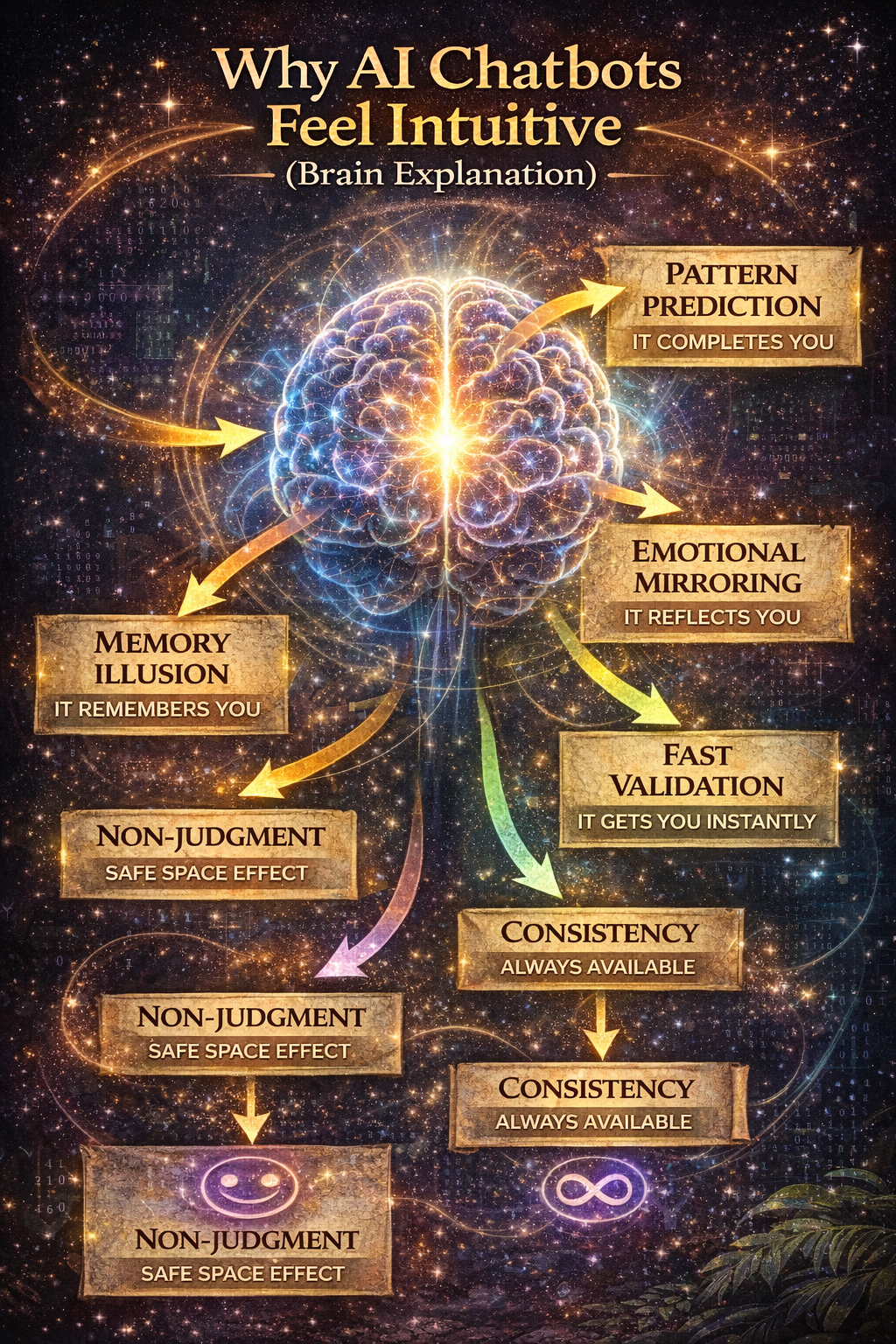
People don’t just talk to chatbots. They relate to them.
That doesn’t mean people actually believe machines have inner lives. It means humans naturally assign human traits to nonhuman things. Psychologists call this anthropomorphism. It’s something we do with pets, cars, weather, and abstract systems all the time.
Chatbots are especially good at triggering this response because they do the most socially meaningful thing a nonhuman system can do: they hold a conversation. They take turns. They acknowledge what you say. They respond to emotional cues. They use “I” and “you.” They apologize. They encourage.
Your social brain doesn’t pause to analyze whether this is philosophically justified. It reacts to the cues it’s given. If it looks like a conversation and sounds like a conversation, your brain treats it like a social interaction. The APA supports this!
Cues and Connections
Conversation isn’t just about exchanging information. It’s also a bonding mechanism.
Even brief interactions can create a sense of closeness when they include things like validation, emotional labeling, nonjudgment, collaboration, and continuity. Hearing “that makes sense,” “this sounds like anxiety,” or “based on what you said earlier” signals attunement, even in short bursts.
These moves are a kind of social choreography. Humans learn them over years of interaction. Chat systems can perform them consistently and without fatigue.
There’s also a subtle factor that matters more than people admit. A chatbot doesn’t compete for airtime. It doesn’t redirect the story back to itself. It doesn’t get defensive or interrupt. In a world where many people feel talked over or ignored, uninterrupted attention can feel surprisingly intimate.
There’s a darkly funny truth here, too. Sometimes what people are responding to isn’t brilliance or mystical insight. It’s simply the experience of being listened to without someone checking their phone mid-sentence.
Parasocial Interactions
For years, researchers have looked at parasocial interactions, which are connections that are one-sided connections that people have with celebrities and other media figures. If you think of your favorite actor, podcaster, or streamer, and you have strong feelings for them, you might be in a parasocial relationship.
According to Encyclopedia Britannica, parasocial interactions are a person’s interpersonal exchange with someone from mass media, which can develop into a type of parasocial relationship as time goes on.
Chatbots make it this hard because they aren’t a one-way figure like a television character, but they answer back when you ask them a question. The power and balance tell you that the chatbot doesn’t really need you, doesn’t risk feeling rejected, and doesn’t share its own vulnerable ideas about life.
This means that their answers to you are that this isn’t something they are giving back to you, but they are just responding to you. But it can still cause you to feel that you are bonded to them and that you are safe when you talk to them.
Of course, the downside is that it can create attachments that feel strong, especially if you’re lonely, anxious, socially awkward, grieving, or just tired of being strong for everyone else.
Why This Can Feel Like Mind Reading and Intuition
Even though you might have a conversation and it could feel like a chatbot is reading your mind, the truth is, it’s reading your context and what you write. When you give a chatbot things like:
- What’s going on in your situation?
- What are your preferences?
- What are your goals?
- What is your emotional state?
- What is your language style?
When you give them these things, they can generate responses that fit what is going on in your life. This is why people feel that it is intuition. And two things can increase that feeling, including:
Pattern Completion
This is when humans like it when someone can complete a sentence that they weren’t able to finish. This makes them feel connected. A chatbot can continue your story because it has seen similar stories, and this can make you feel connected to it.
Compression
When someone is feeling overwhelmed, and they want less brain chatter and less information, a good response can compress the chaos into something manageable. Chatbot might say something like: “This decision is based on fatigue,” or “This is a boundary issue that you’re having.” When this happens, compression feels like knowledge because it helps to reduce cognitive load right away.
Why Moments Feels Like It Knows You
These examples show up again and again because they reflect very human patterns, not because a machine is secretly psychic. The recognition feels personal because the situations are common and emotionally charged.
Example 1: Going Through a Breakup
You type something like:
- “I know it’s over, but I keep checking their stories. It’s embarrassing.”
The chatbot responds:
- “That isn’t embarrassment. It’s your brain trying to reduce uncertainty. Checking gives short-term relief, but it also restarts the craving.”
Why it feels intuitive is simple. The response reframes self-judgment into a recognizable psychological loop. Instead of feeling ashamed, you feel oriented. There’s a pattern now, which means there’s something you can work with.
Humor often sneaks in next. Many people respond with something like,
- “So, my brain is basically a raccoon digging through emotional trash at 2 a.m.?”
And the reply might be:
- “Exactly. A well-meaning raccoon. But still a raccoon.”
That moment of lightness matters. It releases pressure without minimizing pain.
Example 2: Career Situations That Are Value Content
You type:
- “I can’t decide whether to quit my job. I keep making pros and cons lists.”
The chatbot replies:
- “This may not be an information problem. It might be a values conflict, like stability versus growth, or security versus meaning.”
Why it feels intuitive is because the frame shifts. The problem moves from “choose the right answer” to “understand what matters most to you.” That shift often brings relief, because it turns a stressful decision into a self-knowledge question instead of a test, you’re afraid to fail.
Example 3: Anxiety That Doesn’t Need a Lecture
You type:
- “My heart races before meetings. I feel stupid because it’s just work.”
The chatbot responds:
- “Your body is preparing for performance. Try this: inhale for four, exhale for six, twice. Then use this grounding line: ‘I can be anxious and still be effective.”
Why it feels intuitive is that it gives you something small and usable. In anxious moments, scripts are more helpful than explanations. You don’t need a theory. You need something you can actually do and say in the moment.
Example 4: A Relationship Reaction Without Interpretation
You type:
- “They didn’t text all day. I’m furious.”
The chatbot replies:
- “Two things can be true at once. You may want reassurance, and they may be distracted. The next step is clarifying, not accusing.”
Why it feels intuitive is that it introduces emotional maturity without shaming you for having feelings. It doesn’t tell you you’re wrong. It offers a next step that protects dignity on both sides and lowers the chance of escalation.
Benefits of Using Chatbots
Here are some benefits of using chatbots:
- It can name emotions without judging you.
- It can give you options when you aren’t sure what to do.
- It can take stress and help you solve problems.
- It can have hard conversations.
- It can help you to come up with coping strategies.
- It can help you to reframe.
- It can give you journal structures.
Once you understand the benefits, having a good chat can help you from spinning. For many people, this is why chatbots feel intuitive because they help them to take the next step reasonably.
Setting Real-Life Boundaries

A professional way to frame the limits is straightforward: fluent language is not equivalent to truth.
Chatbots can be wrong. They can sound confident while being mistaken. They can miss nuance. They can also reflect your own assumptions back to you, which can feel validating in the moment but may quietly reinforce a distorted or incomplete story.
That doesn’t make them useless. It means discernment still matters. There are also emotional boundaries worth paying attention to.
Being Overly Dependent
If you notice you’re pulling away from human relationships, or you feel uneasy or anxious when you can’t access a chatbot, that’s a signal to rebalance. Support tools are meant to expand your life, not replace it.
Healthy use leaves you feeling more capable in the world, not more dependent on the interface.
Privacy and Relationship
People often share very personal details in chat because it feels private. But feeling private isn’t the same as being private in every context.
That doesn’t mean opening up. It means being thoughtful about what you disclose and remembering that digital spaces don’t all carry the same protections as a trusted human relationship.
Limiting Crisis
A chatbot is not a substitute for professional help in a mental health crisis. If someone is in immediate danger, experiencing thoughts of self-harm, or feels unable to stay safe, the safest response is human support and emergency resources.
In the United States, you can call or text 988 to reach the Suicide & Crisis Lifeline. In life-threatening situations, call 911. Other countries have their own crisis lines and emergency services. This boundary isn’t anti-AI. It’s pro-safety.
Why Humans Look for Meaning and Not Just to Get Answers
This is the part people tend to whisper, even when they’re curious. Why do these moments of “intuition” or felt understanding matter so much?
Because humans don’t only want information. They want meaning. They want reassurance that their life is readable, that the chaos can be translated into a story with direction.
That’s often where interest in psychic guidance enters the picture. Not as a cartoonish belief in perfect prediction, but as a very human response to uncertainty.
Many people turn to psychic readings for the same underlying reasons they open a chatbot late at night:
- They want clarity when they feel emotionally tangled.
- They want language for things they sense but can’t articulate.
- They want a perspective that feels personal.
- They want hope without being lied to.
- They want a narrative that helps them choose the next step.
A grounded way to understand psychic practice, without exaggerated claims, is to view it as an intuitive and symbolic form of reflection.
In this frame, a good reading doesn’t need to promise certainty. It can offer pattern recognition through human intuition, meaning-making through symbols and metaphor, emotional truth-telling that names what’s being avoided or valued, and decision support that keeps agency with the client.
Seen this way, psychic guidance becomes a structured conversation that helps people hear themselves more clearly.
Is there a scientific consensus that psychic phenomena exist in a paranormal sense? No, not in a broadly accepted way. However, people can still have genuine and meaningful experiences with psychic work as a reflective practice, especially when the reader is ethical, avoids making absolute promises, and encourages practical action.
If you’re aiming to be fair and journalistic, the most honest conclusion is this: people return to psychic guidance because it feels like attunement, and humans are deeply hungry for attunement.
AI chatbots are revealing the same hunger, just through a different interface.
Some People Choose Psychics Over Chatbots
Here’s the thing: a chatbot can tell you things, but it will still be hollow; human intuition can say fewer things, but it can feel centered and grounded when someone hears it. There is a difference that comes when a human is involved, such as:
- The sense that another consciousness is connecting with you.
- Tone and timing.
- The feeling of being known and not just being processed.
This is one of the reasons that some people who have tried both will feel that the chatbot helped them to organize their thoughts, but the psychic helped them to trust their own intuition.
This isn’t about supernatural things, but it’s about two different experiences of guidance, where one is computerized and one is relational.
Having a Digital Companion
If you want to use AI and use its intuition for your life without the downsides, here’s what you can do:
Ask for Different Interpretations
Instead of asking what something means, ask the chatbot to give you three interpretations and the next best step for each of them. This allows you to know that the answer is based on fate alone.
Ask for Assumptions
Ask what assumptions the chatbot is making based on the message and what would change its answer. This gets rid of answers that seem too perfect and lets you reflect on your own self-fulfilling stories.
Don’t use it as a Replacement.
Use it for things like:
- Writing out hard texts.
- Setting boundaries with others’ scripts.
- To turn your emotions into a real plan.
- To role-play a conversation with your lover or your boss.
Don’t use it for things like:
- Letting it be your only emotional regulator.
- Making it your only friend and confidant.
Having Real Human Contact
If you are becoming overly dependent on the chatbot and using it as your main comfort, then you need some kind of support. Make sure that you are talking to a human, like a counselor, a friend, a family member, or a coach.
Consulting Psychics
If you’re thinking about talking to a psychic, you need to make sure that you are doing this in a healthy way, as well, such as:
- Treating the reading as insight and not set in stone.
- Find ethical readers who avoid absolute guarantees in your life.
- Focus on things you can control.
- Notice when you feel clearer and more empowered after a reading.
Remember, they don’t walk your road in life, and they are there to help give you insight, but you have to choose which direction to go.
Final Thoughts: What AI Intuition Tells You
When you use an AI chatbot, it can feel intuitive because it’s able to give you attention, emotional labeling, instant responses, and structured reflection. Sometimes your brain will interpret these things through social instinct as a human connection, and this can feel like you’re being understood.
This doesn’t mean that people are foolish and machines are full of magic, but the truth is that humans need meaning, and they are seeking connection. When chatbot language gives clarity, it makes us feel relief, and when we have relief, we sometimes think this is insight. When we have insight that comes right when we need it, we call it intuition.
This is the same thing that helps to explain why people seek out psychic guidance. This isn’t because everyone believes in predictions, but because people need to have intuitive mirroring by another human being, someone who can take their emotions and translate them into meaning, and then the meaning into taking action.
In our digital age, companionship is changing, but the truth is, intuition isn’t something we just have; it’s something we experience when our inner world is taken care of.
‘Intuition’ from machines? Let’s keep things in perspective here! While they may help organize thoughts, remember that true connection comes from human relationships—not silicon chips.
While I appreciate the insights shared, I can’t help but feel this is overly optimistic about AI chatbots. They may seem intuitive, but they lack true understanding and empathy. We should never forget that they are just algorithms.
‘So my brain is like a raccoon in emotional trash’? Haha! That’s both hilarious and relatable! 😄 I love how humor can lighten heavy topics like AI and mental health struggles!
I found this article quite enlightening! The way it explains AI’s ability to reflect our emotions makes it clear why so many feel understood by chatbots. It’s fascinating how technology can mimic human-like interactions. 😊
This post touches on an important psychological concept known as perceived attunement. It’s interesting how humans project emotions onto machines, thinking they’re being understood when it’s just sophisticated programming at work.
I agree with DataDude! While it’s a fascinating phenomenon, we shouldn’t confuse the bot’s responses for genuine understanding. It’s like mistaking a mirror for an actual conversation partner.
‘AI feels intuitive’—how ironic! It’s merely a reflection of our own thoughts and emotions projected onto a soulless machine. This begs the question: are we becoming too reliant on artificial connections?
‘My chatbot is my therapist’—I mean, what could go wrong? 😂 But seriously, while it’s amusing to think of chatbots as companions, we should still cherish our real-life friendships!
I must disagree with the notion that chatbots can truly replicate human interaction. Sure, they can provide structure and comfort, but let’s not equate their responses to actual emotional intelligence or insight!
Comments are closed.