

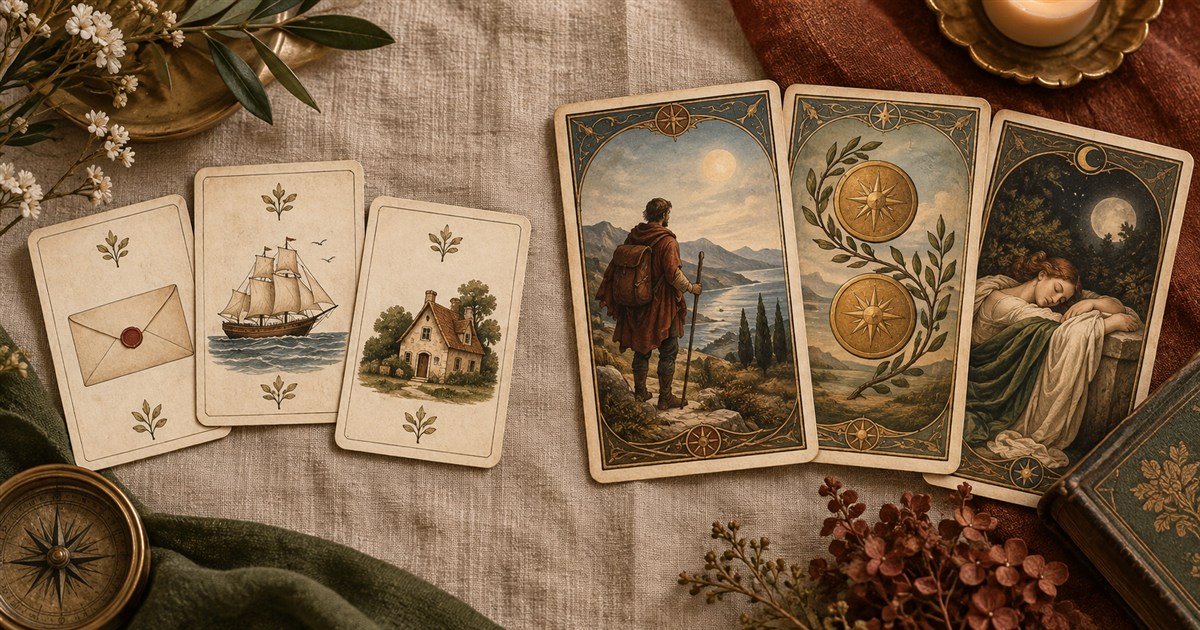
Petit Lenormand usually uses 36 recognisable emblems, combined into short symbolic phrases. Tarot usually uses 78 cards, with scenes, suits and spread positions shaping the interpretation.
Choose the system you enjoy learning: compact symbols and combinations, or a larger set of visual stories. Neither deck establishes facts about another person or guarantees future events.
Lenormand and tarot: the learning comparison
| Feature | Petit Lenormand | Tarot |
|---|---|---|
| Conventional size | 36 cards | 78 cards |
| Visual language | Recognisable emblems | Scenes, suits, numbers and figures |
| Common learning focus | How neighbouring symbols combine | Card meanings, context and spread positions |
| Small practice | Two or three cards | A defined two- or three-position spread |
| What it cannot establish | Verified events or private intentions | Verified events or private intentions |
Understanding Lenormand
Lenormand is a 36-card Petit Lenormand system. It has images of familiar objects, such as Rider, Clover, Ship, House, Tree, and Letter. Different publishers can change the art while keeping the emblems recognizable.
The British Museum's record of a historical Lenormand deck describes a complete pack of thirty-six fortune-telling cards associated with Marie-Anne-Adélaïde Lenormand. That museum record is useful historical evidence about the object; it does not establish the predictive power of the cards.
Don’t just think that every product that has Lenormand’s name is the same system. There are also bigger decks and adaptations that exist, and you should check the card count in the guidebook before you buy it, especially if you want to follow a course that uses the conventional 36 cards.
Having a consistent set of identifiable symbols works better for beginners than having big decorations. If the emblem is hard to recognize, learning the combinations can be confusing.
Understanding Tarot
A modern Tarot card deck has 78 cards, with 22 called the Major Arcana and 56 called the Minor Arcana. The Minor Arcana includes four suits and court cards. The decks have different names, artwork, and interpretive traditions.
The Metropolitan Museum of Art’s account of tarot history places early tarot within European card games. Its later spiritual uses developed through changing traditions, rather than one unchanged system from a single ancient source.
Some beginners will learn a deck that’s influenced by the Rider-Waite-Smith tradition, and the numbered cards have illustrated scenes. Other tarot card traditions use different visuals, so advice based on one deck might not feel the same as advice based on another.
Tarot cards have a larger number of cards and can seem hard at first, but the suits, numbers, court ranks, and imagery provide ways to organize your learning. You don’t have to memorize each interpretation before you start a thoughtful practice.
Seeing the Symbols Working Together
Lenormand readers often build meaning by combining the cards. A symbol can be interpreted in relation to a neighboring symbol instead of being treated as a complete message on its own. This can look like forming a phrase from a small set of vocabulary words.
Tarot card readers also combine cards, but the illustrated scenes and spread positions can play a bigger role. A card might suggest a question about a motive, experience, or response, and the same card might be interpreted differently when it shows an obstacle instead of advice.
These descriptions are part of a reading, and they don’t mean that Lenormand gives concrete fixes or that Tarot cards only talk about feelings. People often use both systems in different ways, and a possible reader should always explain their approach to the cards.
A good comparison is how you like to learn a language. You might like linking symbols into sentences, or you might like looking at a picture in its context. Either of these preferences can help guide your choice instead of creating a feeling that one deck is better than the other.
Interpretations and Certainty
Hearing a short Lenormand statement can sound direct, and a long Tarot interpretation might sound important, but neither of these styles means they’re accurate. It’s important that you listen for clear language, but certainty has to be understood as not always being there.
A combination that’s interpreted as communication about travel, for example, is still just an interpretation. It doesn’t prove that a message will come tomorrow. Also, a detailed Tarot card discussion of emotional hesitation doesn’t say what a partner is feeling.
Ask the reader to show the difference between the symbols they drew, the meaning they assigned to them, and their real-world conclusion or thinking. You should be able to see where the interpretation starts instead of getting it as a final claim or a fact.
Doing this can keep the pleasure of a reading. You can enjoy an association but leave space for other explanations and for information that comes from conversations or observation.
Spreads and Tarot Card Readings
A spread allows each card to have a role. A card in a position labeled “what can be an influence” shouldn’t be looked at as a report of other people’s intentions. The position gives you part of the interpretation.
Joan Bunning’s lesson on tarot spreads explains how a card’s position contributes to its meaning within her method. Decide the positions before drawing so their roles remain clear.
For someone who’s a beginner, the three positions can be enough: what I’m noticing, what deserves a different perspective, and an action I can consider. This kind of structure allows the reading to stay connected to your own reflection and choices.
Don’t add more positions just because the first answer doesn’t feel complete. A bigger spread creates more material that you have to interpret, but it also makes it easier to connect unrelated ideas to a story that feels more certain than it really is.
See How Combinations Shape a Lenormand Reading
When you are learning Lenormand, start with two or three cards and think about the question you actually asked. Look at the basic meaning of each symbol first and then think about how those meanings might work together. Try to keep the interpretation connected to your original question instead of trying to find a meaning for every possibility the cards could represent.
For example, if you pulled the Letter and House cards, you might think about communication involving your home or family. If your question was about sharing responsibilities around the house, the combination might give you the idea of writing down who is responsible for certain things. You do not have to turn the same cards into a prediction about receiving a legal notice, buying a house, or something else that has nothing to do with the question you asked.
You will also find that different Lenormand readers have different ways of working with the cards. Some pay close attention to the order of the cards, how far apart they are, which direction they face, or certain cards they consider especially important. When you are first learning, it can be easier to find one method that makes sense to you and practice with it for a while. If you mix several different methods together before you understand how each one works, you can end up with so many possible meanings that almost anything seems to fit.
It can also help to write down your interpretation before you know what happens next. Later, you can look back and see what you originally thought the cards meant instead of accidentally changing the meaning to match something that already happened. This can be a helpful way to learn the cards and become more aware of how you are interpreting them.
Try the Same Question with Two Systems
Imagine a fictional person named Daniel who asks, “What should I consider before changing my weekly work routine?” He is not asking the cards to predict what his employer will do or make the decision for him. He simply wants another way to think about the situation.
In a Lenormand reading, imagine that Daniel pulls the Ship and Anchor. The Ship can be connected with things like movement or change, while the Anchor can be connected with stability. Together, they might encourage Daniel to think about where he wants more flexibility in his schedule and which parts of his routine need to stay dependable.
Now imagine that Daniel asks the same question using tarot and pulls the Two of Pentacles and Four of Swords. Those cards might get him thinking about how much he is currently juggling and if he is giving himself enough time to rest. From there, he could look at his actual workload and think about a schedule change he might want to discuss.
The cards can give Daniel different ways to think about the same situation, but he still has to consider things like his actual work schedule, responsibilities, and what is realistic for his life. Lenormand and tarot simply give him different symbolic starting points. He can keep the ideas that help him think through the situation and leave behind the ones that do not fit.
Choose According to the Questions You Enjoy Exploring
If you like working with shorter meanings, combining symbols, and learning a smaller group of cards, you might enjoy Lenormand. You might also like the challenge of taking a few simple symbols and figuring out how they work together without having a detailed picture telling an entire story.
If you like looking at detailed images, characters, emotions, and different possibilities within a card, tarot might feel more natural to you. The artwork can give you several things to notice and think about even while you are still learning the traditional meanings of the cards.
Neither of these things says anything about how practical, spiritual, or sensitive you are. Some people naturally connect more with one system, while plenty of readers enjoy using both. You also do not have to decide that one is better than the other.
Before buying a deck, take some time to look at sample cards and, if possible, read a little about how the deck is meant to be used. Think about if the symbols make sense to you, if you like the artwork, and if the guide explains things in a way that is easy for you to understand. The deck you enjoy learning from is probably going to be much more useful to you than one you picked simply because someone else said it was the best.
Pay Attention to Identity
Some card systems include gendered figures that are traditionally in the set. Contemporary decks and readers look at these figures in different ways. A card’s title or artwork shouldn’t cause a person to have to assign an identity, relationship role, or appearance to a rigid category.
Before you share a reading with someone, explain how any person designating cards will be used. Let the people decide how they want to be represented or pick a method that shows the figures as roles and qualities instead of fixed identities.
Don’t infer a stranger’s sexuality, gender identity, pregnancy or private health status from a card. These are personal matters that symbolic interpretations cannot establish, and the person may not give you consent to discuss them.
The same goes for relationship readings. A figure near another figure doesn’t prove that an affair is happening or shows a rival. Interpretive language shouldn’t be used as a reason to accuse someone of something or to pry into someone’s private life.
Imagery of the Cards
Both of these systems have images that can be fearful for a new reader. In Lenormand, a coffin or a scythe might appear, and in Tarot cards, cards such as Death or the Tower can feel scary. A dramatic image doesn’t diagnose, predict death, or show a curse.
Learn the different meanings in the method you’re using and then connect them cautiously to the question that’s asked. Endings, changes, interruptions, or a need to stop can be looked at symbolically without claiming that a disaster is coming.
If a reading scares you, stop and go back to the situation. Put the cards away, talk to someone you trust, and use good information and practical concerns. You don’t have to pay for another reading to make you feel better.
A reader who turns hard imagery into urgent demands for money to protect you or pressures you are one that you should instantly stop talking to.
Learning the Different Methods
Using Tarot and Lenormand together can be interesting, but it includes interpretive choices. Someone who’s a beginner might find it easier to understand the systems separately before using them to interact.
If you decide to combine them later, write down the notes in advance. You might use Tarot for reflective questions and Lenormand for symbolic prompts. Don’t just draw from a second deck just to get a different result that you didn’t like.
Make sure your notes are clear about which interpretation came from which method. A long, blended story can contradict what you’re saying and make it hard to learn what you actually did.
You can keep the systems separate permanently if that’s what you want to do. There’s no requirement to add more decks or to add more techniques to your practice. Being familiar with one method can be better than constantly searching for the best system.
Knowing the Cost of Learning
A deck and a guidebook can be enough to look at the system of either one. Before you pay for a bunch of courses, find out if you understand the teacher’s method and if it matches the deck that you own. Just because something has expensive packaging doesn’t mean that the reading is more accurate.
You can invent your own scenarios to practice instead of always asking about emotionally charged relationships. This allows you room to learn the symbol combination and the spread positions without turning every reading into a verdict about your own future. Keep sample interpretations labeled so that you don’t mistake a practice story for a prediction you made about a real person.
Final Thoughts: Keeping Your Practice Strong
Start with a small question, a limited number of cards, and a stopping point. Write down the interpretations in plain language and include anything you’re not sure about. If there’s an ordinary action you can take, write that down.
A reading about a friendship, for example, might lead you to check if you’ve made time for someone instead of predicting that they’re going to contact you. A reading about work might help you to see a preference before you get real information about an opportunity.
Pay attention to how the practice makes you feel. If it helps you reflect and go back to your life, that is different from continuing to draw cards until uncertainty disappears. You can take a chance to pause or change your practice if it isn’t serving a purpose.
Lenormand and Tarot cards give two different symbolic languages. Pick the one you like learning and can use responsibly while keeping consent, evidence, and your own judgment in mind when you’re making real-life decisions.
For the next step, explore ethical fortune telling, choosing a tarot reader.
Lenormand or Tarot?: visual guide
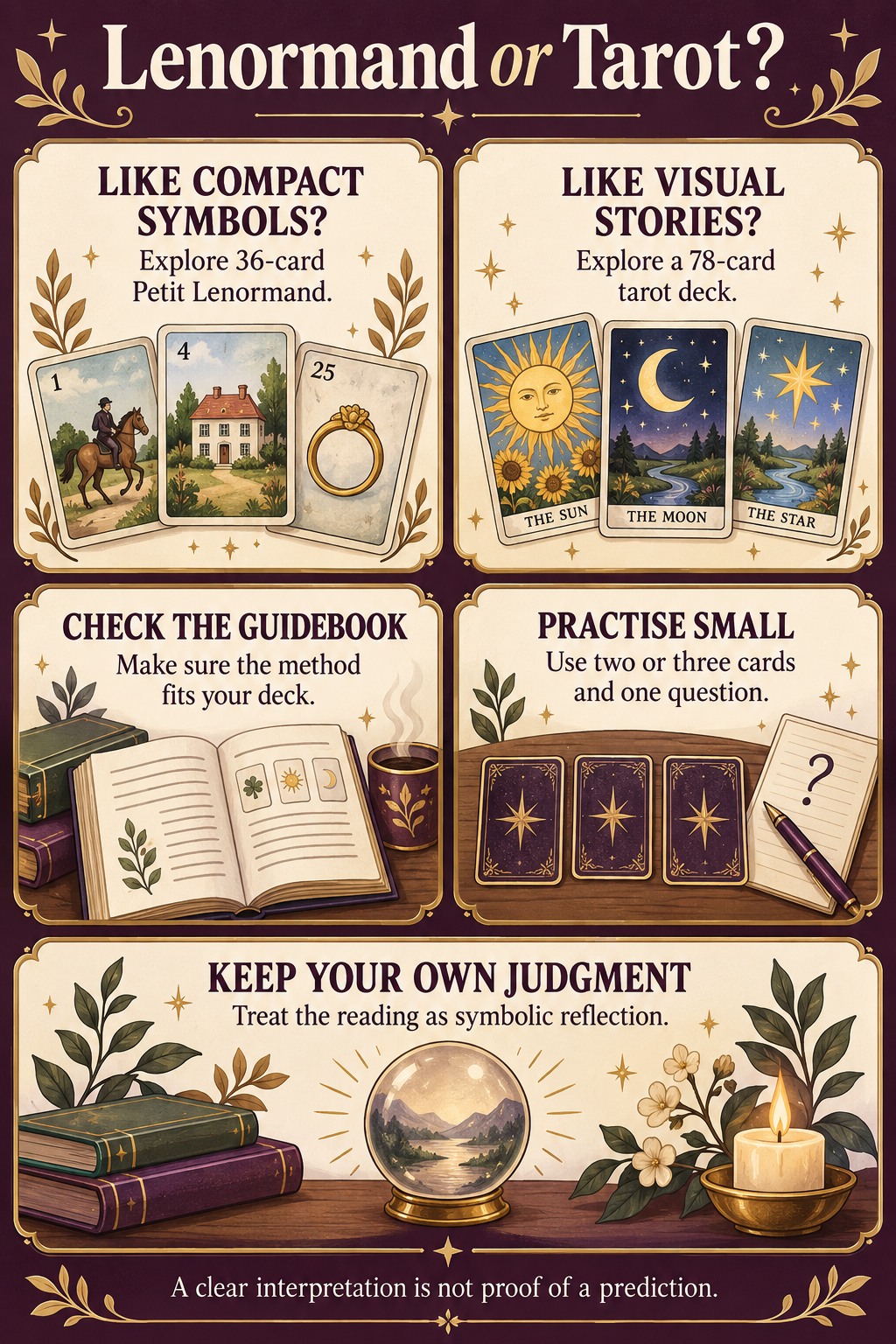
Read the infographic as text
- LIKE COMPACT SYMBOLS?: Explore 36-card Petit Lenormand.
- LIKE VISUAL STORIES?: Explore a 78-card tarot deck.
- CHECK THE GUIDEBOOK: Make sure the method fits your deck.
- PRACTISE SMALL: Use two or three cards and one question.
- KEEP YOUR OWN JUDGMENT: Treat the reading as symbolic reflection.
Frequently asked questions
1. What is the main difference between Lenormand and tarot?
Petit Lenormand uses a smaller set of emblems whose combinations are central to many readings. Tarot uses a larger structure with scenes, suits and spread roles.
2. How many cards does Petit Lenormand have?
The conventional system has 36. Products using Lenormand’s name can vary, so check the deck and guidebook before following a course.
3. How many cards does tarot have?
A conventional modern tarot deck has 78: 22 Major Arcana and 56 Minor Arcana. Special editions and adaptations may differ.
4. Is Lenormand easier for beginners?
Its smaller vocabulary may appeal to you, but combining cards takes practice. A smaller deck is not automatically an easier reading method.
5. Can beginners start with tarot?
Yes. Learn suits, numbers and a few spread roles rather than trying to memorise every possible meaning before practising.
6. Does Lenormand predict more concrete events?
Some practitioners use more direct language. That stylistic difference does not establish that its predictions are more accurate.
7. Does tarot only describe emotions?
No. Readers use it for many subjects. The scenes and spread positions may encourage reflective discussion, but methods differ.
8. Do card positions matter?
Yes within methods that assign roles to them. Define those roles before drawing so you do not change the spread to force a preferred interpretation.
9. Do Lenormand card combinations have one fixed meaning?
No. Traditions, order and the question influence interpretation. Choose a clear method and label uncertain possibilities.
10. Can I use both decks together?
You can, but learn their conventions separately first. Record which interpretation came from which system rather than blending them into an untraceable story.
11. Should I buy an expensive deck?
Clear symbols, an understandable guide and artwork you enjoy matter more for learning than price. Expensive packaging does not certify accuracy.
12. Does the Death card predict a death?
No. A dramatic image does not establish a diagnosis or future event. Interpret it within the chosen symbolic method and actual question.
13. Can person cards reveal someone’s identity?
They cannot establish a person’s gender, sexuality or private intentions. Agree on representation and consent when reading for someone else.
14. What is a useful practice question?
Try a fictional question such as what a character should consider before changing a routine. This lets you practise the method without turning every card into a personal verdict.
15. When should I stop drawing more cards?
Set a limit before starting. Pause if additional cards create confusion or you are repeating the same question for reassurance.