
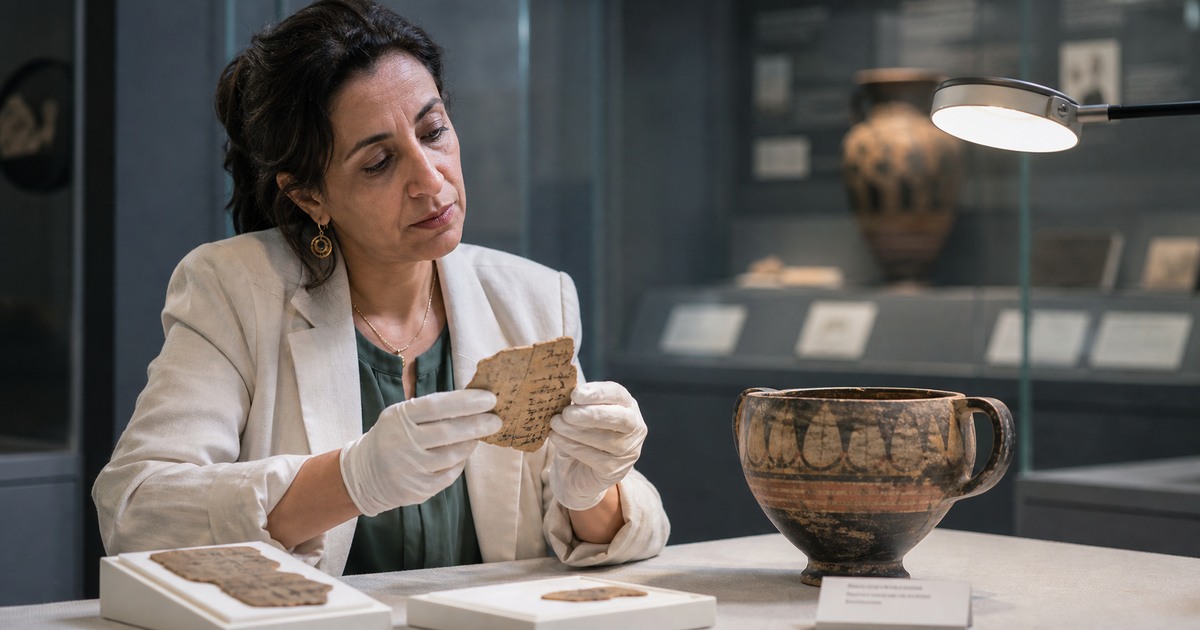
Ancient societies used many forms of divination, but they did not share one universal “psychic” profession. Their practices belonged to specific religious, political, medical, and social worlds.
Quick Guide
- Use the culture’s own period-specific term whenever it is known.
- Separate surviving evidence from later legend and modern reconstruction.
- Ask who controlled access, interpretation, and political authority.
- Do not treat elite patronage as proof that a method predicted accurately.
Source
Identify the object, text, date, and excavation context.
Practice
Ask what action produced or interpreted the sign.
Power
Notice who could consult, speak, record, or decide.
Limit
Separate cultural importance from predictive validation.
“Psychic” Is Usually the Wrong Historical Label
The modern English word can blur priesthood, prophecy, divination, dream interpretation, astrology, medicine, and political consultation into one category. Ancient practitioners understood their roles through local gods, institutions, scripts, calendars, and ritual obligations. A source-first history begins with those differences.
Delphi: Consultation in a Sacred Institution
At Delphi, the Pythia delivered responses associated with Apollo. Consultation occurred within a sanctuary and a managed ritual process; ancient writers and later historians disagree on details of performance and interpretation. Cities and rulers could consult oracles on war, colonization, law, and ritual. That influence tells us the oracle mattered politically. It does not turn every preserved response into a successful forecast.
Shang Oracle Bones: Questions Preserved in Writing
In late Shang China, divination questions were inscribed on animal bone or turtle shell. Heat produced cracks that specialists interpreted. Some inscriptions record charges, prognostications, and outcomes, making oracle bones crucial evidence for early Chinese writing and royal concerns. They are not generic fortune cookies; their meaning belongs to a court, ancestors, ritual technology, and a particular historical period.
Dreams, Stars, Lots, and Signs
| Evidence | What historians can study | Common modern mistake |
|---|---|---|
| Oracle inscription | Question, material, script, patron, sometimes outcome | Reading it without court context |
| Dream text | Compiled interpretations and social anxieties | Assuming a universal dream dictionary |
| Astrological record | Observed sky events and omen traditions | Equating ancient omen practice with modern astronomy |
| Literary oracle | How an author used prophecy in a narrative | Treating literature as a transcript |
Fortune Psychics’ guide to postcognition claims offers a useful comparison with modern readings. Its article on Mercury retrograde shows how an old astrological vocabulary continues in contemporary life.
Divination and Authority
Divination could legitimize a ruler, time a ritual, frame risk, or create a sanctioned way to debate uncertainty. Access was not equal. A king’s archive, temple network, or trained scribal class shaped which questions survived. We should therefore ask not only “What was predicted?” but “Who benefited from this way of deciding?”
How to Check a Popular History Claim
- Find the museum object, inscription, or ancient text behind the claim.
- Confirm the date, place, translation, and archaeological context.
- Distinguish a contemporary record from a later author.
- Look for competing scholarly interpretations.
- Avoid claims that every culture used the same symbols or methods.
- Do not turn a ritual role into a modern clinical or scientific credential.
What Ancient Divination Can Teach Today
These practices show how humans organize uncertainty through institutions, stories, objects, and expertise. They also reveal the long relationship between information and power. A ruler might seek an omen before war; a modern executive might seek a forecast before a merger. In both cases, the consultation can influence behavior even if predictive accuracy is unproven.
The most responsible reading holds two ideas together: divination has immense historical and cultural importance, and its importance alone does not demonstrate supernatural foresight. Careful terminology, original objects, and transparent uncertainty make the history more interesting—not less.
Key Takeaways
- Ancient divination included many distinct practices, not one universal psychic profession.
- Oracle bones preserve rare evidence about Shang royal questions and early writing.
- Delphi’s political influence shows cultural authority, not automatic predictive accuracy.
- Objects, dates, translations, and institutional context should anchor historical claims.
Frequently Asked Questions
1. Were ancient diviners psychics?
Some roles resemble modern ideas, but period-specific terms are more accurate than applying one modern label.
2. Who was the Pythia?
She was the woman who delivered Apollo’s oracle at Delphi within a sanctuary institution.
3. Did rulers consult Delphi?
Yes, individuals and communities consulted it, including on public decisions, but patronage does not prove accuracy.
4. What are oracle bones?
Animal bones or turtle shells used in late Shang court divination, often bearing early Chinese inscriptions.
5. How were oracle bones read?
Heat-created cracks were interpreted within a formal royal divination practice.
6. Did ancient Egyptians have psychics?
Egypt had priests, dream texts, omens, magic, and ritual specialists; calling them all psychics oversimplifies them.
7. Was astrology the same as astronomy?
Ancient sky observation and omen interpretation overlapped, but modern astronomy uses different scientific methods.
8. Are ancient dream meanings universal?
No. Dream interpretation depended on culture, text, status, and historical setting.
9. Did every culture use divination?
Many did, but methods, authorities, meanings, and surviving evidence differed greatly.
10. Can literature document a real oracle?
It can preserve traditions and authorial purposes, but it is not automatically a verbatim record.
11. Why did governments use divination?
It could legitimize decisions, schedule action, manage uncertainty, or mediate religious authority.
12. Does long use prove effectiveness?
No. Longevity shows cultural persistence, not necessarily predictive validity.
13. How do museums help?
Catalogs provide provenance, dates, materials, inscriptions, and scholarly context for surviving objects.
14. What is the biggest historical mistake?
Combining distant cultures and centuries into one timeless system.
15. How should I describe ancient practice?
Name the culture, period, evidence, practitioner, and uncertainty as specifically as possible.