

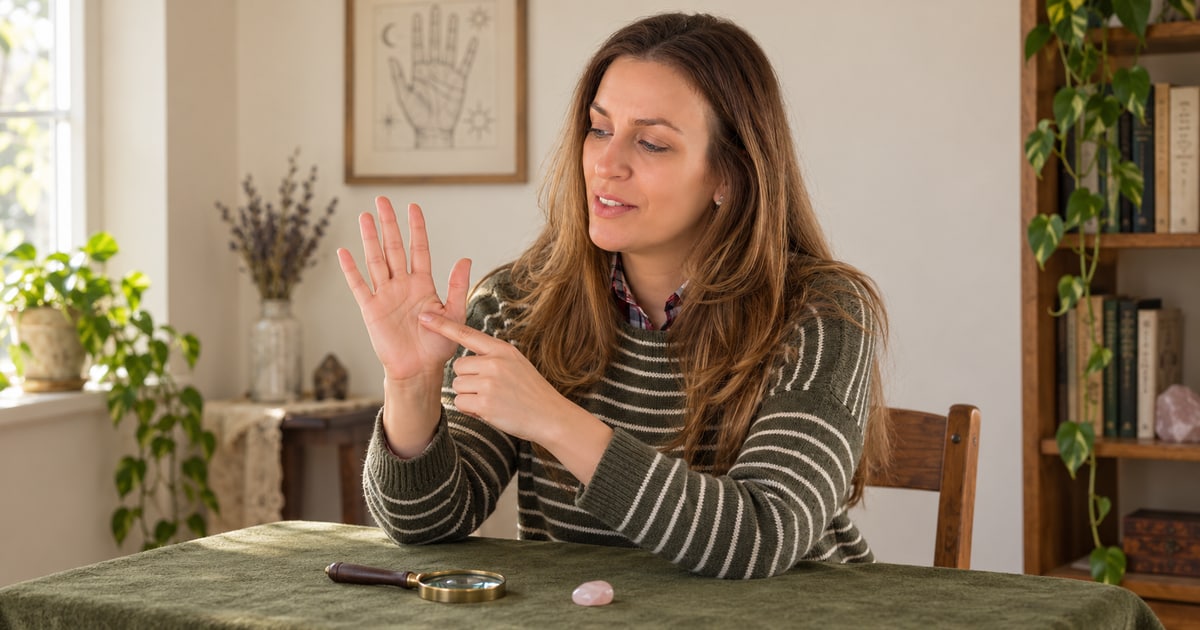
In palmistry, the fate line is a roughly vertical pattern in the centre of the palm, traditionally read in relation to direction, work and outside influences. It often points toward the area beneath the middle finger, called the Mount of Saturn. It may begin in different places, appear faintly or be absent.
You can explore its symbolism without treating your hand as a fixed timetable. A clear line does not guarantee success, and a missing or broken line does not mean you lack purpose. Your choices, circumstances and opportunities remain part of the story.
Where to look for the fate line
Hold your hand comfortably in clear, even light. Look at the central palm rather than the curve around the thumb. A fate line may rise near the wrist, from another part of the lower palm or from within the palm itself; it need not extend all the way to the fingers.
Cheiro’s historical Palmistry for All describes several starting points for the line of destiny or fate. It is a source for a palmistry tradition, not evidence that a line determines events.
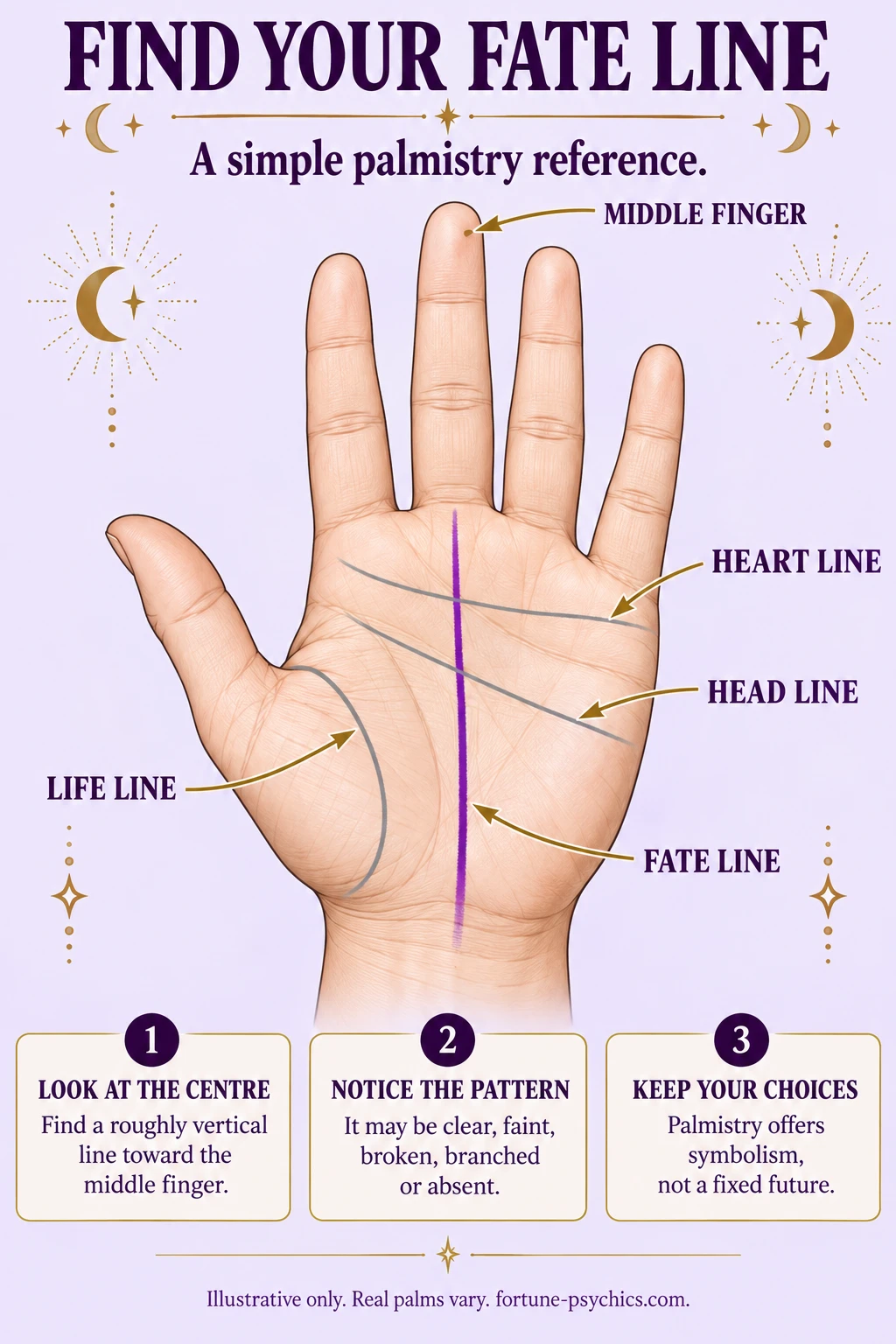
Distinguish it from the other major lines
| Line | Typical illustrated position | Keep in mind |
|---|---|---|
| Fate | Roughly vertical through the centre, toward the middle finger | Its start, length and visibility vary. |
| Life | A curve around the thumb pad | It is not a reliable measure of lifespan. |
| Head | A line crossing the middle of the palm | A palmistry label is not a test of intelligence. |
| Heart | A line across the upper palm beneath the fingers | It cannot establish someone’s private feelings. |
The drawing simplifies the patterns so you can find the general areas. Do not force every crease in a real hand to match it or draw a conclusion from one mark alone.
What common patterns can invite you to explore
Readers may interpret the same feature differently. The following meanings are symbolic starting points drawn from common palmistry descriptions; the reflection question gives you something to consider without predicting an event.
| Pattern | A symbolic theme | A practical reflection |
|---|---|---|
| Clear or continuous | Direction or focus | What goal currently deserves my attention? |
| Faint or difficult to see | Exploration or a less defined path | What would help me consider my options? |
| A break | A change of direction | Which transition am I actually experiencing? |
| A branch | More than one interest or possibility | How could I explore an interest without overcommitting? |
| A link with another line | Different life areas meeting | How do work, relationships or family expectations affect my choices? |
| No distinct fate line | Some readers emphasise a self-directed path | What direction would I choose without needing a sign? |
Starting points and outside influences
Some palmists associate a line beginning near the life line with family influence, and other starting points with independence or the contribution of other people. Use those themes to ask about your actual experience rather than to invent a personal history from the hand.
For example, you might consider whether a family expectation still fits your career plans. A useful response could be learning about an alternative, discussing a responsibility or acknowledging a choice you already made. The mark itself cannot tell you what your relatives intended.
Breaks are not a reason to fear your future
A break or change in a line can be discussed as a transition within a symbolic reading. It is not a diagnosis, a prediction of disaster or proof that something has gone wrong.
If a reader gives a frightening interpretation, ask which tradition it comes from and what uncertainty remains. You can decline the topic or leave it unresolved. Our guide to ethical fortune telling and boundaries explains ways to retain your choices during a reading.
Branches and more than one direction
A branching pattern may invite reflection on several interests. You might be balancing work with a creative project, considering further study or deciding how much time to give a new activity.
The useful question is how to explore the possibility in your actual circumstances. Start with a reversible step, check the time and cost, and review what you learn. A branch does not guarantee a second career or a profitable business.
Crossings and traditional age scales
Some systems attach age zones to points where lines meet. These schemes vary and should not be used as reliable calendars for employment, marriage, illness or other life events.
Ask the reader how the scale is constructed, rather than treating a precise age as established fact. If the discussion highlights education or relationships, connect it to information and choices you can review now.
Which hand should you examine?
Readers differ in how they compare the dominant and non-dominant hands. Ask what each hand represents in the method being used. You do not need a rule that assigns a fixed hand by gender to begin looking at the patterns.
If comparing photographs, keep the light, hand position and distance reasonably consistent. A crease may look stronger in one photograph simply because of angle or contrast. Do not assume an apparent change proves that destiny has shifted.
A careful way to record your reading
- Describe the visible pattern in plain words.
- Note the reader’s symbolic interpretation separately.
- Write any connection you recognised, leaving uncertain parts open.
- Choose one question or action that fits your real life.
Keep hand photographs private unless you choose to share them, and obtain permission before photographing another person’s hand. A reading does not require private medical details, financial records or a full family history.
Let the reading support a conversation
Palmistry can be an interesting spiritual or symbolic practice. Its value need not depend on an exact prediction. You might leave with a clearer question about your direction, a memory to reflect on or simply curiosity about the tradition.
For another approach, our comparison of Lenormand and tarot explores different reading formats. Use the method that suits your interest while keeping practical decisions grounded in the facts and support relevant to them.
Frequently Asked Questions
1. Where is the fate line?
It is typically illustrated as a roughly vertical pattern through the central palm toward the area beneath the middle finger.
2. Is the fate line also called the destiny line?
Yes. Some palmistry traditions use destiny line or line of fate for this pattern.
3. Does every palm have a distinct fate line?
No. It can be faint, partial or absent. That does not determine someone’s worth or purpose.
4. What does a clear line mean symbolically?
Some readers associate it with direction or focus. It does not guarantee success.
5. What if my line is faint?
You can explore themes of uncertainty or options, without treating visibility as a measure of confidence or ability.
6. Does a break predict disaster?
No. A symbolic interpretation of change should not be treated as a diagnosis or a guaranteed event.
7. What can a branch suggest?
Some readings use it to explore more than one interest or direction. Consider practical options rather than assuming a promised career.
8. What if it starts near the life line?
Some traditions discuss family influence. Compare that theme with your actual experience instead of inferring a history from the hand.
9. Can the line tell me an exact age?
Traditional age scales vary and should not be used as reliable calendars for life events.
10. Which hand should I read?
Ask which method is being used and how it compares the hands. There is no need to assign a fixed hand by gender.
11. Does the life line measure lifespan?
Do not use a palm line to predict lifespan or make health decisions.
12. Can a palm photograph look different later?
Yes. Lighting, angle, position and contrast can affect the appearance. Do not infer a destiny change from a photograph alone.
13. Can palmistry decide my career?
Use it as optional reflection. Career decisions need actual information, preparation and attention to circumstances.
14. What if a reading frightens me?
Ask about the interpretation and its uncertainty, decline the subject or stop. You do not need to accept a fear-based prediction.
15. What should I keep in my notes?
The visible pattern, symbolic interpretation, your associations and a manageable question or action, kept separate.